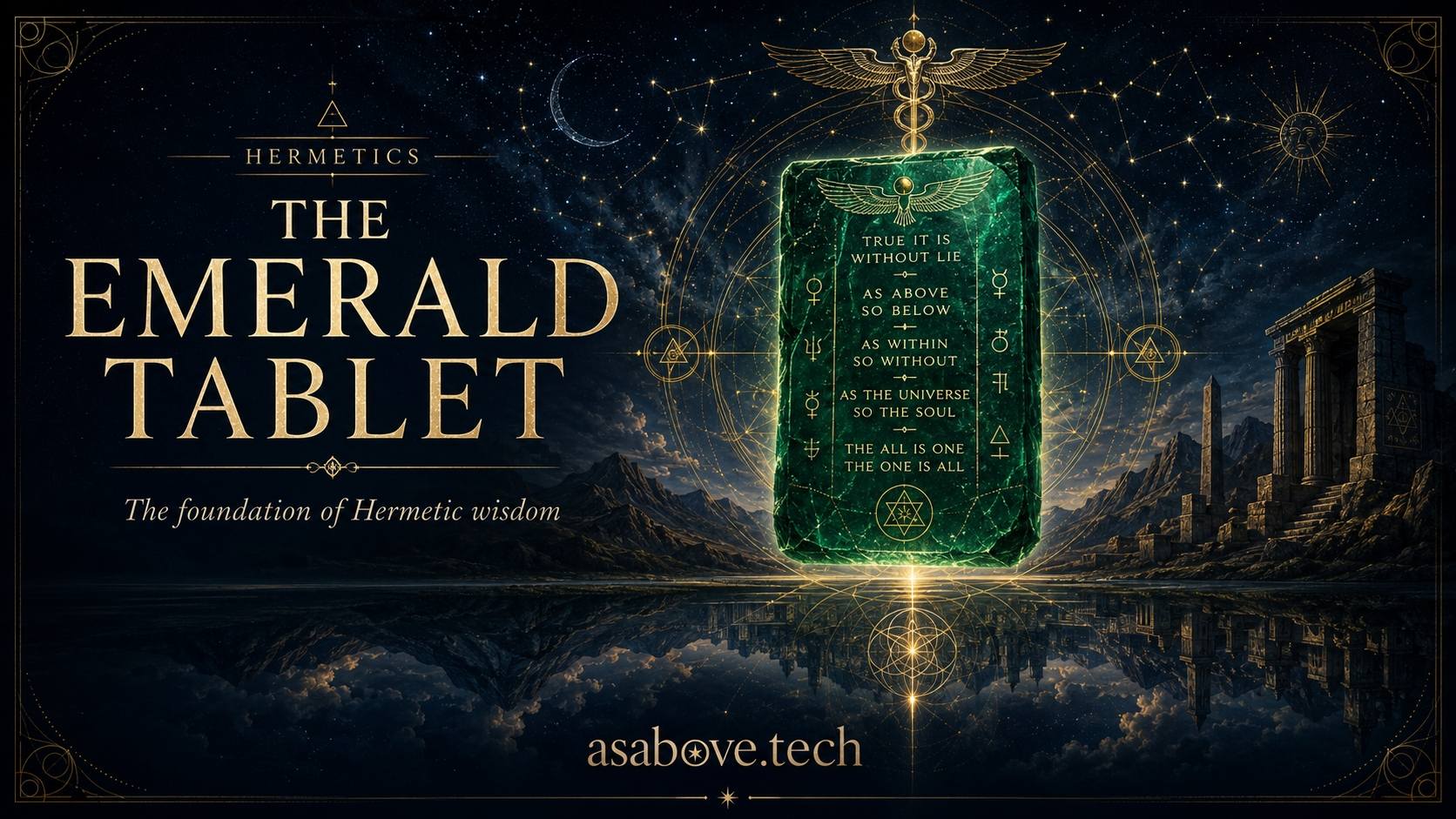
What is the Emerald Tablet?
The Emerald Tablet is a short Hermetic and alchemical text traditionally attributed to Hermes Trismegistus. Its earliest securely attested form survives in the Arabic Book of the Secret of Creation, probably compiled in the eighth or ninth century. Medieval Latin versions later shaped European alchemy, and Isaac Newton produced his own translation and commentary. No ancient physical tablet has been found, and historians treat Hermes as a legendary authorial figure rather than the verified writer of the text.
| Earliest surviving context | Arabic Sirr al-khalīqa, not an excavated Egyptian tablet |
|---|---|
| Attributed author | Hermes Trismegistus, a legendary composite figure |
| Central idea | Processes at different levels of nature correspond within one ordered whole |
| Historical importance | A compact authority text for medieval and early-modern alchemy |
For the wider tradition, continue with the Hermetic principle of correspondence, the Twelve Gates of the Great Work, and our guide to The Way of Hermes.
- Introduction: The Most Influential Text You've Never Read
- I. The Complete Text of the Emerald Tablet
- II. Historical Origins and Transmission
- III. Hermes Trismegistus: The Thrice-Great
- IV. Line-by-Line Analysis
- V. "As Above, So Below": The Principle of Correspondence
- VI. The Prima Materia and the Great Work
- VII. Influence on Alchemy, Science, and Philosophy
- VIII. Newton's Translation and Alchemical Pursuits
- IX. Modern Interpretations and Applications
- X. Modern Science: Analogy Is Not Evidence
- Conclusion: The Eternal Relevance
- Further Reading
Introduction: The Most Influential Text You've Never Read
In the entire history of Western esotericism, no document has wielded more influence from fewer words than the Emerald Tablet...known in Latin as the Tabula Smaragdina. Comprising barely a dozen sentences, this cryptic text has shaped the course of alchemy, inspired Renaissance philosophy, occupied the mind of Isaac Newton for decades, and continues to fascinate seekers of hidden knowledge today.
The Tablet purports to reveal the secret of the prima materia...the primordial substance from which all things arise and to which all things return...and the process by which this substance can be manipulated to achieve the magnum opus, the Great Work of spiritual and material transformation. Its most famous axiom, "As above, so below," has become a foundational principle not only of Hermetic philosophy but of Western occultism as a whole.
Yet for all its influence, the Emerald Tablet remains shrouded in mystery. No original physical tablet has ever been found. The earliest surviving versions are Arabic texts from the 8th or 9th century CE, themselves claiming to transmit far more ancient wisdom. The mythical author, Hermes Trismegistus, may never have existed as a historical person...yet his name became synonymous with the highest reaches of esoteric knowledge.
This article offers a comprehensive exploration of the Emerald Tablet: its complete text in multiple translations, its contested historical origins, the mythic figure of its author, a detailed interpretation of each line, and its remarkable influence across two millennia of intellectual history. We will trace its path from the temples of Hellenistic Egypt through the laboratories of medieval alchemists to the notebooks of Isaac Newton, then separate the document's verifiable history from later spiritual and scientific analogies.
The Emerald Tablet is not merely a historical curiosity. It represents a persistent human intuition about the fundamental unity of existence...an intuition that has driven both mystical contemplation and scientific investigation. Understanding this text illuminates the deep roots of ideas that still shape our thinking about the nature of reality, the relationship between mind and matter, and the possibility of transformation.
I. The Complete Text of the Emerald Tablet
The Emerald Tablet exists in numerous versions and translations, reflecting its long journey across languages and centuries. No single "authoritative" text exists; rather, we have a family of related texts that preserve the core teachings with varying degrees of elaboration. What follows are the most significant versions, allowing the reader to compare and appreciate the subtle variations in meaning that different translations convey.
The Arabic Original: Sirr al-Khalīqa
The earliest known version of the Emerald Tablet appears embedded within a larger Arabic work called Kitāb Sirr al-Khalīqa wa-Ṣanʿat al-Ṭabīʿa (Book of the Secret of Creation and the Art of Nature), attributed to Apollonius of Tyana but likely compiled in the 8th or 9th century CE. This Arabic text presents the Tablet as discovered in a vault beneath a statue of Hermes, clutched in the hands of his corpse.
In truth, without falsehood, certain and most true:
That which is above is like that which is below, and that which is below is like that which is above, to accomplish the miracles of the one thing.
And as all things came from the One, by the mediation of the One, so all things arise from this one thing by adaptation.
Its father is the Sun, its mother the Moon; the Wind carried it in its belly; its nurse is the Earth.
This is the father of all perfection throughout the world.
Its power is complete if it is turned towards the earth.
Separate the earth from the fire, the subtle from the gross, gently and with great ingenuity.
It ascends from earth to heaven and descends again to earth, and receives the power of the superior and the inferior things.
Thus you will have the glory of the whole world. Therefore all obscurity will flee from you.
This is the strongest of all powers, the force of all forces, for it overcomes every subtle thing and penetrates every solid thing.
Thus was the world created.
From this are wonderful adaptations, of which this is the manner.
Therefore I am called Hermes Thrice-Greatest, having the three parts of the wisdom of the whole world.
What I have said of the operation of the Sun is complete.
Medieval Latin Translations
The Emerald Tablet entered Western consciousness primarily through Latin translations made during the 12th and 13th centuries, as part of the broader translation movement that brought Arabic learning to Europe. Several Latin versions circulated, with minor but sometimes significant variations.
The Vulgate Latin Version
This is the most widely circulated medieval Latin text, found in numerous alchemical manuscripts:
Verum, sine mendacio, certum et verissimum:
Quod est inferius est sicut quod est superius, et quod est superius est sicut quod est inferius, ad perpetranda miracula rei unius.
Et sicut res omnes fuerunt ab uno, meditatione unius, sic omnes res natae ab hac una re, adaptatione.
Pater eius est Sol, mater eius est Luna; portavit illud Ventus in ventre suo; nutrix eius terra est.
Pater omnis telesmi totius mundi est hic.
Virtus eius integra est, si versa fuerit in terram.
Separabis terram ab igne, subtile ab spisso, suaviter, magno cum ingenio.
Ascendit a terra in coelum, iterumque descendit in terram, et recipit vim superiorum et inferiorum.
Sic habebis gloriam totius mundi. Ideo fugiet a te omnis obscuritas.
Haec est totius fortitudinis fortitudo fortis, quia vincet omnem rem subtilem, omnemque solidam penetrabit.
Sic mundus creatus est.
Hinc erunt adaptationes mirabiles, quarum modus est hic.
Itaque vocatus sum Hermes Trismegistus, habens tres partes philosophiae totius mundi.
Completum est quod dixi de operatione Solis.
Hugo of Santalla's Translation (c. 1140)
One of the earliest Latin translations, made in Spain during the great translation movement:
This is true and no lie, certain and to be depended upon:
The superior agrees with the inferior, and the inferior with the superior, to effect that one truly wonderful work.
As all things owe their existence to the will of the only one, so all things owe their origin to the one only thing, the most hidden, by the arrangement of the only God.
The father of that one only thing is the Sun, its mother is the Moon, the wind carries it in its belly; but its nurse is a spiritual earth.
That one only thing (after God) is the father of all things in the universe.
Its power is perfect, after it has been united to a spiritual earth.
Separate that spiritual earth from the dense or crude by means of a gentle heat, with much attention.
In great measure it ascends from the earth up to heaven, and descends again, newborn, on the earth, and the superior and the inferior are increased in power.
By this wilt thou partake of the honours of the whole world. And darkness will fly from thee.
This is the strength of all powers. With this thou wilt be able to overcome all things, and transmute all what is fine and what is coarse.
In this manner the world was created.
From this will proceed wonderful adaptations which are to be brought about in this manner.
For this reason I am called Chiram Telat Mechasot, one in essence but three in aspect. In this trinity is hidden the wisdom of the whole world.
It is ended now, what I have said concerning the effects of the Sun.
Isaac Newton's Translation (c. 1680)
Isaac Newton made his own translation of the Emerald Tablet as part of his extensive alchemical studies. This translation, found among his papers now held at King's College, Cambridge, reveals the great scientist's deep engagement with Hermetic philosophy:
1. Tis true without lying, certain & most true.
2. That wch is below is like that wch is above & that wch is above is like yt wch is below to do ye miracles of one only thing.
3. And as all things have been & arose from one by ye mediation of one: so all things have their birth from this one thing by adaptation.
4. The Sun is its father, the moon its mother,
5. the wind hath carried it in its belly, the earth its nourse.
6. The father of all perfection in ye whole world is here.
7. Its force or power is entire if it be converted into earth.
7a. Seperate thou ye earth from ye fire, ye subtile from the gross sweetly wth great indoustry.
8. It ascends from ye earth to ye heaven & again it desends to ye earth and receives ye force of things superior & inferior.
9. By this means you shall have ye glory of ye whole world & thereby all obscurity shall fly from you.
10. Its force is above all force, ffor it vanquishes every subtile thing & penetrates every solid thing.
11a. So was ye world created.
12. From this are & do come admirable adaptations whereof ye means (Or process) is here in this.
13. Hence I am called Hermes Trismegist, having the three parts of ye philosophy of ye whole world.
14. That wch I have said of ye operation of ye Sun is accomplished & ended.
Modern Scholarly Translations
Dennis William Hauck's Translation (2008)
A contemporary rendering attempting to balance fidelity to the original with accessibility:
In truth, without deceit, certain and most veritable:
That which is Below corresponds to that which is Above, and that which is Above corresponds to that which is Below, to accomplish the miracle of the One Thing.
And just as all things have come from this One Thing, through the meditation of One Mind, so do all created things originate from this One Thing, through transformation.
Its father is the Sun; its mother the Moon. The Wind carries it in its belly; its nurse is the Earth.
It is the origin of All, the consecration of the Universe. Its inherent strength is perfected if it is turned into Earth.
Separate the Earth from Fire, the Subtle from the Gross, gently and with great Ingenuity.
It rises from Earth to Heaven and descends again to Earth, thereby combining within itself the powers of both the Above and the Below.
Thus will you obtain the Glory of the Whole Universe. All Obscurity will be clear to you.
This is the greatest Force of all powers, because it overcomes every Subtle thing and penetrates every Solid thing.
In this way was the Universe created.
From this will come many wondrous Applications, because this is the Pattern.
Therefore am I called Thrice Greatest Hermes, having all three parts of the wisdom of the Whole Universe.
Herein have I completely explained the Operation of the Sun.
The differences between translations are not merely stylistic...they reflect different interpretive traditions and theological commitments. Hugo of Santalla's version, for example, introduces explicitly Christian language ("the only God") absent from other versions. Newton's translation preserves certain ambiguities that others resolve. Comparing multiple translations reveals both the stable core of the teaching and the adaptive interpretations it has inspired.
II. Historical Origins and Transmission
The historical origins of the Emerald Tablet are genuinely mysterious. No physical artifact has ever been found, and the text's own claims about its discovery are clearly legendary. What we can trace with some confidence is the documentary history...how the text was transmitted through various cultures and languages.
Egyptian Roots and Hellenistic Synthesis
The intellectual milieu from which the Emerald Tablet emerged was Hellenistic Egypt, particularly the cultural melting pot of Alexandria. Here, between roughly 300 BCE and 300 CE, Egyptian religion, Greek philosophy, Jewish mysticism, and various Near Eastern traditions merged and interacted in unprecedented ways.
The Egyptian god Thoth...lord of wisdom, writing, magic, and the moon...became identified with the Greek Hermes, messenger of the gods and guide of souls. This syncretic deity, known as Hermes Trismegistus ("Thrice-Greatest Hermes"), became the legendary author of an entire library of wisdom texts. The Egyptians themselves had traditions of ancient wisdom texts attributed to Thoth, inscribed on temple walls and papyri. The idea of secret knowledge inscribed on imperishable tablets was already well established.
The broader collection of texts attributed to Hermes Trismegistus...the Corpus Hermeticum and related writings...reflects this Hellenistic synthesis. These texts, composed primarily in Greek between the 1st and 3rd centuries CE, combine Platonic philosophy with Egyptian religious imagery, presenting a path of spiritual ascent through gnosis (direct knowledge) of the divine.
Arabic Transmission: The Crucial Link
The earliest surviving text of the Emerald Tablet is not Greek but Arabic, appearing in the Kitāb Sirr al-Khalīqa (Book of the Secret of Creation), attributed to Balīnūs (Apollonius of Tyana). This work, likely compiled in the late 8th or early 9th century, presents itself as translating Greek sources, though the exact relationship to any Greek original remains unclear.
The Arabic text includes a narrative framing device: Balīnūs (Apollonius) discovers a vault beneath a statue of Hermes. Inside sits the sage himself, long dead, holding the Tablet in his hands. This framing...the discovery of ancient wisdom preserved against time...became canonical in later retellings.
Several factors made the Islamic world the crucial transmitter of this knowledge:
- Translation Movement: The Abbasid Caliphate sponsored massive translation projects, rendering Greek philosophical and scientific texts into Arabic. This "Translation Movement" (8th-10th centuries) preserved works that might otherwise have been lost.
- Alchemical Tradition: Arabic alchemy (al-kīmiyā) flourished, building on Greek and Egyptian foundations. Figures like Jābir ibn Hayyān (Geber) produced vast alchemical writings that incorporated Hermetic principles.
- Cosmopolitan Culture: Islamic civilization integrated knowledge from Greek, Persian, Indian, and other sources, creating a rich intellectual environment for the development and transmission of esoteric teachings.
Jābir ibn Hayyān, known in the West as Geber, is perhaps the most important figure in Arabic alchemy. His corpus (or the corpus attributed to him) explicitly references the Emerald Tablet and interprets its teachings. Jābir developed the sulfur-mercury theory of metals...the idea that all metals are composed of sulfur (the masculine, hot principle) and mercury (the feminine, cold principle) in different proportions. This theory, derived partly from Hermetic principles, dominated alchemical thinking for centuries.
Latin Translations and the European Reception
The Emerald Tablet entered Western European consciousness through the translation movements of the 12th century, centered particularly in Spain where Christian, Jewish, and Muslim scholars collaborated in rendering Arabic texts into Latin.
By the Renaissance, the Emerald Tablet had become one of the most cited and commented-upon texts in the Western alchemical tradition. Its brevity made it endlessly interpretable; its attributed antiquity gave it immense authority; its cryptic language invited elaboration.
III. Hermes Trismegistus: The Thrice-Great
The alleged author of the Emerald Tablet, Hermes Trismegistus, was not a historical person but a legendary figure...a divine sage combining attributes of the Egyptian god Thoth and the Greek god Hermes. Understanding this figure is essential for understanding why the Tablet carried such authority.
The Divine Synthesis
Thoth, the Egyptian god, was:
- Lord of writing and scribes
- Master of magic, especially words of power
- Keeper of divine knowledge and cosmic records
- Associated with the moon, measurement, and time
- Judge and record-keeper in the afterlife
- Often depicted as an ibis or a baboon
Hermes, the Greek god, was:
- Messenger of the gods
- Guide of souls to the underworld (psychopomp)
- God of boundaries and transitions
- Patron of travelers, merchants, thieves, and orators
- Inventor of the lyre and fire-sticks
- Associated with interpretation (hence "hermeneutics")
The fusion of these deities created Hermes Trismegistus, whose triple greatness was variously interpreted as:
Three Domains of Wisdom
Mastery of alchemy (the physical), astrology (the celestial), and theurgy (the divine)... the "three parts of the philosophy of the whole world" mentioned in the Tablet itself.
Three Incarnations
Some traditions held that Hermes appeared three times in human history: as the antediluvian sage who inscribed wisdom on temple walls, as the Egyptian Thoth, and as the Greek Hermes.
Superlative Honor
"Thrice-greatest" may simply be a superlative, indicating supreme greatness...a common form in Egyptian honorific titles where repetition indicated emphasis.
The Hermetic Corpus
Hermes Trismegistus was credited with authorship of thousands of texts. The Church Father Clement of Alexandria (c. 150-215 CE) claimed that the Egyptian temples contained forty-two essential books by Hermes, covering everything from hymns and rituals to philosophy, astrology, and medicine.
What survives today includes:
- The Corpus Hermeticum: Seventeen Greek philosophical treatises, primarily dialogues between Hermes and his son Tat or his disciple Asclepius
- The Asclepius: A Latin text (possibly translated from Greek) on the nature of the gods and the universe
- The Emerald Tablet: The brief alchemical text we are examining
- Various astrological and alchemical texts: Attributed to Hermes in the Arabic and Latin traditions
Renaissance thinkers believed Hermes Trismegistus was a real historical figure, contemporary with or even older than Moses. This placed him at the fountainhead of what they called the prisca theologia...an ancient theology that had anticipated Christianity and been passed down through a chain of sages including Orpheus, Pythagoras, and Plato. The Emerald Tablet's authority derived partly from this belief in its stupendous antiquity. When Isaac Casaubon demonstrated in 1614 that the Corpus Hermeticum was post-Christian in date, this historicist framework collapsed...but the philosophical interest in Hermetic ideas continued.
The Discovery Legend
The Arabic tradition preserves the most elaborate account of the Tablet's discovery. According to the Kitāb Sirr al-Khalīqa, Apollonius of Tyana (Balīnūs) found a subterranean vault beneath a statue of Hermes:
I entered the underground chamber... and there I found an old man sitting on a throne of gold and holding in his lap an emerald tablet on which was written the following text in Phoenician characters... At the man's breast lay a book stating: "Here is the secret of creation and the science of the causes of all things." ...Kitāb Sirr al-Khalīqa (Book of the Secret of Creation)
Other versions of the discovery legend involve Alexander the Great finding the Tablet in the tomb of Hermes at Hebron, or Sarah (wife of Abraham) discovering it in a cave. These varying accounts all serve the same function: establishing the text's antiquity and authority by connecting it to legendary figures and miraculous preservation.
IV. Line-by-Line Analysis
The Emerald Tablet's power lies in its compression...vast cosmological and practical teachings encoded in a few sentences. What follows is a detailed interpretation of each line, drawing on the alchemical, philosophical, and spiritual traditions that have grown around this text.
This emphatic opening establishes the text's claim to absolute truth. The triple affirmation...truth, certainty, veracity...mirrors the threefold nature of Hermes himself. In alchemical reading, this signals that what follows is not metaphor but literal description of cosmic law, though expressed in symbolic language that requires proper understanding to decode.
The phrase also functions as a magical formula. In ancient magical texts, speaking truth was itself a form of power...the words of creation. By beginning with this declaration, the text positions itself as logos, creative word that participates in the reality it describes.
This is the most famous line of the Tablet, condensed into the aphorism "As above, so below." It expresses the fundamental Hermetic principle of correspondence: the universe is an interconnected whole in which every level reflects every other level.
Cosmologically: The heavens (macrocosm) and the earth/human being (microcosm) share the same structure and are linked by sympathy. What occurs in the celestial realm manifests below; what is perfected below affects what is above.
Alchemically: The operations performed in the laboratory mirror cosmic processes. The alchemist's work on physical matter participates in and influences spiritual transformation.
Psychologically: Inner states and outer circumstances correspond. The transformation of consciousness and the transformation of reality are aspects of the same process.
The "One Thing" (res una) is the underlying unity that makes correspondence possible...the prima materia in its metaphysical aspect.
This line connects Hermetic philosophy to Neoplatonic emanation theory. The universe proceeds from the One (the divine source) through Mind (nous) into multiplicity. All things maintain their connection to this source.
"Meditation" or "Mediation": The Latin meditatione can mean either contemplation or intermediary action. Both readings are valid: the One Mind both contemplates and thereby creates, and serves as the intermediary between transcendent unity and manifest plurality.
"Adaptation" or "Transformation": The Latin adaptatione suggests that the One Thing takes on different forms, adapts itself to circumstances, without losing its essential nature. This is crucial for alchemy: the prima materia can become any substance through appropriate transformation.
This line employs the language of generation and birth to describe the origins and nature of the One Thing (often identified with the Philosophers' Stone).
Sun (Father): The active, masculine, hot, and dry principle. In alchemical terms, often identified with sulfur, gold, or the spirit. Represents the fire principle, consciousness, will.
Moon (Mother): The passive, feminine, cold, and moist principle. Identified with mercury, silver, or the soul. Represents the water principle, receptivity, reflection.
Wind (Bearer): The element of air as the medium of transmission. Represents spirit or pneuma...the animating breath that carries the seed from potency to actuality. Also suggests volatility: that which can rise and move between realms.
Earth (Nurse): The element that nourishes and brings to completion. Represents the body, fixation, manifestation. The spiritual must be "earthed" to become real and effective.
Read together, the line describes a complete process: conception (Sun and Moon joining), gestation (carried by Wind), and nurturing to completion (by Earth). This maps onto both cosmic creation and alchemical laboratory work.
"Father of all perfection" / "Telesm": The Latin telesmi derives from the Greek telesma, meaning consecrated object, completion, or ritual perfection. The Stone is both the source of perfection and perfection itself... alpha and omega.
"Turned into Earth": A crucial practical instruction. The volatile must be fixed; the spiritual must be embodied. Abstract understanding must become concrete realization. In laboratory terms, this refers to processes of coagulation, precipitation, and crystallization. In spiritual terms, enlightenment must be integrated into daily life.
This is the central practical instruction of the Tablet, describing the alchemical operation of separation (separatio).
Earth from Fire: Separate the fixed from the volatile, the body from the spirit. In practical alchemy, this refers to distillation, calcination, and similar processes that separate components.
Subtle from Gross: Extract the pure essence from the crude matter. The "subtle" (subtile) is the refined, spiritual, active portion; the "gross" (spissum) is the heavy, material, passive residue.
"Gently": The Latin suaviter emphasizes that force is counterproductive. Transformation requires patience, gradual heat, careful attention. This applies to spiritual development as much as laboratory work.
"Great Ingenuity": The work requires skill, intelligence, and creative problem-solving. The art cannot be reduced to mere recipes; it demands the whole person.
This describes the alchemical operation of circulation (circulatio), one of the most important processes in the Great Work.
Ascent: Volatilization, sublimation, spiritualization. The material is refined, rarified, lifted up. Spirit is extracted from matter.
Descent: Coagulation, condensation, embodiment. The spirit returns enriched, bringing celestial powers down into earthly form.
This cycle, repeated many times, progressively purifies and empowers the substance. Each circuit adds virtue. The final product contains "the powers of both the Above and the Below"...it is a coincidentia oppositorum, a union of opposites.
Spiritually: The soul must ascend to contemplation of divine realities, then descend to bring that illumination into embodied life. Neither pure transcendence nor mere immanence suffices; the adept must master both movements.
"Glory of the Whole Universe": The successful adept gains not merely the power to transmute metals but a comprehensive understanding of reality and participation in divine power. The Stone confers universal mastery.
"Obscurity will flee": Ignorance, confusion, and illusion disperse. The adept sees clearly, understands the hidden connections between things, perceives truth directly. This is gnosis...liberating knowledge.
The Stone's power is absolute and bidirectional:
"Overcomes every Subtle thing": It masters the spiritual, the refined, the volatile. No spirit can resist it; no subtlety can deceive it.
"Penetrates every Solid thing": It enters and transforms the most dense and resistant matter. Physical limitations do not constrain it.
This passage explains why the Stone can effect transmutation: it operates at a level more fundamental than the distinction between subtle and gross, and therefore can modify both.
A remarkable claim: the process described in the Tablet is not merely an analogy for cosmic creation...it is the process by which the universe was created. The alchemist who masters this process participates in the creative power that made all things.
This connects to the Hermetic principle that human beings, as microcosms containing all cosmic principles, can recapitulate cosmic processes on a smaller scale...and in doing so, contribute to the ongoing work of creation.
The Tablet provides not just one recipe but a universal pattern or paradigm applicable to countless specific operations. Master the principle, and you can apply it in innumerable ways.
"Wondrous Adaptations": The Latin adaptationes mirabiles suggests that the principle adapts itself to different contexts while remaining essentially the same. This is why the Tablet could generate centuries of diverse alchemical literature...each author finding new applications of the basic pattern.
Hermes authenticates the teaching by signing it with his title. The "three parts of wisdom" are traditionally understood as:
- Alchemy: The transformation of matter and the physical world
- Astrology: The knowledge of celestial influences and cosmic cycles
- Theurgy: The practice of divine magic and spiritual ascent
These three disciplines together constitute complete wisdom...knowledge of the lower, middle, and upper worlds, and the ability to work in all three.
"Operation of the Sun": The Solar Work, the production of the Philosophers' Stone, the achievement of gold (physical and spiritual). The Sun represents completion, illumination, perfection.
"Completely explained": A bold claim that everything necessary is contained in these few lines. The Tablet is complete in itself...though it requires understanding and practice to unlock.
V. "As Above, So Below": The Principle of Correspondence
Of all the teachings in the Emerald Tablet, none has had wider cultural influence than the principle expressed in its second line: "That which is Below corresponds to that which is Above." This principle of correspondence is foundational not only to Hermeticism but to most systems of Western esoteric thought.
The Philosophical Foundation
The principle of correspondence rests on a particular view of the cosmos: that reality is a unified whole organized according to analogical relationships. Every level of existence reflects and participates in every other level. The cosmos is not a collection of separate things but a web of meaningful connections.
This cosmology has deep roots in ancient thought:
- Plato's Theory of Forms: Physical things are reflections of eternal archetypes. The visible world corresponds to an invisible realm of perfect patterns.
- Stoic Sympathy: The Stoics taught that the cosmos is a living organism in which all parts are connected by sympatheia...each part affects and reflects every other part.
- Neoplatonic Emanation: Reality flows from the One through successive levels (nous, soul, matter), each level containing and reflecting those above it.
The most important application of correspondence is the doctrine of microcosm and macrocosm: the human being is a "small universe" containing in miniature all the structures and forces of the "great universe." This means that by knowing yourself, you can know the cosmos; by transforming yourself, you can influence the cosmos; by aligning yourself with cosmic patterns, you can tap cosmic powers.
Levels of Correspondence
The Hermetic tradition identifies correspondences across multiple domains:
| Domain | Above | Below | Correspondence |
|---|---|---|---|
| Theology | God, Divine Mind | Human soul/mind | Humans are made in God's image |
| Cosmology | Heavens, stars, planets | Earth, elements, metals | Celestial influences shape terrestrial events |
| Astrology | Planetary bodies | Bodily organs, metals | Sun/gold/heart, Moon/silver/brain, etc. |
| Psychology | Higher Self, nous | Ego, personality | Inner work transforms outer life |
| Magic | Spiritual forces | Material objects | Symbols and rituals connect realms |
Practical Applications
The principle of correspondence is not merely theoretical...it has practical implications across multiple disciplines:
Each planet corresponds to specific metals, plants, body parts, and diseases. Treatment involves understanding these correspondences and applying appropriate sympathies. Saturn (lead, bones, spleen) is treated with Saturnine herbs and minerals; Jupiter (tin, liver) with Jovian remedies. This system dominated Western medicine through the Renaissance.
The alchemist works on physical matter while simultaneously working on spiritual development. The purification of metals corresponds to the purification of the soul. The laboratory is a temple; chemical operations are rituals; the Stone is Christ or Buddha-nature.
Magical ritual creates correspondences between the ritual space and cosmic structures. The temple becomes a model of the universe; the magician assumes the role of cosmic forces; symbols and actions below invoke and channel powers from above. Ritual timing aligns with planetary hours to strengthen correspondence.
C.G. Jung interpreted alchemical symbolism as a projection of psychological processes. The work on matter corresponds to the work on the unconscious. "As above, so below" becomes "as within, so without"...inner psychological transformation manifests in outer life circumstances.
The Unity Behind Correspondence
Correspondence works because reality is fundamentally one. The divisions we perceive... between spirit and matter, heaven and earth, self and other...are apparent rather than ultimate. The "One Thing" of the Tablet underlies all phenomena. Correspondences are not arbitrary conventions but expressions of this underlying unity.
This insight has profound implications. If everything is connected, then nothing is truly isolated. Every action reverberates through the whole. Knowledge of one part illuminates all parts. Transformation anywhere affects everywhere.
VI. The Prima Materia and the Great Work
The Emerald Tablet's practical teaching centers on the prima materia...the "first matter" or primordial substance from which all things emerge and into which all things can be reduced. Understanding this concept is essential for grasping the alchemical interpretation of the Tablet.
What is the Prima Materia?
The prima materia is perhaps the most elusive concept in alchemy. Alchemists describe it in contradictory terms precisely because it transcends ordinary categories:
"The stone is familiar to all men, both young and old, is found in the country, in the village, in the town, in all things created by God; yet it is despised by all. Rich and poor handle it every day. It is cast into the street by servant maids; children play with it. Yet no one prizes it, though, next to the human soul, it is the most beautiful and the most precious thing upon earth." ...The Golden Tract, c. 1625
The prima materia has been identified with countless substances:
- Common salt, sulfur, mercury
- Dew, rainwater, morning dew
- Lead, antimony, vitriol
- Blood, urine, human excrement
- Earth, clay, common dirt
- The human body itself
- Consciousness or awareness
These contradictory identifications point to a deeper truth: the prima materia is not a specific substance but the underlying potentiality in any substance...that which can be transformed. It is "everywhere and in everything" because all things contain this transformable essence.
The Great Work: Stages of Transformation
The magnum opus or Great Work describes the process of transforming the prima materia into the Philosophers' Stone. While different authors enumerate different stages, the most common scheme involves four major operations, often symbolized by colors:
Operations: Calcination (burning to ash), dissolution (dissolving in liquid)
Operations: Separation (dividing components), conjunction (first union of purified elements)
Operations: Fermentation (introducing the solar seed)
Operations: Multiplication (increasing the Stone's power), projection (using it for transformation)
The Emerald Tablet's Instructions
The Tablet encodes these stages in its brief verses:
- "Separate the Earth from Fire, the Subtle from the Gross" ... The nigredo: breaking down the initial matter, separating volatile from fixed
- "It ascends from Earth to Heaven" ... Sublimation, volatilization: the spirit rises, leaving behind the gross residue
- "And descends again to Earth" ... Coagulation, fixation: the purified spirit returns to embody, enriched with celestial virtue
- "Receives the power of the superior and the inferior things" ... The conjunction of opposites, the marriage of Sun and Moon
This circulation...solve et coagula, dissolve and coagulate...repeated many times, gradually perfects the matter until it becomes the Stone.
Physical and Spiritual Interpretations
The Great Work has been understood on multiple levels:
Physical Alchemy
The literal interpretation: laboratory work with metals, minerals, and chemical substances, aiming to produce the Philosophers' Stone capable of transmuting base metals to gold and creating the Elixir of Life.
Spiritual Alchemy
The work as a metaphor for spiritual development: transforming the base lead of ordinary consciousness into the gold of enlightenment. The laboratory is the soul; the prima materia is one's own nature; the Stone is Christ consciousness or Buddha nature.
Psychological Alchemy
Jung's interpretation: the work as individuation, the integration of conscious and unconscious, the development of the Self. The nigredo is depression and shadow work; the rubedo is wholeness and self-actualization.
VII. Influence on Alchemy, Science, and Philosophy
The Emerald Tablet's influence on Western intellectual history is incalculable. For over a thousand years, it served as the foundational text for alchemical practice and theory, and its principles shaped the development of chemistry, medicine, psychology, and philosophy.
Medieval Alchemy
In the medieval period, the Tablet became the most authoritative single text in the alchemical tradition. Major figures who cited and commented upon it include:
- Albertus Magnus (c. 1200-1280): The "Universal Doctor," teacher of Aquinas, incorporated alchemical ideas including the Tablet's principles into his natural philosophy.
- Roger Bacon (c. 1214-1292): The "Doctor Mirabilis" wrote extensively on alchemy and cited the Tablet as a primary authority.
- Raymond Lull (1232-1316): Though some attributions are spurious, the "Lullian" alchemical corpus shows deep engagement with Hermetic principles.
- Arnold of Villanova (c. 1240-1311): Court physician and alchemist who helped systematize alchemical theory based on Hermetic foundations.
Renaissance Hermeticism
The Renaissance saw an explosion of interest in Hermetic philosophy. Key developments:
Marsilio Ficino (1433-1499) translated the Corpus Hermeticum into Latin in 1463, believing he was recovering the most ancient wisdom of humanity. This translation electrified the intellectual world and sparked the Renaissance Hermetic movement.
Giovanni Pico della Mirandola (1463-1494) synthesized Hermetic philosophy with Kabbalah, creating a new form of Christian esoteric thought that emphasized human dignity and transformative potential.
Heinrich Cornelius Agrippa (1486-1535) wrote De Occulta Philosophia, the most comprehensive Renaissance magical treatise, thoroughly grounded in Hermetic principles.
Paracelsus (1493-1541) revolutionized medicine by applying Hermetic and alchemical principles. His "three principles" (sulfur, mercury, salt) and his emphasis on correspondence between microcosm and macrocosm derive from Hermetic sources.
The Scientific Revolution
Contrary to popular belief, the Scientific Revolution did not simply reject Hermetic philosophy...it grew partly out of it. Several key figures in early modern science were deeply engaged with Hermetic ideas:
The development of modern chemistry from alchemy was not a clean break but a gradual transformation. Robert Boyle, often called the "father of chemistry," began as an alchemist. His experimental method and corpuscular theory emerged from engagement with alchemical problems. The transition from alchemy to chemistry was as much about changing goals (from transmutation to analysis) as changing methods.
- Copernicus cited Hermes Trismegistus in De Revolutionibus to support his heliocentric theory, appealing to the Hermetic image of the Sun as the visible god at the center of creation.
- Johannes Kepler saw his astronomical work as revealing the geometric harmonies built into creation...a thoroughly Hermetic conception.
- Isaac Newton devoted more writing to alchemy than to physics and mathematics combined, as we shall explore in detail.
Psychology and Modern Spirituality
In the 20th century, the Emerald Tablet gained new life through psychological interpretation:
Carl Gustav Jung (1875-1961) devoted years to studying alchemical texts, seeing in them projections of psychological processes. His works Psychology and Alchemy (1944), Alchemical Studies (1967), and Mysterium Coniunctionis (1955-56) interpret the opus alchymicum as a symbolic representation of individuation...the development of the Self through integration of opposites.
Jung's interpretation has profoundly influenced contemporary spirituality, making alchemical symbolism accessible to modern seekers who might never enter a physical laboratory.
VIII. Newton's Translation and Alchemical Pursuits
Of all the famous figures who engaged with the Emerald Tablet, none is more surprising to modern readers than Isaac Newton (1642-1727), the founder of classical physics. Newton's extensive alchemical work...largely unpublished during his lifetime...reveals a dimension of his thought that doesn't fit the standard narrative of the Scientific Revolution.
The Scope of Newton's Alchemy
Newton left behind approximately one million words of alchemical writings...more than his writings on physics and mathematics combined. These manuscripts, now held at Cambridge University, Hebrew University, and other collections, show that Newton:
- Studied alchemical texts obsessively for over thirty years
- Conducted practical laboratory experiments
- Developed his own alchemical terminology and theories
- Corresponded with other alchemists
- Made his own translations of key texts, including the Emerald Tablet
Newton's alchemical manuscripts were known but ignored for centuries. When John Maynard Keynes acquired many of them at auction in 1936, he declared Newton "not the first of the age of reason" but "the last of the magicians." Recent scholarship has increasingly recognized that alchemy was central rather than peripheral to Newton's intellectual life.
Newton's Engagement with the Tablet
Newton's translation of the Emerald Tablet (quoted above) demonstrates careful attention to the text. His numbered format suggests systematic analysis; his retention of archaic spellings indicates he was working directly from Latin rather than copying an English translation.
Several features of Newton's thought connect to Hermetic themes:
- Prisca Sapientia: Newton believed in an ancient wisdom that had been lost and needed to be recovered. He thought ancient sages possessed knowledge of natural philosophy that had been corrupted over time.
- Active Principles: Newton's physics posits gravitational attraction acting at a distance...a notion that troubled his contemporaries as suspiciously "occult." His alchemical work explored "active principles" that might explain such forces.
- The Vegetable Spirit: Newton's unpublished writings discuss a "vegetable spirit" pervading the world...remarkably similar to Hermetic concepts of world-soul or anima mundi.
- Unity of Nature: Newton sought unified explanations. His alchemical work can be seen as attempting to extend his unification project beyond mechanics to include chemistry and life.
Alchemy and the Development of Newtonian Science
Scholars continue to debate the relationship between Newton's alchemy and his scientific work. Some connections are suggestive:
- His theory of matter as composed of particles may owe something to alchemical corpuscular theory.
- His concept of "active principles" mediating between passive matter and divine agency has Hermetic parallels.
- His experimental method...careful, repeated, attentive to small variations...may have been honed in alchemical laboratory work.
- His willingness to consider "action at a distance" (gravity) may have been enabled by familiarity with Hermetic concepts of cosmic sympathy.
"Newton was not the first of the age of reason. He was the last of the magicians, the last of the Babylonians and Sumerians, the last great mind which looked out on the visible and intellectual world with the same eyes as those who began to build our intellectual inheritance rather less than 10,000 years ago." ...John Maynard Keynes, 1946
IX. Modern Interpretations and Applications
The Emerald Tablet continues to inspire interpretation and application in the contemporary world. While literal laboratory alchemy has largely given way to chemistry, the Tablet's principles find new expression in psychology, spirituality, and even certain strands of scientific thought.
Psychological Alchemy
Following Jung, many contemporary practitioners read the Tablet as a map of psychological transformation:
The Great Work becomes the process of becoming whole...integrating shadow, anima/animus, and other unconscious contents into a unified Self. The prima materia is one's own psyche in its unrefined state; the Stone is the achieved Self.
- Nigredo: Depression, confrontation with shadow, ego dissolution
- Albedo: Withdrawal of projections, clarity, purity of intention
- Rubedo: Integration, wholeness, the coniunctio of opposites
Spiritual Practice
Various spiritual traditions have incorporated the Tablet's teachings:
- The Hermetic Order of the Golden Dawn (founded 1888) made the Emerald Tablet central to its magical curriculum. Members memorized and meditated upon it as a foundational practice.
- Builders of the Adytum (B.O.T.A.), founded by Paul Foster Case, continues this tradition, offering courses in Hermetic Qabalah that incorporate the Tablet's principles.
- Contemporary Hermeticists use the Tablet as a meditation text, a framework for understanding correspondences, and a guide for personal transformation.
Integral Approaches
Some modern thinkers have attempted to integrate Hermetic principles with contemporary thought:
Ken Wilber's Integral Theory can be seen as a contemporary articulation of the correspondence principle. His "four quadrants" (interior-individual, exterior-individual, interior-collective, exterior-collective) map the traditional Hermetic idea that each level of reality reflects every other.
Systems Theory and Ecology emphasize interconnection and mutual influence between parts and wholes...modern scientific articulations of "as above, so below."
Practical Applications
Beyond spiritual development, the Tablet's principles have been applied in various practical domains:
- Organizational Development: Understanding that organizational culture (the "above") and individual behavior (the "below") mirror and influence each other
- Therapeutic Practice: Working with the correspondence between inner states and outer circumstances, body and mind, conscious and unconscious
- Creative Process: The alchemical stages as a model for creative work... dissolution of the old, incubation, emergence of the new
- Personal Development: The principle that changing one level of life influences all other levels; that inner work manifests outwardly
X. Modern Science: Analogy Is Not Evidence
Modern writers often connect the Emerald Tablet with quantum entanglement, the observer effect, systems theory, or the holographic principle. These comparisons may be useful as metaphors, but they are not historical meanings of the Tablet and they do not constitute scientific confirmation of Hermetic philosophy.
Quantum mechanics does not prove “as above, so below.” Physics supplies mathematical models with testable predictions; the Tablet supplies a compressed symbolic account of alchemical transformation. Similar words such as “correspondence” or “unity” do not make the two systems equivalent.
A responsible modern comparison keeps three levels separate:
- Historical claim: what the Arabic and Latin textual traditions actually say.
- Interpretive claim: how later readers apply the text to psychology, spirituality, or systems thinking.
- Scientific claim: what repeatable evidence and formal models establish.
The Tablet remains culturally important without needing retrospective validation from modern physics. Its value lies in its influence on alchemy and in the disciplined interpretive questions it raises about scale, process, and transformation, not in claims that a medieval text anticipated contemporary physical theory.
Conclusion: The Eternal Relevance
The Emerald Tablet endures because it addresses perennial questions about the nature of reality and the possibility of transformation. In barely a dozen sentences, it articulates a complete worldview: the universe as unified yet articulated into levels, connected by correspondence, accessible to understanding, and susceptible to transformation by those who grasp its secrets.
This worldview has obvious attractions. It promises meaning...everything is connected, nothing is arbitrary. It promises power...understanding the connections enables influence. It promises purpose...the Great Work gives life direction. And it promises unity...the divisions that trouble us (spirit/matter, self/other, divine/human) are ultimately apparent rather than real.
Whether these promises are fulfilled depends partly on interpretation and partly on practice. The Tablet is not simply information to be believed but a program to be enacted. "Separate the subtle from the gross" is an instruction, not just a statement. The text calls for engagement, experiment, transformation.
For modern readers, the Emerald Tablet can serve multiple functions:
- Historical window: Understanding this text illuminates a vast tradition that shaped Western culture in ways we've largely forgotten.
- Philosophical resource: Its principles offer alternative frameworks for thinking about consciousness, matter, causation, and transformation.
- Psychological map: Its stages of the Great Work provide a model for personal development and integration.
- Spiritual practice: Its dense symbolism offers material for contemplation and meditation.
- Scientific speculation: Its intuitions about unity and correspondence resonate with some directions in contemporary physics.
The Tablet's brevity is part of its genius. It says just enough to orient, not so much as to foreclose. Each generation finds in it what it needs. The 9th-century Arabic alchemist, the Renaissance magus, the Enlightenment chemist, the Jungian analyst, and the quantum physicist can all read the same text and find relevant wisdom.
"As above, so below" remains perhaps the most compressed and powerful statement of a worldview that sees reality as an interconnected whole rather than a collection of separate parts. In an age of fragmentation...intellectual specialization, social atomization, environmental alienation...this ancient formula speaks with renewed urgency.
The Emerald Tablet does not demand belief. It invites inquiry. Take its principles as hypotheses. Test them in your experience. See if correspondence holds. Attempt the separations and circulations it describes. Observe what transforms. The text promises that darkness will flee and the glory of the whole universe will be revealed.
Whether this promise is metaphor or literal, the invitation stands. The Tablet has waited more than a millennium for each new reader to discover it, ponder it, and perhaps...through great ingenuity and gentle attention...to accomplish the miracle of the One Thing.
Quod est superius est sicut quod est inferius,
et quod est inferius est sicut quod est superius,
ad perpetranda miracula rei unius.
That which is Above is like that which is Below,
and that which is Below is like that which is Above,
to accomplish the miracle of the One Thing.
Further Reading
Primary Sources
-
The Arabic Hermes: From Pagan Sage to Prophet of Science
A scholarly history of the Arabic Hermetic tradition that preserves the Tablet's earliest attested context.
-
Corpus Hermeticum
The standard scholarly translation of the Hermetic philosophical texts.
-
The Way of Hermes
Accessible translations of the Corpus Hermeticum and Asclepius.
-
Newton's translation and notes on the Tabula Smaragdina
Catalogue record for Newton's English and Latin translation, commentary, manuscript source, and dating.
Historical Studies
-
Giordano Bruno and the Hermetic Tradition
Groundbreaking study of Renaissance Hermeticism that transformed the field.
-
The Forge and the Crucible
Classic study of alchemy's mythical and ritual dimensions.
-
The Secrets of Alchemy
Modern scholarly overview of alchemy's history and practice.
-
Isaac Newton: The Last Sorcerer
Accessible biography emphasizing Newton's alchemical work.
-
The Janus Face of Genius
Scholarly study of the role of alchemy in Newton's thought.
Psychological Interpretations
-
Psychology and Alchemy
Jung's fundamental work on alchemical symbolism as psychological projection.
-
Mysterium Coniunctionis
Jung's final and most comprehensive work on alchemy and individuation.
-
Anatomy of the Psyche
Clear exposition of Jungian alchemical psychology.
Contemporary Applications
-
The Emerald Tablet: Alchemy for Personal Transformation
Practical guide to applying alchemical principles to personal development.
-
The Kybalion
Popular presentation of Hermetic principles (note: not an ancient text but a modern synthesis).
-
The Hermetica: The Lost Wisdom of the Pharaohs
Accessible introduction to Hermetic philosophy.
Science and Hermeticism
-
Wholeness and the Implicate Order
Physicist's exploration of wholeness and hidden order in physics.
-
The Holographic Universe
Popular exploration of holographic theory and its implications (read critically).
-
Mind, Matter, and Quantum Mechanics
Physicist's exploration of consciousness in quantum theory.
References and Citations
- Copenhaver, Brian P. Hermetica: The Greek Corpus Hermeticum and the Latin Asclepius. Cambridge University Press, 1992.
- Dobbs, Betty Jo Teeter. The Janus Faces of Genius: The Role of Alchemy in Newton's Thought. Cambridge University Press, 1991.
- Ebeling, Florian. The Secret History of Hermes Trismegistus. Cornell University Press, 2007.
- Faivre, Antoine. The Eternal Hermes: From Greek God to Alchemical Magus. Phanes Press, 1995.
- Haage, Bernard D. Alchemie im Mittelalter: Ideen und Bilder...Von Zosimos bis Paracelsus. Artemis & Winkler, 2000.
- Jung, C.G. Psychology and Alchemy. Collected Works, Vol. 12. Princeton University Press, 1968.
- Keynes, John Maynard. "Newton, the Man." Royal Society Newton Tercentenary Celebrations, 1946.
- Newman, William R., and Lawrence M. Principe. Alchemy Tried in the Fire: Starkey, Boyle, and the Fate of Helmontian Chymistry. University of Chicago Press, 2002.
- Principe, Lawrence M. The Secrets of Alchemy. University of Chicago Press, 2012.
- Ruska, Julius. Tabula Smaragdina: Ein Beitrag zur Geschichte der hermetischen Literatur. Carl Winter's Universitätsbuchhandlung, 1926.
- Yates, Frances A. Giordano Bruno and the Hermetic Tradition. University of Chicago Press, 1964.
Continue your exploration of the Hermetic tradition
Explore Hermetic Studies