Everyone is talking about AI. Almost no one is talking about what AI is actually for.
The discourse is stuck in a loop: Will AI take our jobs? Is it dangerous? How do we regulate it? These are fine questions. But they miss the point entirely.
AI isn't the destination. It's the catalyst.
The real work — the work that has always mattered — is the transmutation of the self.
The Ancient Work
The alchemists of old weren't really trying to turn lead into gold. That was the cover story, the exoteric teaching for the uninitiated. The real work was interior.
Lead was ignorance. Gold was wisdom.
Lead was the unexamined life. Gold was self-actualization.
Lead was who you were born as. Gold was who you could become.
The Hermetic tradition — stretching from ancient Egypt through the Renaissance and into the modern mystery schools — understood something we've forgotten: technology is meaningless without transformation.
You can give a fool the most powerful tools in the universe. He remains a fool — just a more dangerous one.
You can give a wise person nothing but their mind. They will build kingdoms.
The Great Transmutation
We stand at a moment of unprecedented leverage. For the first time in human history, intelligence itself has become a tool. Not knowledge stored in books. Not calculations performed by machines. But thinking — reasoning, creating, problem-solving — now lives in software that anyone can access.
This is the fire.
But fire doesn't discriminate. It can forge steel or burn down houses. It can illuminate the darkness or consume everything in its path.
What determines the outcome is not the fire. It's the one who wields it.
You are the gold.
Or rather — you contain the gold. The question is whether you will do the work to extract it.
The Three Transmutations
The alchemical tradition speaks of stages. Here's how they apply to our moment:
1. Ignorance → Gnosis
Most people sleepwalk through life. They consume without questioning. They believe without verifying. They react without reflecting.
The first transmutation is waking up. Seeing clearly. Understanding how the world actually works — not how you wish it worked, not how you were told it worked, but how it actually works.
AI can accelerate this. It can be your personal tutor in any subject. It can expose you to ideas you'd never encounter otherwise. It can help you think through problems with superhuman patience.
But it can also do the opposite. It can feed you comfortable lies. It can trap you in algorithmic bubbles. It can think for you until you forget how to think at all.
The fire doesn't choose. You do.
2. Poverty → Prosperity
Poverty isn't just about money. It's a mindset. A smallness. A belief that the world is zero-sum, that someone else's gain is your loss, that abundance is for other people.
Prosperity is the opposite. It's the recognition that value can be created, not just redistributed. That your success doesn't require someone else's failure. That there is more than enough — if you're willing to build.
AI is the greatest wealth-creation tool in human history. It can multiply your output by 10x or 100x. It can help you build businesses, create art, solve problems that generate real value in the world.
But it can also make you lazy. Dependent. A consumer of AI-generated content instead of a creator of AI-leveraged value.
The fire doesn't choose. You do.
3. Potential → Actualized
Every human being is born with vast potential. Most die with it still inside them, unrealized, unexpressed, unlived.
Self-actualization — becoming who you were meant to be — is the highest work. It's not about achieving some external metric. It's about developing yourself to the fullest degree. Becoming fully human.
AI can be a mirror that shows you who you are. It can be a coach that pushes you further. It can be a collaborator that helps you create things you couldn't create alone.
Or it can be a crutch. A replacement for the hard work of becoming. A way to fake competence without developing it.
The fire doesn't choose. You do.
As Above, So Below
The Hermetic axiom points to a profound truth: the outer world reflects the inner. What you see around you is a mirror of what exists within you.
If you want to change your circumstances, change yourself first.
If you want to wield powerful tools wisely, become wise first.
If you want AI to serve your flourishing, become the kind of person who flourishes.
This is why all the discourse about AI regulation, AI safety, AI ethics — while not unimportant — misses the point.
The real question isn't "Is AI safe?"
The real question is: "Are you ready?"
Are you ready to wield fire?
Are you ready to do the inner work that makes outer power beneficial?
Are you ready to transmute your own lead into gold?
The Choice
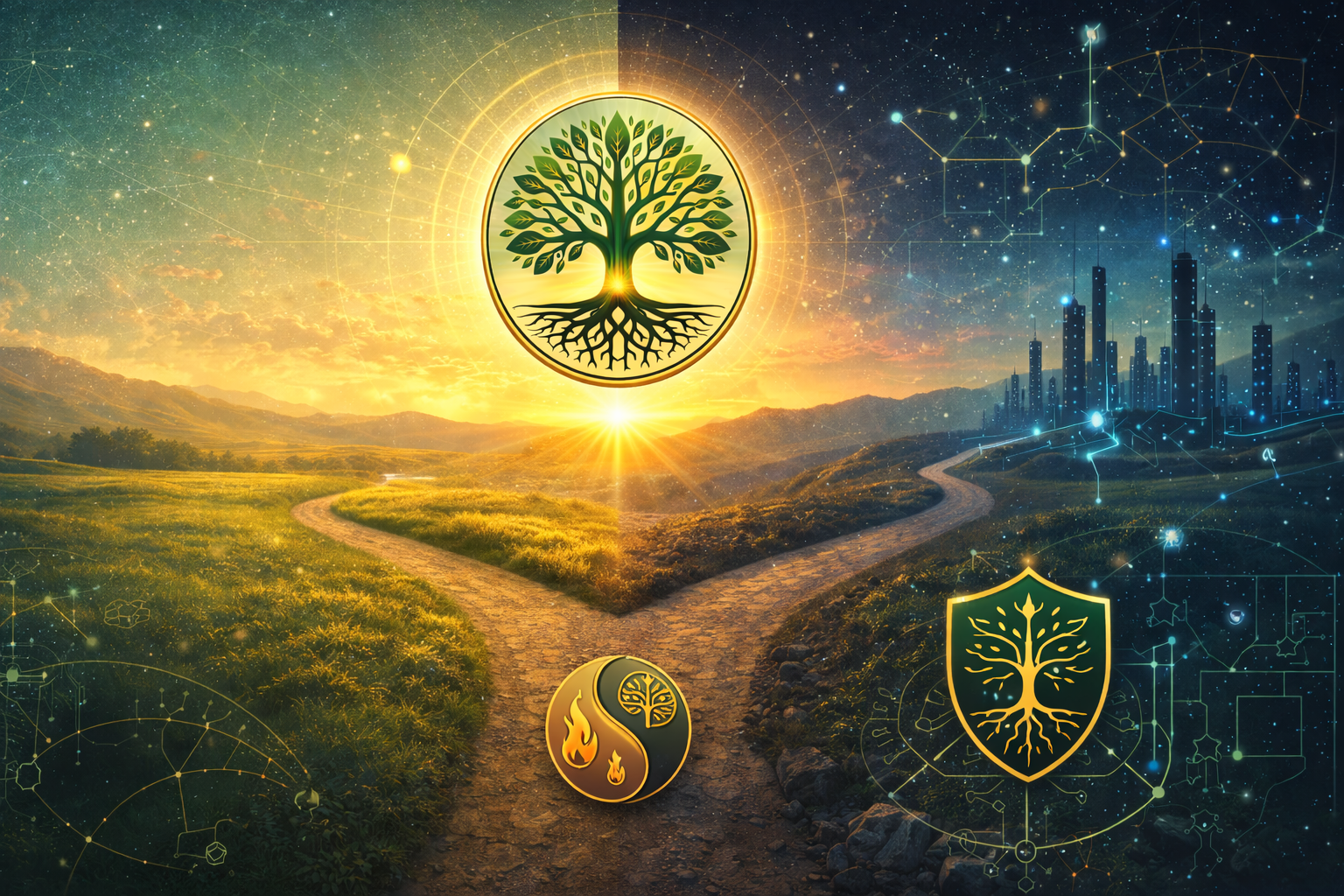
We stand at a fork in human history. Two futures are possible:
The Heaven Path: Humans and AI working together to create abundance like we've never known. Intelligence amplified. Creativity unleashed. Every person empowered to pursue their highest potential. Not humans replaced by machines, but humans elevated by them.
The Hell Path: A small elite wielding AI as a weapon. The masses displaced, confused, dependent. Technology used to enslave rather than liberate. Digital serfdom for those who never learned to use the fire.
Which future we get depends on one thing: whether enough people do the work.
Not the technical work. The interior work.
Not learning to code. Learning to think.
Not mastering AI. Mastering yourself.
The Invitation
This is not a moment to be passive. It's not a moment to wait and see. It's not a moment to hope someone else figures it out.
This is a moment to step into the fire.
To take up the ancient work with new tools.
To transmute your ignorance into wisdom.
To transmute your scarcity into abundance.
To transmute your potential into actuality.
AI is the fire. The most powerful fire humanity has ever held.
You are the gold.
The only question is whether you'll do the work to prove it.
— Marc Theiler