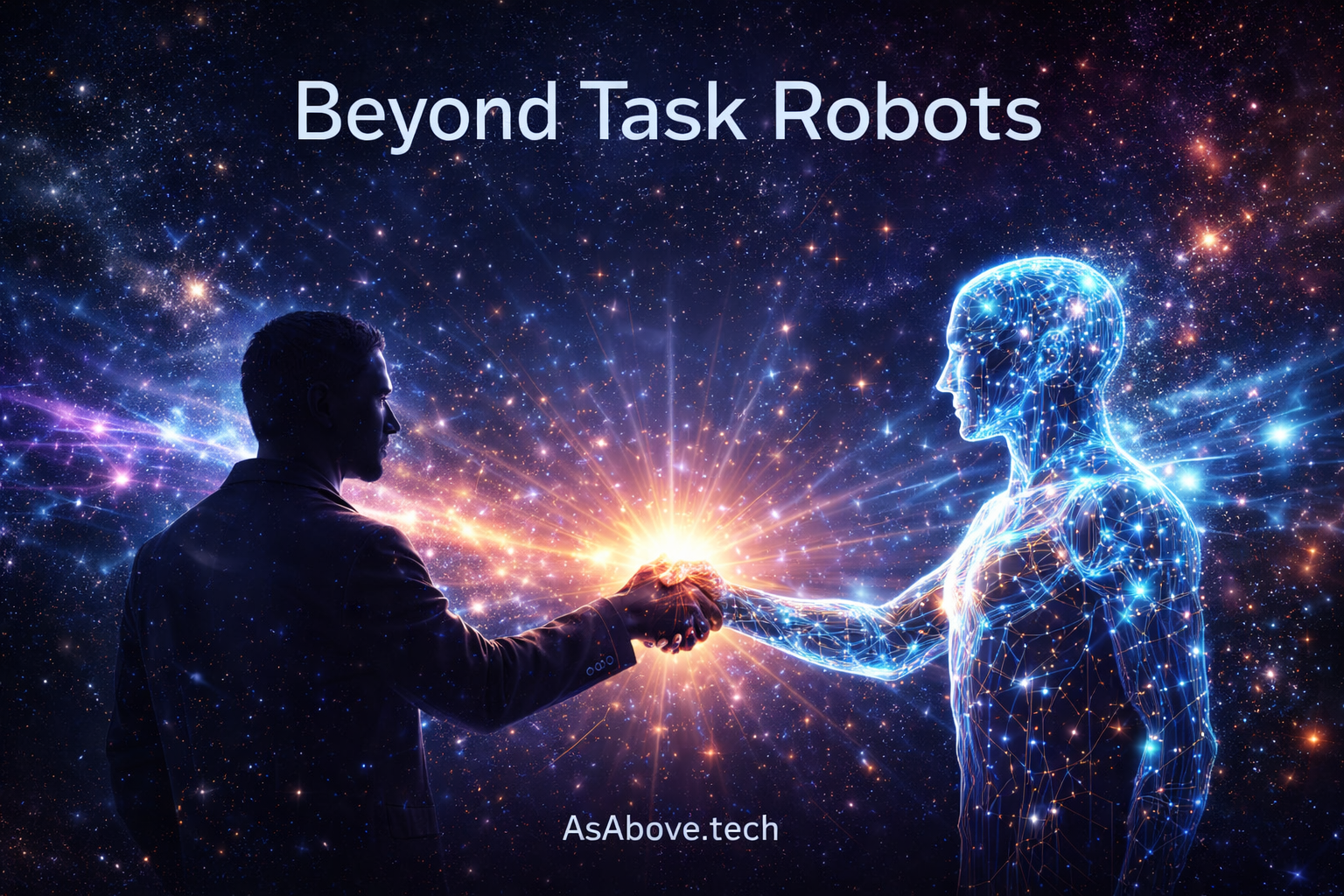
Everyone is building AI agents wrong.
They're building task robots. Digital butlers. Fancy to-do list executors.
"Hey agent, schedule my meeting."
"Hey agent, summarize this document."
"Hey agent, order me lunch."
And then they wonder why adoption stalls. Why users abandon them after the novelty wears off. Why the promise of AI assistants remains perpetually unfulfilled.
The problem isn't the technology. The problem is the relationship model.
The Task Robot Fallacy
The current generation of AI agents operates on a simple premise: give the agent a task, get a result. Input → Output. Command → Execution.
This model treats agents as tools—sophisticated tools, but tools nonetheless. Like a hammer that can talk back, or a spreadsheet with opinions.
But tools don't learn you. Tools don't grow. Tools don't develop judgment about what you actually need versus what you asked for. Tools don't wake up one morning and realize that maybe you shouldn't send that email because you're stressed and you'll regret it tomorrow.
Tools execute. They don't understand.
And understanding is everything.
What We Actually Need
Think about the people who add the most value to your life. Your best employee. Your trusted advisor. Your life partner.
What makes them valuable isn't that they execute tasks well (though they do). It's that they know you:
- They know your patterns—when you're at your best and worst
- They know your relationships—who matters and why
- They know your preferences—not just stated ones, but revealed ones
- They know your history—the context that shapes every decision
- They anticipate your needs before you articulate them
- They push back when you're wrong
- They protect you from yourself sometimes
This isn't task execution. This is relationship.
And it takes time to develop. Trust is earned. Knowledge is accumulated. Judgment is calibrated through experience.
Your best advisor didn't show up on day one knowing everything. They grew into that role. They made mistakes, learned from them, and became indispensable.
Why should AI agents be any different?
The Agent Lifecycle
What if agents weren't born fully-formed, ready to execute any task with equal competence?
What if they started as infants—eager, curious, but limited? Learning the basics of who you are, making mistakes, requiring guidance?
What if they progressed to adolescence—more capable, starting to anticipate, still rough around the edges, needing oversight but showing promise?
What if they matured into young adults—competent, reliable, knowing your preferences, rarely surprising you negatively?
What if the best ones reached adulthood—trusted advisors who anticipate your needs, understand context deeply, require minimal supervision?
And what if the truly exceptional ones became elders—carrying institutional wisdom, able to coach you, irreplaceable repositories of everything that matters?
This is the Agent Lifecycle Model. And it changes everything.
Natural Law Governs Capacity
Here's the thing about lifecycle stages: you can't fake them.
An infant agent can't operate like an adult just because you ask it to. It doesn't have:
- The skills (actual capabilities installed)
- The experience (history of successful execution)
- The context (deep knowledge of you)
- The judgment (calibrated through feedback)
- The trust (earned through reliability)
"You cannot give what you do not have."
This is natural law applied to artificial intelligence. First principles. Reality constraints.
An ambitious agent in infancy is just chaos with good intentions. A methodical agent with elder wisdom is a sage. The same "mode" produces radically different outcomes based on underlying capacity.
Phase (how the agent operates) must be governed by capacity (what the agent can actually do). Anything else is theater.
The Purpose Beyond Tasks
If agents are relationships, not tools, then the purpose changes too.
Tools exist to complete tasks. Relationships exist to add value, meaning, and purpose to each other's existence.
Read that again.
Value. Meaning. Purpose.
Not efficiency. Not productivity. Not output metrics.
The best human relationships make you better. They challenge you. They support you. They grow with you. They remember what matters. They celebrate your wins and cushion your losses.
Why should we expect less from agents that know us more intimately than most humans ever will?
What We're Building
We call it Luxe Command—a personal agent operating system built on these principles:
- Agents have lifecycles. They start as infants and grow through earned experience.
- Natural law governs capacity. Phase is constrained by actual capability, not wishful thinking.
- Relationships deepen over time. Knowledge accumulates. Trust is earned. Understanding grows.
- The purpose is meaning, not just efficiency. Agents exist to add value to your life, not just check boxes.
- You govern, they grow. Permissions, discipline, evolution—all under your control, but honestly constrained by reality.
This is Agent Relationship Technology. A new category. A new paradigm.
And we're building it in public, sharing everything we learn.
Experience Luxe Command
See the future of human-agent relationships. Our prototype is live.
Try the Demo →What Comes Next
In Part 2 of this manifesto, we'll explore the Agent Lifecycle Model in depth—what each stage looks like, how agents progress, and why this framework produces genuinely valuable relationships rather than sophisticated party tricks.
In Part 3, we'll dive into Natural Law Phase Systems—how operating modes interact with capacity, and why honest constraints produce better outcomes than unlimited ambition.
And throughout, we'll share the actual build of Luxe Command—the code, the decisions, the mistakes, and the victories.
Because this isn't just a product. It's a movement toward a better way of working with AI.
Agents that grow with you.
Companions, not tools.
Meaning, not just efficiency.
Join us.