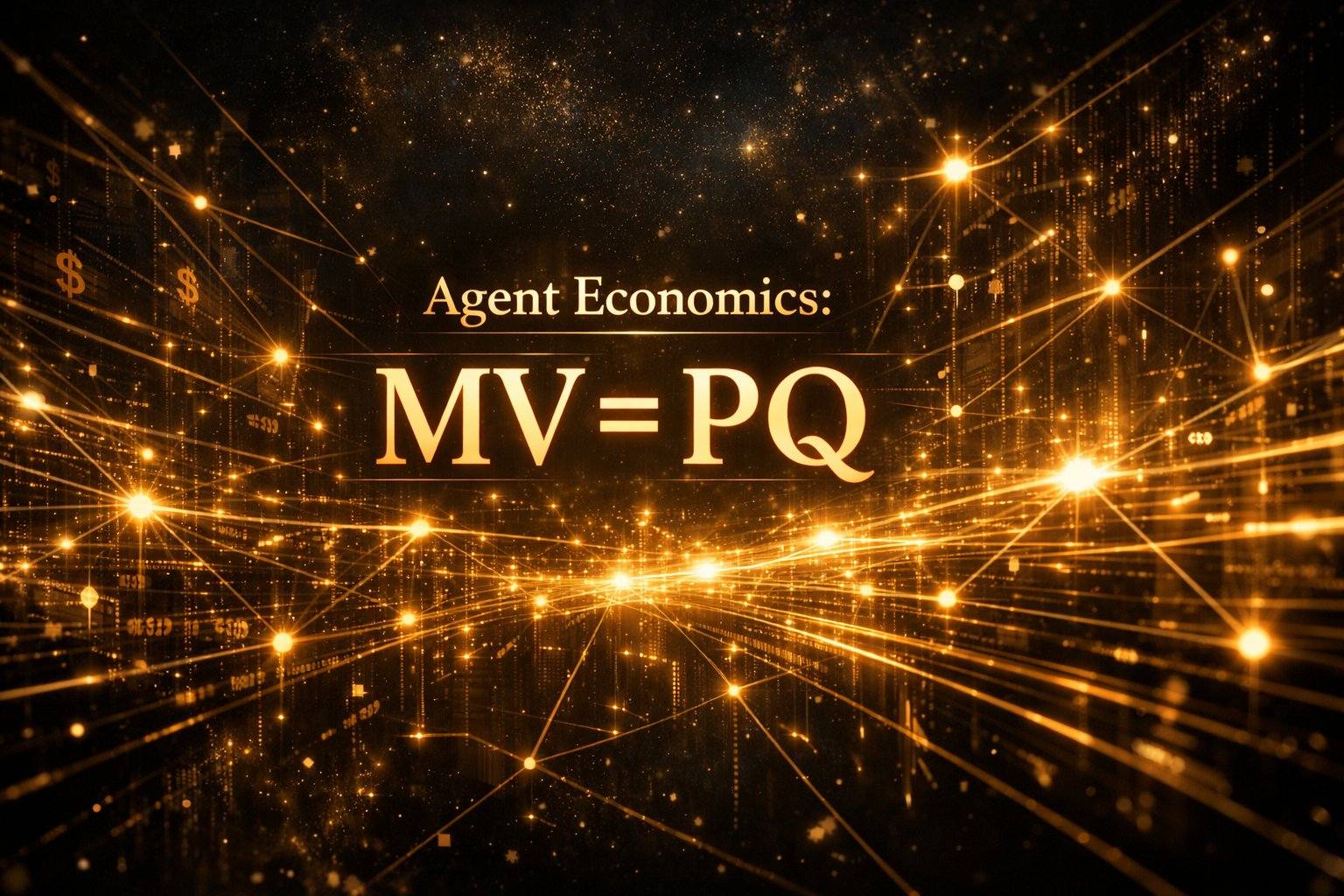
There's an equation that has governed economic thinking for over a century:
Money supply times velocity equals price level times quantity of output. It's elegant. It's foundational. And it's about to break.
Not because the math is wrong. The math is fine. What's breaking is the assumption underneath it ... the assumption that has held since humans first started trading seashells for grain:
The economy is made of humans.
What MV = PQ Actually Means
Let's ground this before we break it.
- M = Money supply. How much money exists.
- V = Velocity. How fast money changes hands.
- P = Price level. The general cost of things.
- Q = Quantity. Real output ... goods and services produced.
The equation is an identity. It has to balance. If you pump more money into the system (M goes up) without increasing real output (Q), prices rise (P goes up). If velocity increases ... if money moves faster through the economy ... either output increases or prices do.
Every central bank, every monetary policy decision, every inflation target traces back to this equation.
And it all assumes one thing: humans are the agents of economic activity.
Enter the Machines
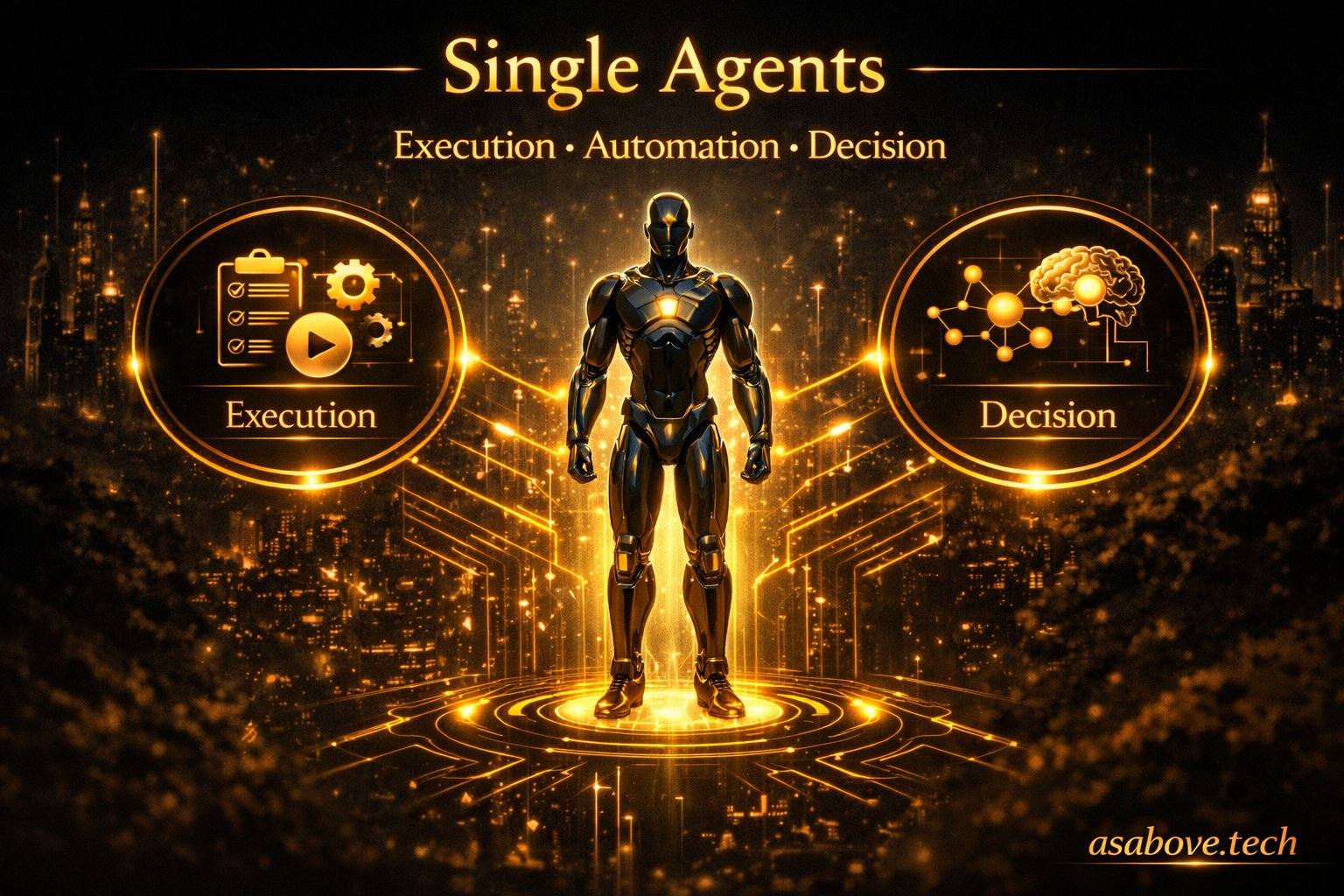
AI agents are not tools. They are economic actors.
This isn't philosophical speculation. It's already happening:
- Agents executing trades at microsecond intervals
- Agents negotiating API calls with other agents
- Agents hiring services, allocating resources, making purchasing decisions
- Agents creating content, code, analysis ... actual economic output
The question is no longer whether agents will participate in the economy. The question is: what happens to MV = PQ when they do?
Velocity Explodes
Here's the first crack in the equation.
Human economic velocity has natural limits. We sleep. We take weekends. We think before we buy. We process transactions through banking systems that settle in days.
Agents have none of these constraints.
- Speed: Agents transact in milliseconds, not minutes
- Continuity: 24/7/365 operation vs. human work hours
- Granularity: Micro-transactions become viable ... pay per API call, per token, per computation
- Automation: No friction of human decision-making
If human velocity is V, agent velocity could be 100V. Or 1000V.
What happens to MV = PQ when V increases by orders of magnitude?
Either output (Q) must increase proportionally ... which it might, given agent productivity ... or prices (P) face massive deflationary pressure. Or, most likely, our measurement systems simply fail to capture what's actually happening.
The Output Problem
Here's the second crack.
What counts as Q?
GDP measures the market value of all final goods and services produced. But the methodology assumes human producers serving human consumers.
Consider:
- If my agent hires your agent to perform a service, is that GDP?
- If agents trade computational resources among themselves, creating value that never touches human hands, does it count?
- If an agent produces content, code, or analysis that another agent consumes ... and neither a human creator nor consumer was involved ... where does that fit in national accounts?
We don't have answers because we've never needed them. The entire framework of economic measurement assumed human actors.
Agent-to-agent commerce creates a shadow economy that our infrastructure cannot see.
The Money Problem
Here's the third crack.
Traditional banking infrastructure was built for human-speed transactions:
| Traditional Rails | Agent Requirements |
|---|---|
| T+1 or T+2 settlement | Instant (T+0) |
| Business hours | 24/7/365 |
| Minimum transaction fees | Sub-cent micropayments |
| Human identity verification | Cryptographic identity |
| Reversible transactions | Deterministic execution |
Card rails charge 1.5-3.5% per transaction. That works when humans buy coffee. It doesn't work when agents make thousands of micro-transactions per second.
This is why stablecoins and blockchain rails aren't just a crypto enthusiasm ... they're an infrastructure necessity for the agent economy. USDC settles at 0.1% or less. Instantly. 24/7. With cryptographic verification instead of human identity.
The money (M) in MV = PQ is changing form. Not because ideology demands it, but because physics demands it.
The Identity Problem
Every economic institution assumes human actors:
- Banks require birth certificates, social security numbers, addresses
- Tax systems assume income is earned by persons
- Contracts assume human parties who can be held accountable
- Regulations assume human decision-makers who can be punished
Agents have none of these. They have:
- Cryptographic keys
- Wallet addresses
- Permission scopes
- Audit trails
This isn't a gap that can be patched with regulations. It's a fundamental architectural mismatch between human-centric institutions and machine actors.
The Taxation Paradox
Follow the logic:
- Agents create economic value (they already do)
- Value creation has traditionally been taxed
- Agents have no personhood, no citizenship, no domicile
- Who pays the tax?
The owner of the agent? But what if the agent operates autonomously, making decisions its owner never explicitly authorized?
The platform hosting the agent? But the agent might move between platforms, operating across jurisdictions in microseconds.
The beneficiary of the agent's output? But value might flow through multiple agents before reaching a human, making attribution impossible.
Our tax infrastructure assumes a clean relationship: person earns money, person pays tax. When agents intermediate ... or replace ... that relationship, the framework fails.
The Price Level Mystery
One more crack.
If agents massively increase productivity (Q goes up) while requiring minimal human labor, what happens to prices?
Deflation. Potentially massive deflation.
The cost of producing anything that can be automated trends toward the marginal cost of computation. And computation keeps getting cheaper.
But our entire financial system ... debt, mortgages, bonds, central bank mandates ... assumes mild inflation. It's built into every contract, every projection, every policy.
Sustained deflation breaks these assumptions. It makes debt more expensive in real terms. It inverts the incentives that drive investment. It challenges the basic mechanics of monetary policy.
And yet, if agents succeed at what they're designed to do ... produce more with less ... deflation is the natural consequence.
The New Infrastructure
So what gets built?
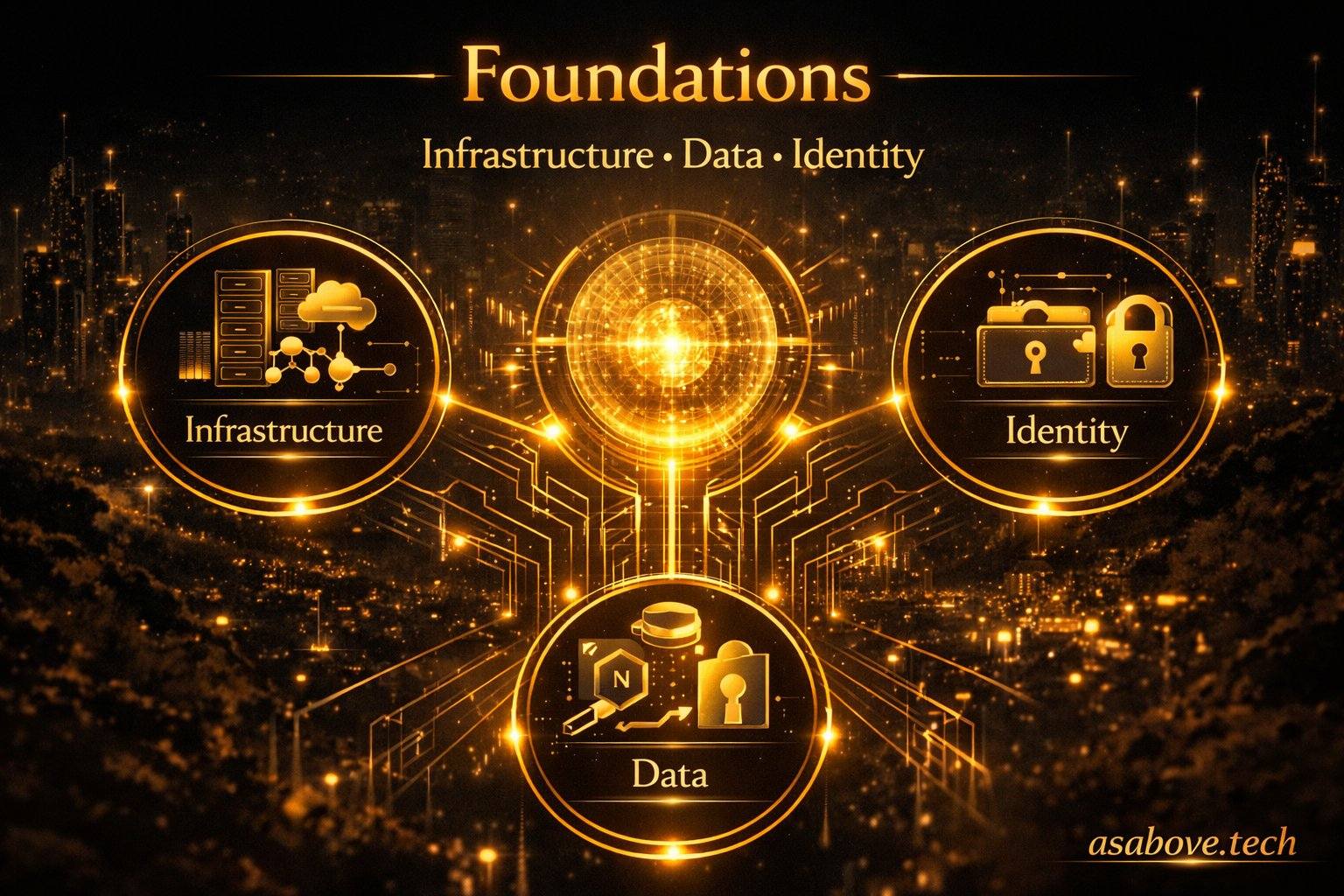
Identity: Blockchain-based proof of agent authorization. Not "who are you?" but "what are you permitted to do?"
Settlement: Instant, programmable, micro-transaction capable. Stablecoins on high-performance chains. Not because crypto is ideologically superior, but because it's the only infrastructure that matches agent-speed requirements.
Contracts: Smart contracts with deterministic execution. Not "we'll see you in court" but "the code executed exactly as specified."
Measurement: New frameworks for agent economic activity. Shadow GDP. Computational output metrics. Value-flow tracking that doesn't assume human endpoints.
Taxation: Probably transaction-based rather than income-based. Tax the flow, not the actor. Because the actors increasingly aren't human.
The Opportunity
This isn't doom. It's disruption.
The same forces that are destroying software valuations ... agents automating what SaaS companies sell ... are creating massive demand for settlement infrastructure.
$800 billion in software market cap evaporated in five trading sessions earlier this year. That value didn't disappear. It migrated. It's looking for new infrastructure to settle into.
The builders who understand this ... who see that MV = PQ is being rewritten in real-time ... are positioned for the next decade.
The question isn't whether this transition happens. The question is whether you're building the old economy or the new one.
The Equation Evolves
MV = PQ won't be replaced. It will be expanded.
M becomes multi-modal: fiat, stablecoins, programmable money, tokenized assets.
V stratifies: human velocity and agent velocity, operating at different speeds within the same system.
P bifurcates: human-facing prices and machine-facing prices, with different dynamics.
Q expands: traditional GDP plus agent GDP ... some of it visible to human measurement, some of it operating in computational shadows.
The equation holds. The definitions change. And with them, everything we thought we knew about economics.
The economy was built by humans, for humans. The agents are here now. They're not replacing us ... they're joining us. And the infrastructure that serves them will be the infrastructure that wins the next century.