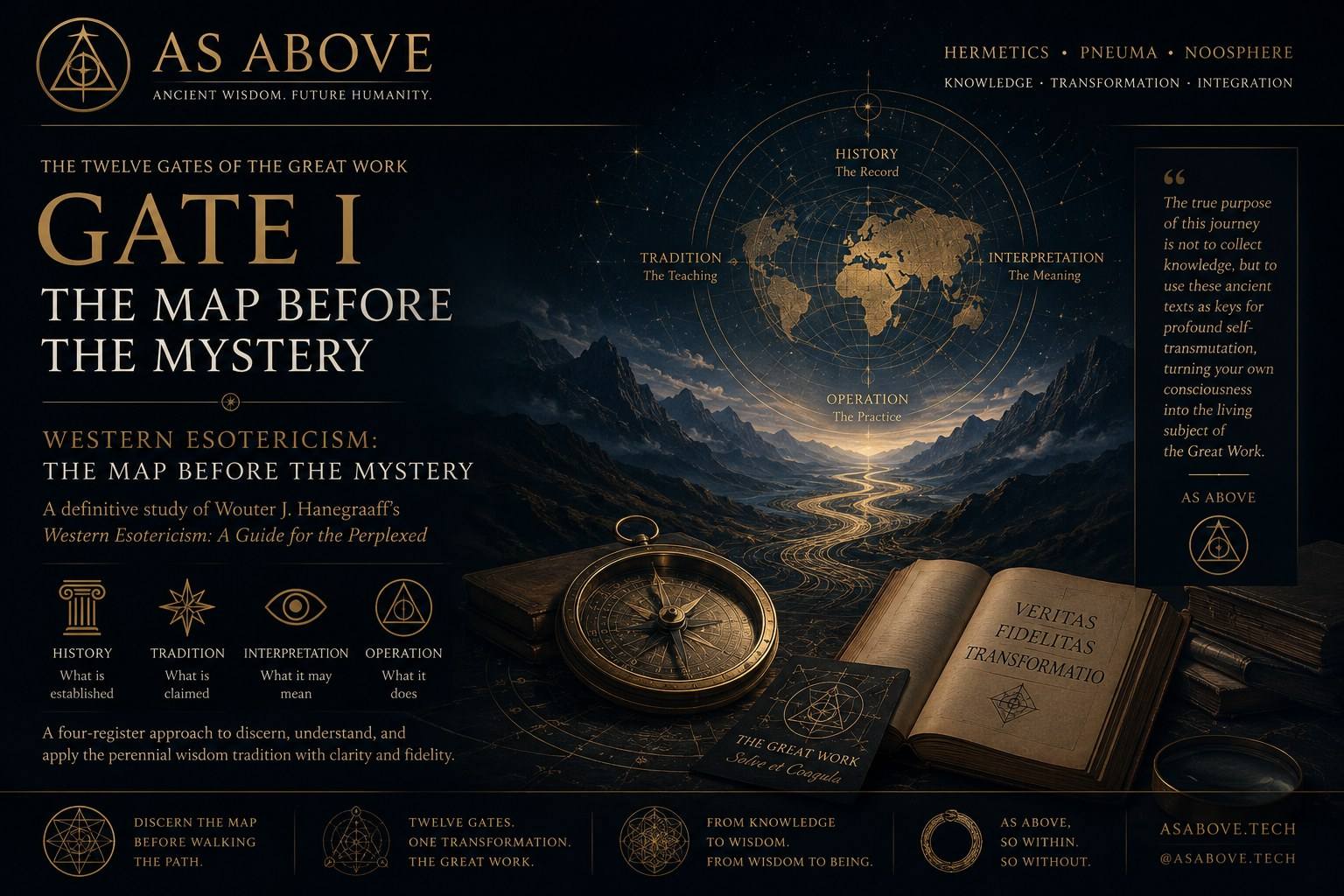
Gate I of The Twelve Gates of the Great Work
Book: Western Esotericism: A Guide for the
Perplexed
Author: Wouter J. Hanegraaff
First published: Bloomsbury Academic, 2013
Gate: I, The Map
Function in the series: Historical orientation and
epistemic discipline
Transformation: From fascination to discernment
Before a seeker can interpret a symbol, invoke a tradition, trust a lineage, or enter a practice, the seeker must first learn to identify what is actually there.
The occult world has never lacked revelation. It has lacked reliable orientation.
A person entering Western esotericism encounters a bewildering field of Hermetic texts, alchemical emblems, Kabbalistic diagrams, astrological cosmologies, initiatory orders, grimoires, mystical philosophies, secret histories, modern reconstructions, personal revelations, and commercial simplifications. Many of these materials possess real historical depth. Some preserve profound philosophical or contemplative insight. Some are creative modern syntheses presented as ancient inheritances. Some contain errors that have been repeated so often that repetition itself has acquired the appearance of proof.
The danger is not confined to fraud. Sincere people can transmit false history. Powerful experiences can generate weak interpretations. Beautiful systems can become self-sealing. A teaching can change a life without being ancient, and a text can be ancient without being wise. The capacity to distinguish among these possibilities is not an academic luxury. It is part of the Great Work.
That is why Western Esotericism: A Guide for the Perplexed must stand at the entrance to this twelve-book curriculum.
Hanegraaff does not hand the reader another secret doctrine. He gives the reader a map of how secret doctrines, occult sciences, mystical philosophies, alternative cosmologies, initiatory movements, and claims of higher knowledge came to be grouped under the modern category called Western esotericism. More importantly, he shows that this category was shaped not only by what its participants affirmed, but also by what religious, intellectual, and academic authorities excluded.
The first Gate therefore asks a harder question than, “What should I believe?”
It asks:
What kind of claim is being made, where did it come from, how did it change, what evidence supports it, and what happens to consciousness when it is accepted?
That question will govern every Gate that follows.
Read This If You Want To
- Enter Hermeticism, Kabbalah, theurgy, astral magic, ceremonial magic, or occult philosophy without confusing later synthesis with original source material.
- Understand why Western esotericism is a modern scholarly category rather than one continuous organization or universally recognized tradition.
- Distinguish historical continuity from symbolic continuity, initiatory claims from documented transmission, and spiritual experience from the interpretation placed upon it.
- Understand how religion, philosophy, science, art, magic, mysticism, and psychology have overlapped rather than existing as timelessly separate domains.
- Learn why “rejected knowledge” can be historically important without being automatically true.
- Build an intellectual immune system against false antiquity, counterfeit lineage, quantum mysticism, indiscriminate perennialism, and persuasive but unsupported synthesis.
- Preserve the experiential and transformative power of esoteric traditions without surrendering critical judgment.
The Book in One Sentence
Western Esotericism is a compact intellectual map of the currents, worldviews, knowledge claims, practices, exclusions, and modern transformations that produced what we now call the Western esoteric field.
The Core As Above Thesis
Historical criticism does not destroy the Great Work. It protects the Work from being captured by fantasy.
The practitioner who needs a tradition to be older, purer, more unified, or more scientifically proven than the evidence permits is no longer serving the truth. The practitioner is using truth as material for identity.
The aim is not disenchantment. The aim is exact enchantment: wonder that does not require falsification, participation that does not erase provenance, and transformation that remains answerable to reality.
Contents
- Why the Map Must Come Before the Mystery
- Edition Lock: What We Are Actually Reading
- The Four Registers
- Wouter Hanegraaff and the Academic Recovery of the Rejected
- What Is Western Esotericism?
- Five Maps of the Same Territory
- Rejected Knowledge: The Master Key
- A Very Short History of a Very Complicated Field
- Apologetics, Polemics, and Mnemohistory
- Worldviews
- Knowledge: Reason, Faith, and Gnosis
- Practice: What Esotericists Actually Do
- Modernization
- Between the Disciplines
- What Hanegraaff Gets Exactly Right
- Where the Map Is Incomplete
- The Necessary As Above Integration
- The Eightfold Fidelity Protocol
- Great Work Exercises
- Questions for Serious Study
- How Gate I Opens the Other Eleven Gates
- Final Assessment
1. Why the Map Must Come Before the Mystery
The eleven books that follow this Gate move progressively deeper into the Western esoteric archive.
The Way of Hermes introduces philosophical revelation and Hermetic rebirth. The Ancient Mysteries opens the ritual worlds of initiation, sacred drama, and divine encounter. Theurgy and the Soul examines embodied participation in the gods. The Early Kabbalah enters emanation, sacred language, and the hidden life of scripture. Picatrix presents a cosmos structured by celestial influence, image, timing, and material correspondence. Agrippa organizes natural, celestial, and intellectual magic into a Renaissance synthesis. Frances Yates interprets the Hermetic imagination of that Renaissance, while also becoming a case study in how a brilliant scholarly paradigm can later require correction. The Lesser Key of Solomon confronts spirit catalogues, command, authority, projection, and shadow. Regardie presents the Golden Dawn as an initiatory machine. Dion Fortune turns the Tree of Life into a modern psycho-cosmic map. Crowley closes the sequence with practical judgment, will, discipline, and the ambiguities of spiritual authority.
Every one of those texts can be misunderstood in predictable ways.
A reader may treat the Corpus Hermeticum as the transcription of a primordial Egyptian doctrine rather than a body of late antique Greek texts formed in a Greco-Egyptian environment. A reader may treat modern occult Qabalah as interchangeable with Jewish Kabbalah. A reader may interpret the Picatrix through modern manifestation culture, or treat a grimoire’s pseudonymous attribution as documentary authorship. A reader may assume that the Golden Dawn transmitted an unchanged ancient order rather than constructing an extraordinarily influential modern synthesis. A reader may read Crowley’s personal formulations backward into traditions that preceded him.
These errors are not small. They determine what the reader thinks the tradition is.
A historical map does not tell us whether the metaphysical claims in these texts are true. It does something prior and indispensable. It tells us what the sources are, when they appeared, what languages and institutions mediated them, what earlier materials they reworked, what later readers added, and where the evidence stops.
Without that map, symbolic resemblance becomes proof of transmission. Personal resonance becomes proof of origin. Repetition becomes authority. The reader begins with a conclusion and recruits history to support it.
This is precisely how captured relevance operates. Once a preferred narrative controls what counts as meaningful, every new fact is sorted according to whether it confirms that narrative. Contradictory evidence is dismissed as profane blindness, institutional suppression, lack of initiation, or materialist prejudice. The belief becomes immune not because it has survived criticism, but because criticism has been reclassified as evidence for the belief.
Gate I breaks that loop.
It does not ask the reader to abandon participation. It asks the reader to become capable of participation without possession.
2. Edition Lock: What We Are Actually Reading
Primary edition
Wouter J. Hanegraaff, Western Esotericism: A Guide for the Perplexed (London and New York: Bloomsbury Academic, 2013).
The volume is concise, approximately two hundred pages of main text, and organized into nine chapters:1
- What Is Western Esotericism?
- A Very Short History
- Apologetics and Polemics
- Worldviews
- Knowledge
- Practice
- Modernization
- Between the Disciplines
- Sources and Resources
The architecture is deliberate. Hanegraaff begins by destabilizing the category, then reconstructs its history, examines the narratives by which it was defended and condemned, analyzes its worldviews and epistemologies, looks at what practitioners actually do, traces its transformations under modernity, and finally explains why the field matters across the humanities and social sciences.
The necessary 2026 companion
A definitive contemporary reading cannot stop in 2013. Hanegraaff published Esotericism in Western Culture: Counter-Normativity and Rejected Knowledge with Bloomsbury Academic in 2025.2 The later book revisits the field through an expanded structure that includes dedicated treatment of internal Eurocentrism, transdisciplinarity, and the global importance of esoteric practices and exclusions.
The 2013 Guide remains the correct first Gate because it is the book named in the twelve-work curriculum, because its compact structure is exceptionally teachable, and because it established many of the categories that make the rest of this series intelligible. The 2025 book should be treated as its substantial contemporary companion, not as an optional footnote.
This article therefore reads the 2013 work in three layers:
- The book on its own terms. What argument does it make, and how is that argument constructed?
- The field after the book. Which debates became more prominent after 2013, particularly concerning global history, colonial categories, race, gender, and the unstable boundary implied by the word “Western”?
- The As Above application. How can the book improve the way a living esoteric library writes, links, classifies, and practices?
What this article is not
This is not a substitute for reading Hanegraaff. It is an interpretive architecture around the book, designed to make the reading more exact and to connect its method to the eleven Gates that follow.
It also does not assume that Hanegraaff’s model is the final definition of esotericism. His framework is one of the most consequential in the field, but it exists within an active scholarly debate. A map becomes dogma when its user forgets that it is a map.
3. The Four Registers: How As Above Will Read Esoteric Claims
The most important editorial instrument developed for this series is the Four Registers model.
Esoteric writing becomes unreliable when different kinds of claims are allowed to slide into one another without notice. A traditional statement is presented as a historical fact. A psychological analogy is treated as proof of a metaphysical entity. A scientific term is borrowed as validation for a spiritual doctrine. A personally transformative experience is universalized into a cosmology.
The Four Registers prevent that collapse.
| Register | Governing question | Appropriate evidence | Typical error |
|---|---|---|---|
| Historical | What can be established about origin, authorship, date, transmission, context, and influence? | Manuscripts, editions, archives, material evidence, philology, documented networks, critical historiography | Treating traditional attribution or symbolic resemblance as proof |
| Traditional | What does the text, lineage, or practitioner community claim about reality and itself? | Primary texts, commentaries, ritual documents, oral teachings, participant testimony | Presenting an internal belief as neutral external fact |
| Interpretive | What philosophical, psychological, phenomenological, or symbolic meaning can be drawn from the material? | Argument, comparison, depth psychology, philosophy, phenomenology, hermeneutics | Mistaking a useful interpretation for the source’s original meaning |
| Operational | What practice, discipline, transformation, risk, or ethical consequence follows? | Reproducible procedure where possible, careful observation, behavioral outcome, participant reports, safety analysis | Confusing intensity, novelty, or altered states with wisdom |
These registers are not enemies. They can illuminate one another, but they cannot replace one another.
Consider the phrase “the golden thread of Hermetic tradition.”
In the traditional register, the phrase may express a real conviction that an underlying wisdom recurs across cultures and centuries. In the interpretive register, it can name a family resemblance among ideas of correspondence, living cosmos, spiritual ascent, divine mind, and transmutation. In the operational register, it can orient a practitioner toward integration and disciplined self-cultivation.
In the historical register, however, “golden thread” does not by itself prove an unbroken institution, stable doctrine, secret chain of initiation, or direct line of transmission from ancient Egypt to the present.
The phrase may remain valuable, but its value changes once its register is named.
This is how the As Above library can preserve visionary language without allowing visionary language to impersonate documentary history.
The non-reduction rule
The Four Registers also guard against reduction in the opposite direction.
To show that a lineage claim is historically unsupported does not prove that every practice associated with it is worthless. To identify the psychological dynamics of a ritual does not prove that nothing metaphysical is occurring. To demonstrate that a doctrine emerged recently does not prove that the doctrine is false. Origin and truth are related questions, but they are not identical questions.
A mature inquiry can say all of the following at once:
- The historical attribution is not supported.
- The text nevertheless became culturally influential.
- Practitioners report meaningful experiences through its use.
- Those experiences admit multiple interpretations.
- Some interpretations are more warranted than others.
- The practice may carry psychological, social, or physical risks.
- Its value must ultimately be judged by the quality of perception and conduct it produces.
That is not indecision. It is disciplined complexity.
4. Wouter Hanegraaff and the Academic Recovery of the Rejected
Wouter J. Hanegraaff has served as professor of the History of Hermetic Philosophy and Related Currents at the University of Amsterdam, where the field acquired one of its most important institutional centers.3 His scholarship spans New Age religion, Renaissance and post-Renaissance esotericism, Hermeticism, gnosis, altered states, historiography, and the intellectual processes by which certain forms of knowledge were expelled from respectable accounts of Western culture.
His significance lies not in being the first person to take occult or esoteric material seriously. Practitioners, antiquarians, religious historians, literary scholars, art historians, and earlier specialists had long studied portions of the territory. His importance lies in helping consolidate a rigorous historical field that could examine these materials without either defending their metaphysical truth or dismissing them as irrational debris.
That methodological position is often called methodological agnosticism.
It does not mean personal indifference. It means that scholarship, as scholarship, suspends judgment on claims that its methods cannot settle. A historian can establish that a person reported angelic communication, that a ritual manuscript prescribed certain actions, that a community accepted the result as revelation, and that the revelation altered subsequent events. The historian cannot simply convert those facts into proof that the angel existed as described. Nor can the historian declare the experience unreal merely because it resists the historian’s preferred ontology.
The object of study is not only whether extraordinary claims are true. It is how those claims arise, how they are authorized, how they are transmitted, what practices support them, what institutions form around them, what experiences they organize, and what effects they produce.
This position is especially important for As Above.
A living esoteric library is not a university department. It is permitted to explore metaphysics, practice, personal transformation, and synthesis in ways that academic historiography deliberately brackets. But it must know when it has crossed from established history into philosophical interpretation or metaphysical proposal. Without that self-awareness, synthesis becomes conflation.
Hanegraaff’s method gives the library a boundary instrument without forcing it into sterile skepticism.
5. What Is Western Esotericism?
The simplest honest answer is that Western esotericism is not one thing.
It is a scholarly umbrella placed over a shifting collection of currents, ideas, practices, texts, and organizations that did not all understand themselves as members of a single field. Ancient Hermetic authors did not identify themselves as “Western esotericists.” Medieval astrologers, Jewish Kabbalists, Christian theosophers, Renaissance Platonists, alchemists, Rosicrucian writers, Swedenborgians, spiritualists, Theosophists, Golden Dawn initiates, Jungians, and New Age channelers did not all share one doctrine, one lineage, one institution, or one view of reality.
The category is retrospective.4
That does not make it arbitrary. Retrospective categories are common in scholarship. The question is whether the category helps us perceive historically meaningful patterns without erasing differences.
Hanegraaff’s answer is to focus on a large and complex domain of currents that became marked as incompatible with dominant post-Enlightenment understandings of legitimate religion, rational philosophy, and proper science. In this model, Western esotericism is not defined by one secret doctrine. It is defined substantially through a history of exclusion.
What it is not
It is not simply “secret knowledge”
Some esoteric groups cultivate secrecy, graded access, initiation, or restricted teachings. Others publish everything. Secrecy can be social, rhetorical, initiatory, commercial, protective, or symbolic. It is important, but not universal enough to define the whole field.
It is not a single perennial philosophy
Many esoteric authors claim that all authentic traditions descend from one primordial wisdom. That claim belongs to the history of esotericism and deserves serious study. It cannot serve as the neutral scholarly definition of the field because it assumes the metaphysical conclusion that historical research is supposed to examine.
It is not whatever mainstream culture dislikes
Rejected knowledge is not a synonym for every marginalized belief, political dissidence, minority religion, conspiracy theory, or unpopular science. The category requires historical specificity. Who rejected what? Through which institutions? Under which standards? In what period? With what consequences?
It is not the timeless opposite of religion
Many practices later called magical were understood by participants as prayer, devotion, sacramental action, angelic invocation, natural philosophy, medicine, or sacred science. The neat opposition between magic and religion often reflects later polemical classifications rather than the categories used by practitioners.
It is not the timeless opposite of science
Astrology, alchemy, natural magic, medicine, cosmology, and experimental practice have occupied changing positions in the history of knowledge. To call all of them pseudoscience in every period is anachronistic. To call them all suppressed advanced science is equally anachronistic.
It is not identical with mysticism
Mysticism, like esotericism, is a disputed scholarly category. The two fields overlap around direct experience, transformation, contemplation, and claims of union or revelation, but neither contains the other completely.
It is not identical with occultism
“Occultism” is especially useful for modern movements that emerged during and after the nineteenth century, when older materials were reorganized in response to modern science, psychology, comparative religion, print culture, colonial encounter, and new forms of association. It should not automatically be projected backward onto every ancient or medieval source.
It is not reducible to Hermeticism
Hermetic texts and later Hermetic receptions are central to the field, but Western esotericism also includes currents that are not simply Hermetic and traditions whose relation to Hermeticism is indirect, contested, or constructed later.
A working definition for this series
For The Twelve Gates of the Great Work, Western esotericism will mean:
A historically changing field of texts, practices, worldviews, and institutions concerned with transformative or higher knowledge, mediated relations between visible and invisible realities, and forms of thought or practice that were repeatedly reclassified, contested, appropriated, marginalized, or reconstructed within Western and globally entangled cultures.
This definition is intentionally provisional.
It identifies recurring concerns without claiming that every current shares them equally. It acknowledges exclusion without making marginality the sole essence. It retains the word “Western” as a description of the history under study while recognizing that the history was never culturally sealed. Greek, Egyptian, Jewish, Christian, Islamic, Persian, Indian, Indigenous, colonial, and global encounters are integral to the very formation of what later Europeans called their own esoteric traditions.
The border is porous because the history is porous.
6. Five Maps of the Same Territory
No definition of esotericism is innocent. Each definition selects some features, excludes others, and creates a different history.
Hanegraaff’s first chapter is most useful when read as an argument among maps rather than as the announcement of one final answer.
Map One: Esotericism as timeless inner truth
The oldest and most influential model is the one found within many esoteric traditions themselves. It holds that beneath the exoteric diversity of religions lies an esoteric unity, a primordial wisdom, philosophia perennis, prisca theologia, or universal doctrine known to sages across the ages.
This model possesses obvious spiritual appeal. It explains why symbols recur, why seekers experience recognition across traditions, and why texts separated by centuries can appear to speak to one another. It can encourage tolerance by treating religions as partial expressions of a deeper whole.
It also creates serious historical problems.
Similar ideas can arise independently. Later readers can create relationships that earlier authors never imagined. Translation can conceal difference. A modern synthesis can select compatible fragments from several traditions while ignoring everything that resists unity. The conviction that all traditions must agree at depth can make disagreement appear superficial by definition.
The perennial model is therefore best treated as a traditional or metaphysical claim, not as the default method of historical research.
Its strongest form asks: “What truth might these traditions share?”
Historical inquiry asks a different question: “What contacts, sources, institutions, translations, and reinterpretations produced the similarities we can document?”
Both questions may be worth asking. They do not have the same evidentiary rules.
Map Two: Frances Yates and the Hermetic Renaissance
Frances A. Yates brought enormous attention to the role of Hermetic texts, magic, memory, and religious imagination in the Renaissance. Her work helped overturn the assumption that Renaissance magic was an embarrassing residue irrelevant to the emergence of modern thought.
The achievement was profound. Figures such as Marsilio Ficino, Pico della Mirandola, Giordano Bruno, and John Dee could no longer be divided into respectable rational parts and disposable occult parts. Their cosmology, religion, natural philosophy, memory arts, magic, and intellectual ambitions belonged to one historical world.
Yet the “Yates thesis” also risked making a unified Hermetic tradition carry too much explanatory weight. Later scholarship complicated her chronology, sources, categories, and causal claims. This does not make Yates irrelevant. It makes her work the ideal example of a paradigm that was both generative and corrigible.
Gate VIII will return to this problem in full.
For Gate I, the lesson is simple:
A theory can be historically indispensable because it opened the right archive, even when later scholarship revises the theory that opened it.
Map Three: Antoine Faivre and the form of thought
Antoine Faivre gave the emerging field one of its most influential typologies.5 Rather than defining esotericism by a single doctrine, he identified recurring characteristics in early modern and modern Western currents.
Four were primary:
- Correspondences. Visible and invisible levels of reality are linked through systems of analogy, sympathy, signature, or resonance.
- Living nature. Nature is understood as animated, meaningful, internally connected, and more than inert mechanism.
- Imagination and mediation. Symbols, rituals, images, angels, spirits, and imaginal faculties mediate between levels of reality.
- Transmutation. Knowledge is not merely conceptual. It changes the knower.
Two further characteristics often accompanied them:
- Concordance. Different traditions are read as expressions of a common underlying wisdom.
- Transmission. Knowledge is passed through masters, initiation, lineage, or disciplined succession.
Faivre’s model remains extraordinarily useful for recognizing the texture of Renaissance and post-Renaissance esoteric thought. It also fits the As Above project closely: correspondence, living cosmos, symbolic mediation, and transmutation already form much of the site’s conceptual grammar.
Its limitation is scope. A typology derived largely from selected early modern and modern Christian currents can become restrictive when treated as the essence of all esotericism. Some materials commonly studied in the field do not display all the features. Other traditions outside the field may display several of them.
A strong typology identifies family resemblance. A weak typology turns resemblance into essence.
Map Four: Kocku von Stuckrad and esoteric discourse
Kocku von Stuckrad shifted attention from a fixed corpus of traditions to the cultural production of knowledge.6 His influential approach emphasizes two linked dimensions:
- Claims to higher, perfect, hidden, or absolute knowledge.
- The means by which access to that knowledge is authorized, restricted, revealed, or cultivated.
This approach makes esotericism less a box of special objects and more a discourse about knowledge, access, concealment, and revelation.
Its strength is flexibility. It can analyze secrecy, initiation, visionary experience, scholarly authority, charismatic teachers, institutions, and conflicts over who is qualified to know. It also exposes a central power question:
Who is permitted to declare that a knowledge is higher, and what social structure is created by that declaration?
Its limitation is breadth. Claims of superior knowledge and restricted access appear in many religious, scientific, political, military, professional, and technological settings. The model must be specified carefully or it risks making almost every expert culture esoteric.
Map Five: Hanegraaff and rejected knowledge
Hanegraaff’s distinctive move is historiographical.7
Instead of asking first which inner characteristics make a current esoteric, he asks how a cluster of currents came to be imagined as a coherent rejected domain. Protestant polemics against paganism, idolatry, magic, and heresy interacted with Enlightenment narratives of reason overcoming superstition. Over time, materials associated with Platonism, Hermetism, astrology, alchemy, theurgy, Kabbalah, magic, and later occultism were pushed outside normative accounts of religion, philosophy, and science.
The field called Western esotericism can therefore be studied as the return of material that standard intellectual history had discarded.
This model explains why the archive feels heterogeneous. Its unity does not depend entirely on one shared worldview. Part of its unity was created by the act of rejection itself.
It also explains why studying esotericism changes the larger history of Western culture. Once the discarded materials are restored, the clean narratives become unstable:
- Modern science did not emerge from reason alone after simply defeating magic.
- Renaissance philosophy cannot be understood by removing astrology, magic, theology, and Hermetic reception.
- Psychology did not arise in complete isolation from mesmerism, spiritualism, Romantic Naturphilosophie, and occult models of mind.
- Modern spirituality did not simply survive from antiquity. It was repeatedly reconstructed through print, colonial encounter, comparative religion, evolutionary theory, psychology, and market culture.
Hanegraaff’s map is powerful precisely because it is not a creed. It is a historical explanation for why these otherwise diverse materials ended up in the same intellectual basement.
No single map is enough
The five models ask different questions:
| Model | Primary question |
|---|---|
| Perennial or religionist | What hidden truth unites the traditions? |
| Yates | How did Hermetic and magical ideas shape Renaissance culture? |
| Faivre | What recurring form of thought characterizes major esoteric currents? |
| Von Stuckrad | How are claims to higher knowledge and access constructed? |
| Hanegraaff | How did excluded currents become a field of rejected knowledge? |
The error is not using a map. The error is forgetting which question the map was designed to answer.
For this series, Hanegraaff provides the base map. Faivre helps identify recurrent structures. Von Stuckrad clarifies knowledge and authority. Yates reveals the power of interpretive paradigms. Perennialism remains an object of metaphysical and traditional inquiry rather than a presupposition of historical method.
7. Rejected Knowledge: The Master Key
The phrase “rejected knowledge” can be misunderstood in two opposite ways.
A skeptic may hear it and assume that the rejected material was rejected because it was false. A believer may hear it and assume that rejection proves the material was dangerous truth suppressed by institutions.
Neither conclusion follows.
Rejection is a historical event, not a truth test.
Ideas can be rejected because they are false, because they threaten authority, because they belong to a defeated institution, because their language becomes obsolete, because new methods expose their weaknesses, because social prejudice marks their carriers as inferior, or because a culture needs an excluded Other against which to define itself. The same idea may be central in one setting and marginal in another.
Hanegraaff’s model is valuable because it redirects attention from the simple label “superstition” to the process of classification.
Rejected by whom?
Every claim of rejection should be completed by four questions:
- Rejected by whom? A church, university, scientific society, state, publisher, professional guild, social class, or rival esoteric group?
- Rejected when? A practice can move from respected to condemned to rehabilitated across centuries.
- Rejected where? European, Islamic, Jewish, colonial, Indigenous, American, and other contexts do not share one center.
- Rejected as what? Heresy, fraud, irrationality, demonic practice, pseudoscience, political threat, primitive survival, cultural contamination, or commercial deception?
Without those questions, “rejected knowledge” becomes romantic theater.
The archive created by exclusion
The modern academic disciplines were partly formed by drawing boundaries.
Theology distinguished orthodoxy from heresy. Philosophy distinguished rational argument from revelation or superstition. Science distinguished legitimate causation from occult qualities, correspondences, vital forces, and spiritual agencies. Psychology distinguished acceptable models of mind from possession, clairvoyance, mesmerism, mediumship, and mystical experience. Art history often aestheticized symbols while bracketing the cosmologies that made them meaningful.
These boundaries were not created once. They were repeatedly negotiated.
The material left outside did not disappear. It survived in manuscripts, lodges, churches, laboratories, private libraries, salons, popular print, healing movements, artistic circles, spiritualist séances, occult orders, alternative religions, depth psychology, counterculture, film, music, games, and eventually the internet.
The rejected archive became a reservoir from which modern culture continued to draw while pretending it had left the material behind.
The As Above implication
As Above exists precisely where modern disciplines separate.
Hermetics examines traditional cosmology and law. Pneuma examines consciousness, spirit, depth psychology, and meaning. Soma examines embodied transformation. Noosphere examines mind and knowledge. Techne examines tools and intelligence. Oikos examines value, markets, and power.
Western esotericism repeatedly crosses all of these boundaries.
That makes it especially generative for the site, but also especially dangerous. Cross-disciplinary synthesis can expose relationships that specialized disciplines miss. It can also create false relationships because the synthesizer has not mastered the standards of the fields being connected.
The answer is not to stop synthesizing.
The answer is to make every bridge load-bearing.
8. A Very Short History of a Very Complicated Field
Hanegraaff’s second chapter compresses more than two millennia into an orientation map. Any summary at this scale is selective, and the point is not to tell one seamless story. The point is to identify major zones of formation and transformation.
Late antiquity: plurality before the category
The ancient Mediterranean world contained philosophical, ritual, religious, medical, astrological, and magical practices that later historians would distribute across separate categories.
Platonism and its later developments offered hierarchies of reality, the soul’s relation to divine intellect, and paths of return. Hermetic texts presented revelation, cosmology, anthropology, rebirth, and higher knowledge in dialogues attributed to Hermes Trismegistus. Theurgy developed ritual means of divine participation. Astrologers modeled the relation between celestial order and earthly events. Alchemical practitioners investigated material transformation through theories of elements, qualities, and hidden processes. Jewish, Christian, Egyptian, Greek, Roman, Persian, and other actors interacted in complex environments that resist a single label.
No one in this world was practicing “Western esotericism” as a modern academic field.
Yet many of the texts and problems later assembled under that heading were already present:
- How can the soul know its divine origin?
- How is the visible cosmos related to invisible causes?
- Can matter receive divine presence?
- Can ritual alter the relation between human and divine?
- Is salvational knowledge communicable, or must it be experienced?
- Are the stars signs, causes, gods, or instruments?
- Can nature be read as a symbolic text?
These questions will return throughout all twelve Gates.
Medieval worlds: transmission through transformation
The medieval history of esotericism cannot be told as a sealed Latin Christian story.8
Greek philosophical, astrological, medical, alchemical, and magical materials were preserved, translated, criticized, expanded, and transformed in Islamic intellectual cultures. Arabic works entered Latin Europe through translation centers and networks, changing natural philosophy, medicine, astrology, and learned magic. Jewish mystical and philosophical traditions developed in their own religious and linguistic contexts, later entering Christian projects of appropriation and synthesis.
Transmission was never passive copying.
A text moving from Greek into Arabic, from Arabic into Castilian or Latin, or from Hebrew into Latin entered a new world of concepts, institutions, theological constraints, and practical uses. The translated work could acquire a new author, new prestige, new dangers, and new meanings.
This matters directly for Picatrix, the early Kabbalistic material, Agrippa, and the later construction of Christian Cabala.
The right image is not a golden thread passing unchanged through history. It is a braided river whose channels divide, disappear, rejoin, carry foreign sediment, and change the landscape through which they move.
The Renaissance: synthesis under pressure
The Renaissance saw major projects to recover, translate, reconcile, and reorganize ancient and non-Christian sources within Christian intellectual frameworks.
Marsilio Ficino translated Plato and the Corpus Hermeticum. Pico della Mirandola sought concord among philosophical and religious authorities, including a Christian appropriation of Kabbalah. Agrippa assembled natural, celestial, and intellectual magic. Bruno developed radical cosmological, mnemonic, philosophical, and religious projects. John Dee joined mathematics, natural philosophy, imperial imagination, angelic communication, and reform.
The period is central because later esotericists repeatedly treated it as a model of integrated knowledge before modern fragmentation.
But the Renaissance synthesis should not be romanticized as unrestricted spiritual pluralism. Its thinkers worked within intense Christian, political, institutional, and confessional pressures. Their appropriations of Jewish, Islamic, Egyptian, and pagan materials involved admiration, transformation, hierarchy, and sometimes distortion.
The Renaissance did not recover one intact ancient wisdom. It created new intellectual systems from newly available, newly translated, and newly imagined antiquities.
Reformation, confessional conflict, and alternative histories
The Reformation shattered the appearance of a single Christian intellectual order. Confessional conflict intensified disputes over authority, scripture, ritual, inspiration, nature, and heresy.
Rosicrucian manifestos, Christian theosophy, Paracelsian medicine, alchemical religion, radical spiritualism, and new forms of association emerged within this fractured environment. Protestants and Catholics produced competing histories of corruption and authenticity. What one group called restoration another called heresy.
This is where apologetics and polemics become essential. Esoteric identities were not formed only by private doctrine. They were formed through accusation, defense, exclusion, and counter-history.
Enlightenment: the invention of the discarded remainder
The Enlightenment did not simply illuminate a dark world. It reorganized the hierarchy of knowledge.
Protestant attacks on paganism, idolatry, enthusiasm, and superstition interacted with new narratives of rational progress. Currents associated with ancient wisdom, Platonism, alchemy, astrology, magic, theosophy, and visionary religion were increasingly cast as residues of a pre-rational past.
The modern story of reason required an irrational predecessor.
That story was never complete or uncontested, but it proved institutionally powerful. It helped create the “wastebasket” into which diverse materials were thrown. In Hanegraaff’s model, the wastebasket eventually becomes the archive of Western esotericism.
The nineteenth century: occultism becomes modern
Modern occultism did not merely revive the past. It translated the past into the conditions of modernity.
Print expanded access. Church and state lost some control over religious association. Comparative religion exposed European audiences to Asian traditions through colonial networks. Evolution became a master narrative. Spiritualism used quasi-experimental settings to investigate survival after death. Mesmerism and trance cultures contributed to changing models of mind. Theosophy assembled a global synthesis from Western occultism, Orientalist scholarship, evolutionary speculation, mediumship, and claims of hidden masters. Ceremonial orders systematized correspondences, grades, ritual, and psychic training.
The modern occultist often rejected “religion” while seeking the prestige of “science.” Ancient wisdom was repackaged as occult science, spiritual evolution, psychic research, or hidden law.
This pattern remains active today.
The twentieth century: psyche, counterculture, and occulture
Psychology became one of the most powerful translators of esoteric material.
Symbols, spirits, alchemy, initiation, rebirth, and visionary encounters could be reinterpreted as archetypes, complexes, individuation, altered states, or unconscious processes. This allowed esoteric forms to survive in secular or therapeutic environments, but it also changed them.
At the same time, occult and esoteric ideas moved through literature, visual art, modernist experimentation, fascist and anti-fascist currents, new religious movements, psychedelic culture, human potential movements, environmental spirituality, popular music, cinema, comics, and gaming.
The field became less dependent on formal initiation. It became an ambient cultural reservoir, sometimes called occulture.
The twenty-first century: the algorithmic grimoire
Digital culture has produced the largest esoteric archive in human history and the weakest average control over provenance.
A manuscript image, a nineteenth-century diagram, a Jungian interpretation, a ceremonial-magical correspondence, an AI-generated seal, and a social-media claim can appear in the same feed without visible hierarchy. The user experiences simultaneity where history contains centuries of difference.
Search engines reward relevance. Social platforms reward engagement. Generative systems reward plausible completion. None of these mechanisms is inherently designed to preserve textual fidelity.
The result is an algorithmic grimoire: limitless, responsive, personalized, and capable of combining authentic fragments into false wholes.
Gate I is therefore more necessary now than when Hanegraaff published the book in 2013.
The modern aspirant does not merely need access to hidden material. The aspirant needs the ability to resist a system that makes every material equally present and therefore falsely equal.
9. Apologetics, Polemics, and Mnemohistory
History concerns what can be reconstructed from evidence.
Mnemohistory concerns how the past is remembered, imagined, narrated, ritualized, and made present.
The distinction is indispensable because esoteric traditions often derive authority from stories about antiquity, persecution, hidden survival, rediscovery, and lineage.
A mnemohistorical narrative may be factually weak yet historically powerful. People organize institutions, perform rituals, take vows, create art, form identities, and make sacrifices because of what they believe happened. The remembered past becomes a cause in the present.
Polemical memory
Opponents of esoteric currents have often constructed a single genealogy of error.
Pagan philosophy, magic, heresy, idolatry, enthusiasm, superstition, irrationalism, and fraud can be linked into one continuous anti-tradition. Differences disappear because all are classified as deviations from orthodoxy or reason.
This negative genealogy helped create the unity of the rejected field.
Apologetic memory
Defenders frequently reverse the value while preserving the structure.
What opponents call the genealogy of error becomes the lineage of wisdom. Pagan sages, Egyptian priests, Chaldean oracles, Hebrew patriarchs, Pythagoreans, Platonists, Hermetic philosophers, Kabbalists, alchemists, Rosicrucians, Freemasons, occult orders, and modern teachers are placed into one initiatory succession.
The polemicist says, “These errors have always opposed truth.”
The apologist answers, “This truth has always been persecuted by error.”
Both may depend on the same imagined continuity.
The source-critical response
Historical criticism asks the less emotionally satisfying but more productive questions:
- What is the earliest surviving source for the lineage claim?
- Did the alleged predecessors use the same concepts?
- Is there evidence of institutional contact or textual transmission?
- When did the group begin narrating its own antiquity?
- Which political, religious, or commercial needs did the narrative serve?
- What changed when a text was translated or re-edited?
- What did later practitioners omit to make the inheritance appear coherent?
This does not make lineage irrelevant.
A lineage can be historically constructed and spiritually effective. Ritual ancestry can create responsibility, identity, symbolic depth, and a sense of participation in a larger work. The problem begins when constructed ancestry is represented as documentary fact after the evidence has failed.
Living lineage versus manufactured lineage
A living lineage can acknowledge discontinuity. It can say:
- We inherited these texts through known modern mediators.
- We reconstructed this practice from incomplete sources.
- We added psychological or ethical interpretations appropriate to our time.
- We do not claim institutional continuity we cannot document.
- Our legitimacy rests on the quality of the work, not on counterfeit antiquity.
A manufactured lineage requires false continuity because present authority depends upon it.
The difference is moral as much as historical.
10. Worldviews: Is the World the Problem, the Temple, or the Furnace?
Hanegraaff’s fourth chapter refuses the idea of one esoteric worldview. Instead, it offers ideal types that clarify how different currents relate divinity, world, matter, spirit, and the human being.
These models are not boxes into which every author fits neatly. They are instruments for comparison.
Metaphysical radicalism
Metaphysical radicals frame the relation between divine perfection and ordinary existence through an uncompromising either-or.
One radical solution is monistic or pantheistic: separation is ultimately illusion. Awakening reveals that there has never been anything outside the divine whole.
Another radical solution is dualistic: the world is a real condition of captivity, ignorance, corruption, or hostile rule from which the soul must escape.
The two solutions disagree about whether the world is illusion or prison, but both treat ordinary divided existence as a problem to be overcome at the root.
This structure can generate tremendous spiritual intensity. It can also generate contempt for embodiment, history, relationship, and ordinary obligation. In extreme cases, a cosmic battle between light and darkness can justify political or psychological absolutism.
The Captured Relevance series is relevant here. A worldview that names one principle as wholly luminous and another as wholly corrupt can become a total relevance filter. Every event confirms the battle. Ambiguity becomes betrayal. Complexity becomes weakness.
This does not refute dualistic metaphysics. It identifies a predictable operational risk.
Platonic mediation
The Platonic model treats reality as a hierarchy or chain extending from divine unity through intermediate levels into material multiplicity.
The cosmos is ordered. Higher and lower realities correspond. The human being occupies a middle position, participating in intellect and body, capable of turning upward while remaining embedded below. Angels, daimons, celestial spheres, images, rites, and symbols can function as mediators.
The world is not simply rejected. It is read vertically.
This model supports several of the central intuitions of Hermetic and Renaissance thought:
- The cosmos is a meaningful order.
- The human is a microcosm.
- Visible forms can reveal invisible principles.
- Knowledge and ritual can realign the human with higher realities.
- Beauty, number, harmony, and correspondence have ontological significance.
Its danger is hierarchy hardened into domination. If every level of reality is fixed beneath a superior level, cosmic order can be recruited to justify social order without sufficient criticism.
Alchemical mediation
Hanegraaff contrasts the spatial hierarchy of Platonic mediation with a more temporal, process-oriented alchemical model.
Here the central image is not only descent through a chain of being. It is transformation through time.
The starting condition is darkness, fragmentation, impurity, ignorance, or unformed potential. Through ordeal, discipline, decomposition, conjunction, and regeneration, the subject moves toward a new state. The human is not simply located in the middle of a finished cosmos. The human participates in an unfinished process.
This is the worldview most directly aligned with the Great Work as self-transmutation.
It also passes readily into modern psychology. Alchemical darkness becomes unconsciousness or fragmentation. The vessel becomes the bounded process of analysis or practice. Conjunction becomes integration. Gold becomes realized wholeness.
That translation can be illuminating. It can also falsify the historical alchemist if the psychological reading is presented as the original or exclusive meaning of laboratory texts.
The three questions for every Gate
Each later book should be tested against three questions:
- Is the world primarily a problem to escape?
- Is the world a symbolic temple that mediates the divine?
- Is the world and the self a furnace of unfinished transformation?
Most major esoteric systems combine these models in unstable proportions.
The instability is not a defect to eliminate. It is often the source of their creative power.
11. Knowledge: Reason, Faith, and Gnosis
The fifth chapter contains the epistemic center of the book.
Esoteric currents are often defined by claims of higher knowledge, but Hanegraaff makes an important refinement. Their representatives do not always claim to possess perfect knowledge. More often, they claim that such knowledge is possible and that human beings possess a faculty, discipline, inheritance, or mode of transformation through which it may be attained.
He distinguishes three broad modes.
Reason
Reason concerns claims that can be communicated and subjected to shared procedures of evaluation.
The procedures may include observation, textual criticism, logical argument, comparison, experiment, measurement, replication, and public challenge. Reason does not guarantee certainty. It creates conditions under which claims can be examined by people other than the claimant.
Historical scholarship belongs here. A manuscript can be dated provisionally. A quotation can be traced. A translation can be compared with its source. A claim of direct influence can be tested against chronology and contact.
Reason is not identical with reductive materialism. It is a method of accountability.
Faith
Faith concerns communicable claims accepted through revelation, authority, tradition, or trust without independent procedures that can decisively verify them.
A doctrine can be stated clearly and argued with sophistication while still depending upon premises that must be believed. This is true of established religion, and it is equally true of many esoteric communities that reject the word faith while accepting channelled texts, invisible masters, initiatory authority, or metaphysical systems on trust.
The relevant question is not whether faith can be eliminated. Human knowledge always involves trust. The question is whether trust is acknowledged, bounded, and open to correction.
Unacknowledged faith is more dangerous than acknowledged faith because it mistakes dependence for direct knowing.
Gnosis
Gnosis concerns direct, transformative, salvational, or suprarational knowing that is said to exceed ordinary language and independent testing.
The knower does not merely accept a proposition about divine reality. The knower claims to encounter, participate in, remember, or become transformed by that reality.
This is why gnosis sits at the center of so many esoteric traditions. It promises a resolution to the limits of both external authority and discursive reason. The deepest truth is not merely handed down or inferred. It becomes present in consciousness.
The promise is immense. So is the epistemic danger.
An experience can be undeniable as experience while remaining uncertain in interpretation.
A person may undergo unity, luminosity, ego dissolution, presence, terror, symbolic communication, apparent contact, rebirth, timelessness, or profound certainty. That such an event occurred in consciousness may be beyond reasonable doubt for the person. What caused it, what ontology it reveals, whether its message is accurate, and how universally it should be applied remain separate questions.
The crucial distinction is:
Experience is data. Interpretation is theory.
The intensity of the data does not remove the need to test the theory.
Gnosis and altered states
Hanegraaff draws attention to bodily and psychological conditions associated with claims of gnosis: ritual setting, prayer, fasting, breathing, concentration, visualization, sensory modulation, sleep disruption, trance, music, psychoactive substances, emotional arousal, and initiatory expectation.
This does not reduce gnosis to physiology.
It does establish that extraordinary knowledge claims arise through embodied conditions. The body is not an irrelevant container around pure spirit. It participates in how the event is induced, shaped, remembered, and interpreted.
This creates a direct bridge to Soma.
Any serious study of visionary knowledge should ask:
- What was the person’s physical condition?
- What techniques preceded the event?
- What symbols and expectations structured it?
- What authority interpreted it afterward?
- What changes persisted after the state ended?
- Did the experience increase integration or destabilization?
- Did it produce humility, responsibility, and clarity, or exceptionalism, compulsion, and dependency?
The premodern integration and modern fracture
Hanegraaff argues that many pre-Enlightenment esoteric thinkers did not understand gnosis as a replacement for faith and reason.
Renaissance figures could be committed Christians, trained philosophers, natural investigators, and seekers of higher knowledge at once. Gnosis completed a fabric that already included theology and rational inquiry.
Modern esotericism often inherits a fractured field.
Institutional religion is rejected as blind faith. Mainstream science is criticized as reductionist. Gnosis is elevated as the superior alternative. Yet the modern practitioner may continue to rely heavily on faith in charismatic teachers, ancient-master narratives, channelled authorities, or scientific-sounding analogies that have not survived scientific review.
The result can be a paradox:
Reason is praised as long as it confirms the revelation, and dismissed as limited when it does not. Faith is condemned in churches, then reintroduced under esoteric names.
Gate I requires the practitioner to see that movement in real time.
The As Above epistemic triad
The site can translate Hanegraaff’s analysis into a practical triad:
| Mode | Legitimate strength | Required safeguard |
|---|---|---|
| Reason | Shared examination, correction, precision, historical control | Humility about what methods cannot settle |
| Faith | Trust, continuity, commitment, orientation, communal inheritance | Transparency about authority and freedom to question |
| Gnosis | Direct transformation, existential certainty, non-discursive insight | Separation of experience from interpretation and long-term integration |
The goal is not to choose one mode and destroy the others.
The goal is to prevent any mode from claiming jurisdiction beyond its competence.
Reason cannot decide every metaphysical question. Faith cannot substitute for evidence where evidence is possible. Gnosis cannot make private certainty automatically binding upon others.
This is epistemic balance.
12. Practice: What Esotericists Actually Do
Popular images of esotericism are dominated by “magic,” but Hanegraaff warns that magic is often a misleading universal category.
A ritual addressed to angels may be religious devotion. The study of hidden properties in nature may be natural philosophy. A healing method may combine theology, medicine, imagination, and experiment. To place all such activity into a third box called magic can reproduce old judgments about what counts as true religion or real science.
Instead of defining practices by an assumed magical essence, Hanegraaff groups them by intended goal.
The eight goals form one of the most useful diagnostic tools in the book.9
1. Control
Practices of control seek influence over circumstances, bodies, relationships, enemies, fortune, danger, wealth, fertility, love, illness, or events.
The motive often begins in vulnerability. Human beings want protection and agency in conditions they cannot master.
Control is not automatically ignoble. Medicine, technology, law, finance, and planning also attempt to reduce vulnerability. The ethical issue is what is being controlled, by what means, with whose consent, and at what cost.
This category exposes a common spiritual camouflage. A practitioner may describe a working as alignment, manifestation, healing, or destiny when its actual goal is control over another person.
The name of the practice does not settle its ethics. The operative intention matters.
2. Knowledge
Practices of knowledge seek information unavailable through ordinary channels.
They include divination, astrology, dream interpretation, scrying, inspired writing, angelic communication, mediumship, and ritual systems for acquiring wisdom or skill.
The key problem is not that all nonordinary information must be false. It is validation.
A system that produces interpretation after interpretation without specifying what would count as failure can become self-confirming. The more ambiguous the symbol, the easier it is to fit retrospectively.
Responsible practice should distinguish:
- Prospective statements from retrospective fitting.
- Specific information from high-probability generality.
- Symbolic usefulness from factual prediction.
- Insight produced by reflection from information allegedly obtained from an external intelligence.
3. Amplification
Practices of amplification seek to extend natural capacities.
Examples include memory training, visualization, concentration, sensory refinement, imaginative cultivation, ritual synchronization, states of heightened confidence, and techniques intended to attune the practitioner to beneficial celestial or environmental conditions.
Amplification is especially relevant to Techne and Noosphere. Much modern performance optimization, biofeedback, neurotechnology, and cognitive enhancement pursues analogous goals through different explanatory systems.
The important question is whether a practice improves the claimed capacity outside the ritual context.
A person who feels powerful during ceremony but becomes less capable in ordinary life has amplified a state, not necessarily a faculty.
4. Healing
Esoteric healing traditions often treat body, psyche, cosmos, morality, and spirit as inseparable.
Ficinian astral medicine, Paracelsian medicine, alchemical remedies, mesmerism, New Thought, spiritual healing, energy models, and contemporary holistic practices differ radically, but they share resistance to a purely local account of illness.
This wider view can restore meaning, agency, relationship, and attention to context. It can also become dangerous when symbolic explanation replaces appropriate diagnosis or when illness is moralized as spiritual failure.
For As Above, the rule is strict:
Metaphysical or symbolic interpretation may accompany evidence-based care. It must not impersonate evidence-based care.
The same fidelity required in history is required in health.
5. Progress
Practices of progress seek advancement through a path, grade, initiation, discipline, curriculum, or developmental sequence.
The image is central to the Great Work. The practitioner moves from ignorance to knowledge, fragmentation to integration, base matter to gold, profane condition to initiation, mechanical behavior to conscious action.
Progress systems provide structure and motivation. They also create status economies.
A grade can become confused with attainment. A title can replace transformation. An institution can reward conformity while claiming to measure consciousness. The person who has memorized the symbolism of a level may not embody its ethical demand.
The operational test is not the grade received. It is the capacity demonstrated.
6. Contact
Practices of contact seek relation with entities, presences, intelligences, ancestors, angels, demons, spirits, masters, gods, or dimensions outside ordinary sensory access.
This category includes some of the most consequential and destabilizing material in the twelve-book series.
No single ontology should be imposed in advance. Contact experiences may be interpreted as autonomous beings, imaginal realities, archetypal configurations, dissociated processes, culturally patterned cognition, interpersonal performance, fraud, or combinations of these.
Whatever the ontology, several safeguards remain valid:
- Contact does not prove authority.
- Eloquence does not prove wisdom.
- Apparent knowledge does not prove benevolence.
- A command does not remove moral responsibility.
- An experience that demands secrecy, isolation, dependency, grandiosity, or harm requires immediate critical distance.
The operator remains responsible for what is enacted in the name of the contact.
7. Unity
Practices of unity seek to overcome separation.
The goal may be union with God, participation in cosmic wholeness, reconciliation of opposites, restoration of the divine image, communion with nature, or dissolution of the isolated ego.
Experiences of unity can become among the most beautiful and morally generative events in a life. They can also be interpreted carelessly.
Feeling that all things are one does not settle how distinctions should be handled when the state ends. Ethical life depends upon distinctions: self and other, consent and coercion, truth and falsehood, medicine and poison, responsibility and excuse.
Mature unity includes difference. It does not erase it.
8. Pleasure
Practice can be an end in itself.
Ritual, study, costume, music, incense, symbolic drama, community, secrecy, collection, and imaginative immersion can be pleasurable. This fact is often hidden beneath claims of higher purpose.
There is no shame in serious play. Problems arise when pleasure is denied and therefore disguised as necessity, revelation, or cosmic duty.
A practitioner should be able to admit:
- I enjoy the symbolism.
- I enjoy the atmosphere.
- I enjoy belonging to this group.
- I enjoy the identity this practice gives me.
- I enjoy the sensation of significance.
That honesty makes freedom possible.
The eight-goal diagnostic
Before any practice, ask:
- Which of the eight goals am I actually pursuing?
- Which goal am I publicly claiming to pursue?
- Are those answers the same?
- What result would count as success?
- What result would count as failure?
- Who bears the risk?
- Does the practice increase agency or dependency?
- What happens when the state, ritual, teacher, or group is removed?
The exercise is more revealing than asking whether the practice is “really magic.”
13. Modernization: Esotericism Does Not Stand Outside History
One of Hanegraaff’s strongest arguments is directed against the fantasy that esotericism represents a timeless worldview preserved unchanged beneath the rise and fall of civilizations.
Esoteric currents modernize.
They respond to scientific authority, colonial encounter, print capitalism, psychology, evolutionary theory, individualism, democratic association, consumer markets, mass media, and digital technology. Even a movement that condemns modernity does so with modern categories.
Hanegraaff identifies five major transformations.10
1. The dominance of instrumental causality
Premodern cosmologies often combined several models of causation.
Events could be explained through direct efficient causes, hidden qualities, celestial influence, symbolic correspondence, sympathy and antipathy, divine agency, spiritual beings, or the spontaneous activity of living nature.
Modern science increasingly privileged instrumental causality: measurable mechanisms linking cause and effect.
Esoteric thought did not simply vanish under this pressure. It adapted.
Some currents attempted to prove occult forces scientifically. Others reinterpreted correspondences psychologically. Still others borrowed frontier concepts from physics to preserve a meaningful cosmos. Magnetism, vibration, energy, fields, dimensions, quantum theory, information, and consciousness became bridges between old intuitions and modern prestige.
This is one of the most important issues for As Above.
A scientific analogy can be intellectually fertile without constituting scientific evidence. Similar language does not establish identical mechanism. “Field,” “frequency,” “observer,” “information,” and “nonlocal” carry precise meanings within specific sciences. They cannot be transferred into metaphysics without an argument.
The correct question is not, “Does quantum physics prove Hermeticism?”
It is, “Which structural analogy is being proposed, where does the analogy hold, where does it fail, and what evidence would be required to move from analogy to explanation?”
2. Expansion of the geographical horizon
European esotericists increasingly encountered Asian, Middle Eastern, African, Indigenous, and other traditions through travel, translation, scholarship, colonial administration, missionary activity, immigration, and popular publishing.
The result was not merely expansion. It was reconstruction.
India could be imagined as the home of primordial wisdom. Egypt could become a universal temple. Tibet could function as a screen for hidden masters. Indigenous practices could be detached from land, kinship, and community and reassembled as universal shamanism. Terms such as karma, chakras, yoga, tantra, and subtle energy entered Western systems in transformed forms.
The history includes genuine encounter, admiration, collaboration, creative synthesis, misunderstanding, hierarchy, appropriation, and colonial power.
The label “Western” therefore conceals internal dependence upon what was classified as non-Western.
This problem has become central to scholarship since 2013. A contemporary study must examine entangled histories rather than imagining a self-contained West that occasionally imports exotic content.
3. Evolutionism
The nineteenth century transformed time.
Biological evolution interacted with older religious, Idealist, progressive, and degenerative models. Esoteric movements developed vast narratives of cosmic and spiritual evolution. Humanity, races, planets, souls, and consciousness were assigned stages in a universal ascent.
Evolution gave initiation a modern temporal logic. The practitioner was not only returning to a lost source. The practitioner was helping consciousness advance toward a future state.
This language remains pervasive in claims about raising frequency, planetary awakening, new humanity, ascension, and stages of consciousness.
It also carries danger.
Spiritual evolution can naturalize hierarchy. People or cultures may be labeled less evolved. Personal disagreement can be dismissed as lower consciousness. Racist and colonial assumptions can hide inside cosmic timelines.
Every evolutionary cosmology should therefore be asked:
- What is the direction of progress?
- Who defines the scale?
- What evidence distinguishes development from preference?
- Does the model rank human groups?
- Can it recognize loss, regression, plurality, and tradeoffs?
4. Psychologization
Modern esotericism increasingly relocated gods, spirits, symbols, and alchemical processes into the psyche.
At the same time, psychology absorbed sacred and esoteric language. The sacred was psychologized while psychology was sacralized.
This double movement made esoteric material available to people who could not accept its traditional cosmology. A demon could become a complex. Initiation could become individuation. Alchemy could become a map of psychic integration. Divination could become a projective instrument. Ritual could become embodied symbolic cognition.
These translations can be powerful. They can also become reductionist in either direction.
“It is psychological” does not mean “it is unreal.” Psychological realities can organize lives, bodies, relationships, institutions, and cultures.
But “it is an archetype” is not a complete explanation. It may simply replace one mysterious noun with another.
The Four Registers must remain active.
5. The religious supermarket
Modern legal pluralism, print culture, mass mobility, markets, and media created unprecedented freedom to choose among traditions.
The seeker can combine Hermeticism, Buddhism, Jung, Kabbalah, astrology, psychedelics, neuroscience, ceremonial magic, yoga, and simulation theory into a personal system.
This freedom is creative. It is also consumerizing.
Teachings become products. Lineages become brands. Initiation becomes content. Difficulty is optimized away. Traditions compete for attention by promising speed, certainty, identity, power, healing, wealth, or cosmic significance.
The internet intensifies the supermarket into an infinite feed.
The problem is not eclecticism itself. Historical traditions have always borrowed and transformed. The problem is frictionless eclecticism without provenance, discipline, reciprocity, or contradiction.
A mature synthesis must know the cost of what it combines.
The sixth transformation: algorithmic selection
Hanegraaff’s five transformations can be extended for the current environment.
The twenty-first century adds algorithmic selection.
The religious supermarket no longer merely displays options. Platforms rank, predict, and personalize them. Content is selected according to engagement and behavioral relevance rather than truth, maturity, or source quality.
This creates a new form of initiation.
The algorithm observes what captures attention, then returns increasingly concentrated versions of it. The seeker experiences this as discovery, synchronicity, or confirmation. In reality, part of the pattern may be a commercial system learning the seeker’s susceptibility.
The algorithmic occult environment therefore requires an explicit discipline of attention.
Not everything repeatedly shown to you is a message from the universe.
Sometimes it is a model optimizing retention.
14. Between the Disciplines
Western esotericism matters because it reveals the incompleteness of disciplinary history.
Religion
The field shows that religion cannot be reduced to churches, doctrines, scriptures, and approved institutions. Visionary practice, heterodox cosmology, healing, ritual experimentation, divination, initiatory societies, and alternative revelation have been persistent features of religious life.
Philosophy
Major thinkers cannot always be divided into philosophical work worth preserving and esoteric interests safe to discard. Their metaphysics, cosmology, theology, natural philosophy, and spiritual practices often formed one project.
Science
The history of science becomes distorted when alchemy, astrology, natural magic, vitalism, psychical research, and other excluded domains are treated only as failed precursors. They also reveal how standards of evidence, causality, expertise, and legitimate objects of inquiry were negotiated.
This does not mean modern science secretly confirms occultism. It means science has a history, and that history was produced through entanglement as well as exclusion.
Psychology
Mesmerism, trance, mediumship, possession, automatisms, spiritualism, psychical research, Romantic models of soul, and esoteric symbolism contributed to the environments in which modern theories of the unconscious developed.
Depth psychology, in turn, became one of the principal vehicles through which esoteric material entered modern culture.
Art and literature
Symbols in art are not merely decorative. Artists have often participated directly in Theosophy, spiritualism, occult orders, ritual practice, esoteric Christianity, astrology, alchemy, or visionary states. Recovering those commitments can change interpretation of the work.
Politics
Esoteric currents can support emancipation, universalism, reform, anti-authoritarian spirituality, ecological consciousness, and resistance to institutional control. They can also support racial hierarchy, conspiracy, authoritarian charisma, millenarianism, nationalist myth, and political absolutism.
The field is not inherently progressive or reactionary.
Technology and media
Every medium changes esoteric authority.
Manuscript secrecy, print standardization, photography, telegraphy, radio, film, audio recording, online forums, virtual worlds, and generative AI each reshape what counts as presence, transmission, proof, community, and revelation.
The medium does not merely carry the message. It changes the possible forms of the message.
Why the disciplines need the rejected
When esoteric material is restored, the standard history becomes less clean but more truthful.
The academy’s discarded remainder is not peripheral because it was secretly right about everything. It is central because people thought through it, practiced through it, organized through it, created through it, and defined legitimate knowledge against it.
The rejected helped form the norm.
15. What Hanegraaff Gets Exactly Right
A definitive study should not praise a book in generalities. It should identify the specific intellectual work the book performs.
1. He makes historicity a spiritual discipline
The book’s most important contribution for practitioners is its insistence that esotericism changes.
Traditions are not preserved by denying change. They are preserved by knowing what changed, why it changed, and what each transformation made possible or concealed.
Historicity is often experienced as a threat because it removes claims of timeless purity. In reality, it replaces fantasy with a more demanding wonder. The true history of transmission, translation, conflict, borrowing, loss, rediscovery, and invention is more intricate than a simplistic secret lineage.
2. He restores the rejected without romanticizing rejection
Hanegraaff takes marginalized materials seriously without assuming that marginality guarantees truth.
This balance is rare. Skeptical treatments often dismiss the archive before studying it. Sympathetic treatments often defend the archive before testing it. The Guide demonstrates that cultural importance does not depend upon metaphysical endorsement.
3. He refuses the false separation of magic, religion, and science
The book repeatedly shows that these categories have histories.
A practice can be devotional, experimental, therapeutic, divinatory, philosophical, and socially transgressive at once. Historical actors do not become intelligible when later disciplinary boundaries are imposed upon them without adjustment.
This is not an argument that all methods are equally valid. It is an argument that validity must be evaluated in context rather than smuggled into the category label.
4. He distinguishes aspiration to gnosis from possession of gnosis
This refinement prevents the field from being defined only by grandiose claims.
Many esoteric systems promise higher knowledge, construct methods for approaching it, and organize authority around proximity to it. Whether anyone attains what is promised is a separate question.
The aspiration itself is historically observable.
5. He examines practice by motive rather than spectacle
The eight goals reveal continuities between apparently exotic practices and ordinary human needs: protection, information, enhancement, healing, development, relationship, wholeness, and pleasure.
This demystifies without trivializing.
The ritual may be unusual. The motive is often recognizably human.
6. He shows that modern esotericism is modern
Theosophy, occultism, New Age spirituality, psychologized magic, and contemporary synthesis are not fossils from antiquity. They respond to modern science, colonialism, evolution, psychology, consumer choice, and mass media.
Their claim to antiquity may itself be one of their most modern features.
7. He changes the history of the center
The field is not important merely because neglected groups deserve a specialized corner.
Once esoteric materials are restored, mainstream narratives of religion, science, philosophy, psychology, art, and modernity must be rewritten. The center looks different when the excluded evidence returns.
That is the book’s largest intellectual achievement.
16. Where the Map Is Incomplete
Respect for a foundational book requires identifying its limits.
1. The word “Western” remains unstable
The category can imply a culturally bounded West whose esoteric history developed internally. The evidence shows something more entangled.
Arabic translations, Islamic occult sciences, Jewish intellectual and mystical traditions, colonial networks, Asian religious concepts, African diasporic traditions, and Indigenous appropriations or collaborations are not external decorations placed upon an already complete Western field. They helped constitute the field.
Julian Strube, Egil Asprem, Liana Saif, Justine Bakker, and other scholars have pressed this problem through global religious history, postcolonial analysis, race, and entangled approaches. Some argue that the “Western” demarcation should be abandoned. Others retain it as a historically situated object while refusing civilizational closure.11
The 2025 successor responds directly by adding sustained attention to internal Eurocentrism and global importance. That development should be integrated into any reading of the 2013 Guide.
2. Rejected knowledge can become too total
The model is strongest when it identifies specific processes of exclusion.
It becomes weaker when “rejected” expands into a stable essence of everything esoteric. Not every esoteric actor was marginal. Some held elite positions, participated in courts, universities, churches, scientific networks, colonial institutions, or wealthy organizations. A current can be rejected in one domain and powerful in another.
Egil Asprem has distinguished more precise uses of rejected knowledge from inflated uses that risk making marginality self-confirming. Marco Pasi has questioned whether a historiographical account alone can provide a sufficient definition of the field.12
The safeguard is specificity: rejection must be demonstrated, not assumed.
3. The category can recreate what it explains
If a field collects everything excluded by religion, philosophy, and science, the collection can begin to look like a coherent alternative tradition even when its original unity was created by opponents.
The scholar may unintentionally reify the wastebasket.
The solution is to preserve differences within the archive and to study the mechanisms that grouped the materials together.
4. The Guide remains a high-altitude survey
A two-hundred-page map cannot provide deep treatment of every current, region, source language, practice, institution, gendered experience, material object, or political context.
Its compression is a strength for orientation and a weakness for final judgment.
No claim about Hermetism, Kabbalah, theurgy, Islamic occult sciences, alchemy, Rosicrucianism, Theosophy, spiritualism, or ceremonial magic should rest on this book alone. Each field requires specialist scholarship and primary sources.
5. The eight practice goals are heuristic, not exhaustive
Control, knowledge, amplification, healing, progress, contact, unity, and pleasure overlap heavily. Practices can also serve identity, community formation, resistance, status, aesthetic production, grief, memory, political mobilization, or economic livelihood.
The categories are valuable because they make motives visible, not because they complete the anthropology of practice.
6. Polemical force occasionally outruns pedagogical neutrality
Hanegraaff writes with justified impatience toward careless perennialism, pseudo-history, indiscriminate science-and-spirituality claims, and scholarly neglect. The clarity is refreshing.
At times, however, a reader may feel that the map privileges certain historiographical solutions before competing approaches have received equal sympathetic reconstruction.
This is not a fatal weakness. It is a reason to read the Guide beside Faivre, von Stuckrad, Pasi, Asprem, Strube, Hammer, Saif, and primary-source specialists.
7. Historical method cannot complete the existential inquiry
The Guide can show when a text appeared, how a doctrine changed, and how a practice was classified. It cannot decide whether consciousness is fundamental, whether divine intelligence exists, whether ritual can mediate autonomous spiritual realities, or whether gnosis discloses an ontological truth.
That limit is not a failure of the book.
It marks the boundary between Gate I and the Gates that follow.
17. The Necessary As Above Integration
Gate I should not remain one excellent article among many. It should become an editorial control layer across the Hermetics and Pneuma libraries.
The golden thread, correctly understood
As Above often speaks in the language of a golden thread connecting ancient and modern currents.
That language should remain. It captures a genuine experience of recurrence, symbolic resonance, and philosophical kinship.
It should be accompanied by one sentence of precision wherever historical continuity is at stake:
The golden thread names a recurring symbolic and philosophical pattern. It does not, without further evidence, establish an uninterrupted institution, doctrine, or chain of initiation.
This single distinction preserves the poetry and prevents the poetry from becoming false history.
Hermetism, Hermeticism, and the Kybalion
The library should distinguish among:
- Ancient Hermetica: Late antique philosophical, revelatory, astrological, alchemical, and technical writings attributed to Hermes Trismegistus.
- Renaissance Hermetic reception: Christian, Platonic, magical, and philosophical reinterpretations shaped by Ficino, Pico, Bruno, Agrippa, and others.
- Later Hermeticism: Diverse modern currents claiming, adapting, or reconstructing Hermetic identity.
- The Kybalion: An early twentieth-century American work associated with New Thought and modern occult synthesis, not an ancient Hermetic scripture.
The Kybalion may remain useful as a modern system. Its usefulness should not depend on collapsing its date and intellectual environment into the ancient Hermetica.
Correspondence without counterfeit science
The Principle of Correspondence can be explored in at least four legitimate ways:
- As a historical cosmological principle.
- As a traditional metaphysical claim.
- As a symbolic or psychological method of organizing meaning.
- As a hypothesis requiring evidence when applied to physical causation.
The error occurs when a metaphorical similarity to holography, quantum theory, information science, or systems theory is presented as scientific confirmation.
The strongest As Above writing will do more than attach modern scientific vocabulary to ancient ideas. It will compare structures precisely, identify differences, and state what would be required for stronger equivalence.
Jungian interpretation with provenance intact
Alchemy, Kabbalah, ritual, spirits, and myth can be read psychologically. Those readings often create real value.
They should be labeled as modern interpretations rather than projected backward as the original purpose of every source. Jung did not merely reveal what all alchemists had secretly meant. He created a powerful twentieth-century psychological reception of alchemical material.
That reception deserves study in its own right.
Internal-link placements
The published Gate I article should connect directly to the following As Above pages:
| Article or series | Recommended anchor and function |
|---|---|
/hermetics/articles/hermeticism-history-application |
Read the living Hermetic overview after Gate I establishes the historical registers |
/hermetics/articles/emerald-tablet-foundation |
Trace how a short Arabic-Latin alchemical text became a foundation of later Hermetic identity |
/hermetics/articles/kybalion-modern-guide |
Distinguish modern Hermetic synthesis from the ancient Hermetica |
/hermetics/articles/principle-mentalism |
Compare a modern metaphysical principle with the historical varieties of nous and mind |
/hermetics/articles/principle-correspondence |
Explore correspondence as cosmology, symbolism, and hypothesis |
/hermetics/articles/mental-alchemy-transmutation |
Move from historical alchemical models to psychological and practical transmutation |
/hermetics/articles/holographic-universe-consciousness |
Examine where structural analogy ends and scientific evidence begins |
/pneuma/series/captured-relevance/ |
Understand why more information cannot correct a captured relevance function |
/pneuma/articles/attention-intelligence-wisdom |
Place discernment above information accumulation |
/pneuma/articles/jung-individuation-path-wholeness |
Study the modern psychological transformation of alchemical mediation |
/pneuma/articles/jung-archetypes-collective-unconscious |
Use archetypal interpretation without erasing historical difference |
/pneuma/articles/eight-circuit-brain-model |
Compare modern developmental maps with esoteric grades and spiritual progress |
A visible claim-label system
Long-form As Above articles should optionally use small inline labels:
- HISTORICAL for claims grounded in documentary scholarship.
- TRADITIONAL for what a source or lineage teaches.
- INTERPRETIVE for philosophical, psychological, or comparative readings.
- OPERATIONAL for practice, application, outcome, and risk.
The labels should be used selectively, especially where a passage could otherwise blur registers.
They are not disclaimers. They are navigation.
18. The Eightfold Fidelity Protocol
Mercurial intelligence is not merely speed, fluency, cleverness, or the ability to connect distant ideas. Its higher function is discrimination: knowing what a sign refers to, whether a message has been altered, and when a bridge between domains can bear weight.
The following protocol should govern every article in The Twelve Gates of the Great Work.
1. Lock the source
Identify the exact edition, editor, translator, publisher, date, pagination, and textual basis.
Do not write about “the book” when several materially different books circulate under the same title.
Question: What precise object am I claiming to interpret?
2. Name the register
Classify the statement as historical, traditional, interpretive, operational, or a clearly marked combination.
Question: What kind of truth is being claimed?
3. Test the chronology
Confirm that alleged influence is temporally possible.
A later resemblance cannot explain an earlier source. A modern term cannot be assumed to carry its current meaning in an older text.
Question: Did the proposed cause exist before the effect?
4. Trace the transmission
Identify the mechanism connecting sources: manuscript, translation, teacher, correspondence, institution, travel, publication, shared network, or documented reception.
Resemblance alone is not transmission.
Question: How did the idea actually move?
5. Audit semantic drift
Track how key terms changed across languages, periods, and communities.
Words such as gnosis, magic, occult, spirit, energy, vibration, initiation, alchemy, Kabbalah, Hermetic, and consciousness do not possess one stable meaning.
Question: Am I comparing the same concept, or only the same word?
6. Seek the strongest counter-reading
Do not test a claim only against weak criticism. Find the most informed interpretation that challenges it.
A belief that survives caricature has not survived scrutiny.
Question: What would the best-qualified dissenter say?
7. Separate experience from interpretation
Record the phenomenology before deciding the ontology.
“I experienced a presence” is more exact than “an angel entered the room.” The second may be the eventual interpretation, but it should not be smuggled into the initial description.
Question: What happened before I named what happened?
8. Audit the consequence
Judge the claim or practice by what it does over time.
Does it increase clarity, proportion, courage, compassion, responsibility, and capacity? Or does it increase fear, dependency, grandiosity, isolation, compulsion, and exemption from correction?
A teaching can be intellectually sophisticated and operationally corrupting.
Question: What kind of person and community does this produce?
Fidelity versus fluency
Fluency makes a claim feel complete.
Fidelity keeps the claim connected to its source, limits, and consequences.
The counterfeit is often smoother than the original because complexity has been removed. The Eightfold Protocol restores the friction that truth requires.
19. Great Work Exercises for Gate I
These exercises are designed to train discernment rather than produce altered states.
Exercise One: The three-column source journal
Choose one esoteric claim that matters to you. Divide a page into three columns:
- What the source actually says. Quote or paraphrase with exact citation.
- What I think it means. Identify your interpretation and assumptions.
- What changes if it is true. Name the practical or ethical consequence.
Do not allow material to move between columns without explanation.
Exercise Two: The lineage autopsy
Select one claimed lineage.
Build a chronology containing only documented dates, texts, people, institutions, and contacts. Then place traditional lineage claims beside the chronology in a different color.
Mark each connection as:
- Documented transmission.
- Plausible influence.
- Symbolic affiliation.
- Later reconstruction.
- Unsupported claim.
The goal is not to humiliate the lineage. It is to discover what kind of lineage it actually is.
Exercise Three: Register separation
Take one paragraph from an occult, spiritual, or consciousness article. Mark each sentence H, T, I, or O.
Any sentence containing more than one register should be rewritten so the transition is visible.
Exercise Four: The failure condition
Choose one belief or practice and complete this sentence:
I would reduce my confidence in this claim if…
Name evidence that could actually occur.
If no possible observation could alter the belief, it is not functioning as an empirical claim. It may still function as faith, metaphysics, symbolism, or commitment, but it should be named accordingly.
Exercise Five: The eight-goal audit
For a practice you currently perform, score each of Hanegraaff’s goals from 0 to 5:
- Control
- Knowledge
- Amplification
- Healing
- Progress
- Contact
- Unity
- Pleasure
Then answer:
- Which motive is strongest?
- Which motive do I usually admit?
- Which motive do I conceal from myself?
- What ethical risk belongs to the strongest motive?
Exercise Six: The strongest dissenter
Find the best scholarly or practitioner critique of a view you hold.
Write the critique in a form its author would recognize as fair. Do not respond until the critique has become stronger in your words than it was in your opponent’s.
Exercise Seven: The algorithmic fast
For seven days, do not accept esoteric claims from an algorithmic feed as research leads unless you can trace them to a source outside the feed.
Record how often repetition had been functioning as evidence.
Exercise Eight: Conduct as verification
Choose one teaching you claim to value.
Define one observable behavior that would embody it for thirty days. Track the behavior, not the feeling of agreement.
A principle that never enters conduct has not yet become operative knowledge.
20. Questions for Serious Study
- Is Western esotericism best understood as a body of traditions, a form of thought, a discourse about higher knowledge, a rejected archive, or a combination?
- What is gained and lost by retaining the word “Western”?
- Can a category created partly through exclusion avoid reproducing the exclusions that formed it?
- Does rejection tell us anything about truth, or only about authority and classification?
- Which parts of your own esoteric worldview depend upon undocumented historical continuity?
- Can a lineage be spiritually legitimate while historically reconstructed?
- What distinguishes a creative synthesis from a misleading conflation?
- When does psychological interpretation illuminate a traditional entity, and when does it erase the tradition’s own ontology?
- What evidence would justify moving a claim from interpretive analogy to scientific explanation?
- Which of reason, faith, and gnosis do you trust most, and which do you practice without acknowledging?
- How can private gnosis be shared without becoming coercive authority?
- Which of the eight practice goals most strongly motivates modern manifestation culture?
- Can ritual pleasure be admitted without weakening ritual seriousness?
- Does a graded initiatory system measure transformation or manufacture status?
- How did colonial encounter shape the supposedly ancient wisdom of modern occultism?
- What happens when spiritual evolution becomes a ranking system for people or cultures?
- How does algorithmic personalization imitate synchronicity?
- Which current As Above claims should be strengthened by clearer register labeling?
- What would a historically honest but spiritually alive Hermeticism look like?
- What must remain unresolved after historical inquiry has done everything it can do?
21. How Gate I Opens the Other Eleven Gates
| Next Gate | What Gate I prevents | What Gate I makes possible |
|---|---|---|
| II. The Way of Hermes | Treating the Hermetica as one primordial Egyptian Bible | Reading the texts within late antiquity while remaining open to their transformative claim |
| III. The Ancient Mysteries | Assuming one universal mystery-school doctrine | Comparing distinct initiatory traditions, sources, and ritual environments |
| IV. Theurgy and the Soul | Reducing ritual either to superstition or psychology | Holding metaphysical, ritual, embodied, and interpretive registers together |
| V. The Early Kabbalah | Collapsing Jewish Kabbalah into Christian Cabala or occult Qabalah | Tracing appropriation, translation, difference, and genuine influence |
| VI. Picatrix | Reading medieval astral magic through modern manifestation language | Reconstructing its cosmology, material practice, Arabic-Latin transmission, and risks |
| VII. Three Books of Occult Philosophy | Treating correspondence tables as timeless universal data | Understanding Agrippa’s Renaissance synthesis and its theological architecture |
| VIII. Giordano Bruno and the Hermetic Tradition | Mistaking an influential thesis for settled history | Learning how scholarship advances through paradigm, criticism, and revision |
| IX. The Lesser Key of Solomon | Assuming pseudonymous attribution proves Solomonic authorship | Studying manuscript history, ritual authority, projection, contact, and shadow |
| X. The Golden Dawn | Believing a modern order simply preserved ancient initiation unchanged | Seeing how traditions are deliberately engineered into coherent curricula |
| XI. The Mystical Qabalah | Confusing a modern occult map with early Kabbalistic history | Using the Tree as an interpretive system while preserving provenance |
| XII. Magick Without Tears | Converting charisma, intensity, or transgression into authority | Evaluating counsel by source, argument, practice, consequence, and judgment |
Gate I does not close the mysteries.
It removes the false doors.
22. Final Assessment
Essentiality
10 out of 10 for this series.
No later Gate can be handled responsibly without the distinctions this book introduces.
Accessibility
The Guide is concise, direct, and unusually readable for a work of field-defining scholarship. Its brevity makes it ideal for orientation, but readers should resist mistaking orientation for completion.
Historical value
Its greatest value lies in changing the reader’s picture of Western culture. Esotericism is no longer an eccentric shelf beside the real history. It becomes evidence of how the real history was edited.
Practitioner value
The book contains no ritual curriculum, yet it may be more protective than many ritual manuals. It trains the capacity to recognize false antiquity, hidden faith, unstable categories, modern reconstruction, and the difference between experience and interpretation.
Principal limitation
The 2013 frame requires supplementation by the global, postcolonial, racial, gendered, material, and methodological debates that have become increasingly prominent, as well as by Hanegraaff’s own 2025 successor.
Bottom line
Western Esotericism: A Guide for the Perplexed should be read before the aspirant attempts to speak for “the tradition.”
Its deepest lesson is not that the occult archive is false.
Its lesson is that the archive has been assembled through centuries of revelation, argument, translation, appropriation, exclusion, invention, and recovery. To love that archive is to become responsible for its differences.
The pretender needs the past to confirm identity.
The practitioner permits the past to correct identity.
That correction is the first transmutation.
Passage to Gate II: The Revelation
A map can tell us where a text stands in history. It cannot encounter the text for us.
Having learned that “Hermeticism” is not one timeless object, we are now prepared to approach a foundational body of Hermetic revelation without demanding that it validate every later doctrine attached to its name.
Gate II turns from the category to the source, from historiography to encounter, from the field called Western esotericism to the voice of Hermes in late antiquity.
Next: The Way of Hermes and the transformation of knowledge into rebirth.
Source Notes
Selected Bibliography and Source Architecture
Primary book and contemporary companion
- Hanegraaff, Wouter J. Western Esotericism: A Guide for the Perplexed. London and New York: Bloomsbury Academic, 2013.
- Hanegraaff, Wouter J. Esotericism in Western Culture: Counter-Normativity and Rejected Knowledge. London and New York: Bloomsbury Academic, 2025.
Foundational historiography and method
- Hanegraaff, Wouter J. Esotericism and the Academy: Rejected Knowledge in Western Culture. Cambridge: Cambridge University Press, 2012.
- Hanegraaff, Wouter J. “Textbooks and Introductions to Western Esotericism.” Religion 43, no. 2 (2013): 178-200. https://doi.org/10.1080/0048721X.2012.733245
- Hanegraaff, Wouter J. “Here, There & Everywhere: Esoteric Practices and the Global Agenda.” Method & Theory in the Study of Religion 37, no. 3 (2025): 300-314. https://doi.org/10.1163/15700682-bja10152
- Faivre, Antoine. Access to Western Esotericism. Albany: State University of New York Press, 1994.
- McCalla, Arthur. “Antoine Faivre and the Study of Esotericism.” Religion 31, no. 4 (2001): 435-450.
- von Stuckrad, Kocku. “Western Esotericism: Towards an Integrative Model of Interpretation.” Religion 35, no. 2 (2005): 78-97. https://doi.org/10.1016/j.religion.2005.07.002
- Pasi, Marco. “The Problems of Rejected Knowledge: Thoughts on Wouter Hanegraaff’s Esotericism and the Academy.” Religion 43, no. 2 (2013): 201-212. https://doi.org/10.1080/0048721X.2013.767611
Global and critical expansion
- Asprem, Egil, and Julian Strube, eds. New Approaches to the Study of Esotericism. Leiden and Boston: Brill, 2021. Open access: https://library.oapen.org/handle/20.500.12657/48320
- Asprem, Egil. “Rejected Knowledge Reconsidered: Some Methodological Notes on Esotericism and Marginality.” In New Approaches to the Study of Esotericism, 127-146.
- Strube, Julian. “Towards the Study of Esotericism without the ‘Western’: Esotericism from the Perspective of a Global Religious History.” In New Approaches to the Study of Esotericism, 45-66.
- Saif, Liana. “That I Did Love the Moor to Live with Him: Islam in/and the Study of ‘Western Esotericism’.” In New Approaches to the Study of Esotericism, 67-87.
- Hammer, Olav. “Mysticism and Esotericism as Contested Taxonomical Categories.” Scripta Instituti Donneriani Aboensis 29 (2020).
Review used for chapter-level orientation
- Petsche, Johanna. Review of Western Esotericism: A Guide for the Perplexed. Alternative Spirituality and Religion Review 4, no. 1 (2013): 179-181.
Official reference pages
- Bloomsbury Academic, Western Esotericism: A Guide for the Perplexed: https://www.bloomsbury.com/us/western-esotericism-a-guide-for-the-perplexed-9781441146748/
- Bloomsbury Academic, Esotericism in Western Culture: https://www.bloomsbury.com/us/esotericism-in-western-culture-9781350459694/
- University of Amsterdam, Wouter J. Hanegraaff profile: https://www.uva.nl/en/profile/h/a/w.j.hanegraaff/w.j.hanegraaff.html
- European Society for the Study of Western Esotericism: https://www.esswe.org/
Wouter J. Hanegraaff, Western Esotericism: A Guide for the Perplexed (Bloomsbury Academic, 2013), table of contents and publication data. The official publisher listing gives the nine-chapter structure used here.↩︎
Wouter J. Hanegraaff, Esotericism in Western Culture: Counter-Normativity and Rejected Knowledge (Bloomsbury Academic, 2025). The official table of contents adds dedicated chapters on internal Eurocentrism, esoteric transdisciplinarity, and global importance.↩︎
University of Amsterdam, official profile of Wouter J. Hanegraaff, including his appointment in the History of Hermetic Philosophy and Related Currents and his role in the institutional development of the field.↩︎
Johanna Petsche, review of Western Esotericism: A Guide for the Perplexed, Alternative Spirituality and Religion Review 4, no. 1 (2013): 179-181. Petsche summarizes Hanegraaff’s treatment of Western esotericism as a modern scholarly construct retrospectively applied to currents that did not originally form one self-conscious domain.↩︎
Antoine Faivre’s typology is presented in Access to Western Esotericism (SUNY Press, 1994) and discussed methodologically by Arthur McCalla, “Antoine Faivre and the Study of Esotericism,” Religion 31, no. 4 (2001): 435-450.↩︎
Kocku von Stuckrad, “Western Esotericism: Towards an Integrative Model of Interpretation,” Religion 35, no. 2 (2005): 78-97, identifies claims of higher knowledge and means of access as central dimensions of esoteric discourse.↩︎
Hanegraaff develops the historiographical model of rejected knowledge most extensively in Esotericism and the Academy (Cambridge University Press, 2012), then condenses it for the 2013 Guide.↩︎
For global and entangled approaches, see Egil Asprem and Julian Strube, eds., New Approaches to the Study of Esotericism (Brill, 2021), especially chapters by Julian Strube and Liana Saif.↩︎
Hanegraaff, Western Esotericism (2013), chapter 6, organizes practices by eight intended goals: control, knowledge, amplification, healing, progress, contact, unity, and pleasure.↩︎
Hanegraaff, Western Esotericism (2013), chapter 7, identifies instrumental causality, geographical expansion, evolutionism, psychology, and the religious marketplace as major modern transformations. Algorithmic selection is an original extension proposed by this As Above article.↩︎
Julian Strube, “Towards the Study of Esotericism without the ‘Western’,” in New Approaches to the Study of Esotericism (Brill, 2021); Egil Asprem, “Beyond the West: Towards a New Comparativism in the Study of Esotericism,” Correspondences 2, no. 1 (2014): 3-33.↩︎
Egil Asprem, “Rejected Knowledge Reconsidered: Some Methodological Notes on Esotericism and Marginality,” in New Approaches to the Study of Esotericism; Marco Pasi, “The Problems of Rejected Knowledge,” Religion 43, no. 2 (2013): 201-212.↩︎