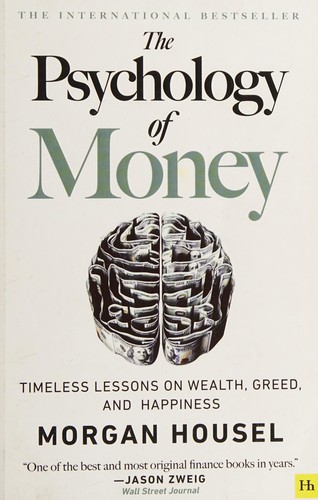
The Essential Question
What is money doing inside your head?
Most financial education begins outside the person. It starts with interest rates, asset classes, tax rules, valuation, and the arithmetic of compounding. All useful. None of it explains why a capable person buys at the top, sells at the bottom, increases risk after a lucky streak, or keeps moving the finish line after already winning.
Morgan Housel begins at the right level. Money is a technical system operated by an emotional animal. The system can be learned in a semester. The animal takes a lifetime.
The Psychology of Money matters because it moves the center of gravity from financial intelligence to financial behavior. That sounds simple. It is actually a demolition charge under much of the wealth industry, which earns its keep by making the simple look technical and the uncertain look controllable.
The central Oikos reading is sharper still: money is applied self-knowledge. Every allocation reveals a hierarchy of values. Every debt reveals a claim on future labor. Every reserve reveals how much uncertainty you are willing to respect. Every status purchase reveals an audience. The balance sheet is never just numbers. It is a map of desire, fear, time, and identity.
The decisive financial skill is building a life and a portfolio you can continue to inhabit when the emotional weather changes.
The Core Framework
Housel's essays circle a single mechanism: financial outcomes emerge from the interaction of behavior, uncertainty, and time. Intelligence helps. Information helps. Neither can compound if the operator cannot remain in the game.
The behavioral compounding loop
Perception
You do not see money cleanly. You see it through the era that formed you, the losses that marked you, the people around you, and the story you tell about what wealth means.
Comparison
Your private plan meets someone else's visible result. Their outcome becomes a false benchmark even when their goals, risks, time horizon, and hidden support are completely different.
Emotion
Envy, fear, pride, urgency, and the need to feel certain convert a financial question into an identity question. Once identity is threatened, position sizing becomes personal.
Action
You spend, save, borrow, hold, or sell. The decision may be perfectly defensible in a spreadsheet while remaining impossible for you to live with.
Compounding
Time magnifies the action. Good behavior gains duration. Bad behavior gains consequence. The loop then becomes part of your memory and alters the next round of perception.
This is why the book is more useful as a mirror than as a manual. Its value lies in giving the reader language for the forces that quietly break good rules.
Behavior Over Intelligence
In most skilled fields, superior knowledge creates a fairly direct advantage. A trained surgeon should outperform an amateur. Money is stranger. A person with modest knowledge and durable habits can build wealth while a brilliant professional destroys it through concentration, ego, illiquidity, or debt.
The difference is that finance has a long feedback loop and a huge emotional surface. Bad decisions can look brilliant for years. Good decisions can look foolish for just as long. Luck can promote fragile behavior before risk finally collects the bill.
Intelligence often makes this worse. A fast mind can manufacture a sophisticated defense for whatever the nervous system already wants. It can turn greed into a thesis, impatience into opportunity cost, and reckless concentration into conviction. The story improves. The exposure remains.
Behavior over intelligence still requires knowledge, placed inside a structure that survives contact with the person using it. The strongest plan is the one you can actually hold through boredom, embarrassment, volatility, and the success of people taking more risk than you.
This joins directly with Trading Psychology 101. A market does not need to defeat your analysis if it can provoke you into abandoning it. The operator is part of the system.
Your history is hiding inside your risk tolerance
People formed by inflation, depression, housing booms, bank failures, bull markets, or stable employment do not encounter the same financial world. They can study the same data and reach different conclusions because each carries a private sample of reality.
This matters at the family level too. One person experiences cash as dead weight. Another experiences it as sleep. One sees debt as a tool. Another feels the memory of a household held hostage by it. Calling either person irrational misses the formation underneath the decision.
Self-knowledge begins by separating a genuine principle from a wound wearing the clothes of a principle. Some caution is wisdom. Some caution is old fear asking to run the portfolio. Some risk appetite is earned competence. Some is a bull market talking through you.
Tail-Driven Outcomes
Many financial results are governed by a small number of extreme events. A handful of investments can account for most of a portfolio's lifetime gains. A few decisions can shape an entire career. One uncontrolled loss can erase years of otherwise sound work.
This creates a brutal mismatch between lived experience and statistical reality. Daily life feels continuous. Outcomes are often discontinuous. We spend years making ordinary decisions, then discover that a few moments carried most of the weight.
Tail-driven outcomes change where skill belongs. The first skill is exposure: you need enough participation to encounter positive tails. The second is sizing: no single negative tail should be allowed to end the process. The third is patience: ordinary periods are the admission price for rare outcomes. The fourth is discernment: a tail event can validate a process, but it can also disguise stupidity with profit.
Positive tails
A few exceptional assets, relationships, products, or decisions create more value than the many ordinary ones. Participation matters because absence has infinite opportunity cost when the rare winner appears.
Negative tails
Ruin and loss are asymmetrical. A 20 percent drawdown can be recovered. Insolvency, forced liquidation, permanent reputational damage, and loss of freedom change the game itself.
The practical answer is a barbell of openness and restraint. Maintain exposure to asymmetric upside while refusing exposures that can force an exit. This is the behavioral foundation beneath Risk Management for Macro Investors and the allocation logic in Portfolio Construction and Allocation.
The Cost of Envy
Envy is expensive because it changes the game after the game has started.
You can build a sound life around a chosen definition of enough. Then someone younger sells a company, a neighbor buys the thing, an anonymous account posts a return, and your private definition is replaced by their public score. The original plan did not fail. Comparison made it feel like failure.
The trap is deeper than wanting more. You usually see the part of another life designed to be seen. You do not see the concentration risk, the debt, the family cost, the fear of losing status, the years of apparent failure, or the lucky break that cannot be reproduced. Envy makes you copy a result without inheriting the full price paid for it.
There is also no natural finish line. The comparison set rises with income. The person who wanted security begins wanting recognition. Recognition becomes access. Access becomes rank. Every level contains someone with more. A game without a stopping rule will consume every victory offered to it.
Enough is a strategic boundary. It protects what has already been won from a desire that cannot be satisfied, giving ambition a clear list of things it is not allowed to sacrifice.
Envy is the moment another person's visible outcome gains authority over your invisible purpose.
Room for Error
A forecast asks what will probably happen. Room for error asks what happens if it does not.
This is the dividing line between prediction and stewardship. The future does not owe us the average. It arrives as sequence, and sequence matters. Two people can earn the same long-term return while only one survives to receive it because the other meets a bad year while overextended.
Room for error appears wasteful during calm periods. Cash drags. Insurance costs money. Diversification dilutes the winner. Conservative debt limits slow expansion. Extra time in a project schedule looks timid. Then reality moves outside the forecast and the supposed inefficiency becomes the asset that keeps choice alive.
A margin of safety should protect more than the balance sheet. You need psychological room for error. A portfolio can be mathematically survivable and emotionally intolerable. You need temporal room for error so a sound thesis is not destroyed by a deadline. You need relational room for error so a financial setback does not turn the household into collateral.
Real resilience is layered:
- Liquidity buys time before a decision becomes forced.
- Position limits stop one belief from becoming a verdict on the whole future.
- Low fixed obligations preserve mobility when income or conditions change.
- Multiple paths prevent one forecast from carrying the entire burden.
- Humility keeps new evidence from becoming an insult.
The Hermetic undertone is correspondence: the same reserve that protects a portfolio protects a business, a body, a calendar, and a household. Space is uncommitted capacity.
Freedom as the Highest Dividend
The visible rewards of money attract the most attention because visibility is their purpose. The deepest dividend is mostly invisible: control over time.
Freedom means the ability to decline the wrong work, leave a corrosive arrangement, stay home when family needs you, wait for a better opportunity, or think without the clock converting every hour into a bill. It is the right to decide what a day is for.
This reframes wealth. Net worth is only a rough measure. A person with substantial assets and massive obligations may have less freedom than someone with modest assets, low needs, and control of the calendar. Income can rise while sovereignty falls. The balance sheet grows, the cage gets nicer, and the owner has no room to move.
Permanent idleness is a poor definition of freedom. Purpose matters. Work can be sacred. The distinction is consent. Work chosen from strength has a different texture than work performed because one missed payment can collapse the structure.
Capital is stored optionality. Spend it deliberately. Every permanent increase in lifestyle converts a piece of future choice into a present obligation. Every reserve converts present restraint into future negotiating power. Saving purchases unclaimed time.
Reasonable Over Rational
Pure rationality imagines an operator without a body, a family, a memory, or a need to sleep. Such an operator can hold the optimal portfolio through any drawdown because the expected value remains positive. No such person has ever opened a brokerage statement.
A reasonable plan includes the human. It may hold more cash than a model recommends because cash prevents panic. It may pay down low-cost debt because the emotional freedom improves every other decision. It may diversify away from a concentrated position even when the tax cost is unattractive. It may accept a lower expected return in exchange for a much higher probability of staying with the plan.
Reasonable decisions engineer for actual conditions without indulging every fear. A bridge earns trust by accounting for the weather, traffic, maintenance, and materials it will actually face.
The test is simple: Can this decision survive both the spreadsheet and the nervous system? If it cannot survive the math, it is fantasy. If it cannot survive the person, it is theater.
What Marc Actually Uses
The Oikos application is a personal financial constitution. It converts the book's behavioral observations into rules set during calm conditions, before envy, fear, or euphoria asks for an exception.
Define enough
Name the conditions that already count as winning. Set the things no additional return is allowed to endanger: family, health, integrity, solvency, and control of time.
Protect the floor
Keep reserves, control fixed obligations, and size risk so a wrong thesis remains information instead of becoming ruin.
Permit the tails
Maintain enough diversified participation to benefit from rare winners. Let asymmetry work without demanding that every position prove intelligence.
Remove the audience
Before a large decision, ask whether it still makes sense if nobody can see it. Status loses much of its power when denied a witness.
Price the time
Evaluate spending and earning by their effect on future choice. A higher return that consumes sovereignty may be a bad trade.
Write the reason
Record why a position exists, what would disprove it, and how much loss was accepted in advance. Memory becomes political once money moves.
The Book's Real Mechanism
The book appears to be a collection of stories about luck, compounding, wealth, saving, pessimism, and risk. Underneath them is one operating instruction: arrange your financial life so that ordinary human weakness does not get a veto over long-term compounding.
That arrangement has three parts. First, reduce the number of moments in which perfect behavior is required. Excess debt, no liquidity, concentrated exposure, and an inflated lifestyle create such moments. Second, make time an ally. A good process needs duration more than drama. Third, measure success by independence rather than display. This removes the most corrosive external scoreboard.
The mechanism is architectural. Willpower is a weak defense against a structure that repeatedly provokes fear and comparison. Change the structure. Lower the obligations. Automate the ordinary. Precommit the risk limits. Keep a reserve. Choose a horizon your temperament can inhabit. Stop asking discipline to rescue a design that keeps manufacturing emergencies.
Where It Is Wrong or Dated
Housel's lens is powerful because it is personal. That is also its limit. Behavior does not operate on a level field. Housing access, healthcare costs, inherited capital, tax structure, labor power, discrimination, geography, and plain bad luck shape which choices are available. A lesson about patience can become insulting when applied to someone whose entire margin is being consumed by structural pressure.
The book also makes durable principles feel universally portable, even though context still governs. Cash means something different to a founder with volatile income than to a tenured employee. Concentration can be reckless in a retirement account and unavoidable in a young operating company. Paying off cheap debt may be emotionally clean while remaining a poor allocation under some conditions.
Its storytelling is both strength and hazard. Memorable examples teach better than equations, but a clean story can hide selection effects. Survivors are available for interviews. Failed versions of the same behavior often disappear. The reader must not turn an anecdote about endurance into a claim that endurance guarantees reward.
Finally, reasonable over rational can be abused. People are excellent at calling a comforting choice reasonable. The correction is evidence. A reasonable decision must name the human constraint it serves and the cost accepted for serving it. Otherwise the phrase becomes a soft blanket thrown over avoidance.
These are boundaries, not dismissals. The book remains unusually valuable because it teaches the reader to respect uncertainty without surrendering agency.
The Oikos Lineage
This is the first study in a twelve-book wealth sequence. Its role is foundational. Before technique comes the operator.
- Behavioral finance: Morgan Housel and Richard Thaler show how the mind distorts financial judgment.
- Market practitioners: Jack Schwager's three Market Wizards volumes, Charlie Munger, and George Soros test ideas against consequence.
- The mechanical floor: George Clason supplies the plain arithmetic of keeping part of what you earn.
- New Thought: Wallace Wattles, Napoleon Hill, and Charles Haanel examine mind as a causal force in material life.
- The hinge: Soros turns the relation between mind and markets into reflexivity, where perception changes behavior and behavior changes the reality being perceived.
Housel belongs at the entrance because every later framework can be corrupted by the person holding it. Mentalism without self-suspicion becomes magical thinking. Market skill without humility becomes leverage. Saving without a purpose becomes fear with a balance. Wealth begins inside, but it is proven by conduct.
Related Studies
Trading Psychology 101
How fear, loss aversion, FOMO, and identity interfere with execution inside live markets.
Risk Management for Macro Investors
The position sizing and survival discipline that turns room for error into a working system.
Portfolio Construction and Allocation
Building a portfolio whose parts serve different jobs across changing conditions.
The Systematic Investor
Using explicit rules and regime awareness to reduce the cost of emotional improvisation.
Liquidity Cycles
Why the financial weather changes, and why personal experience must not be mistaken for permanent law.
Maps of Meaning
A companion study on the stories and value structures that organize perception before conscious analysis.
The Bottom Line
The Psychology of Money earns its place because it refuses the fantasy that wealth is merely a knowledge problem. The decisive terrain is behavioral: what you do when the plan becomes boring, when someone else gets rich faster, when the market humiliates certainty, and when more begins asking you to risk what already matters.
Its deepest lesson concerns the relationship with money that protects time, preserves choice, and leaves the operator intact.
Make the plan reasonable. Leave room. Know your enough. Stay in the game.
Sources and Further Reading
This is an original interpretation, not a chapter summary. It contains no purported quotations from the book. The source spine is Morgan Housel's The Psychology of Money (2020), his original essay The Psychology of Money, and his publication note describing the book's purpose.