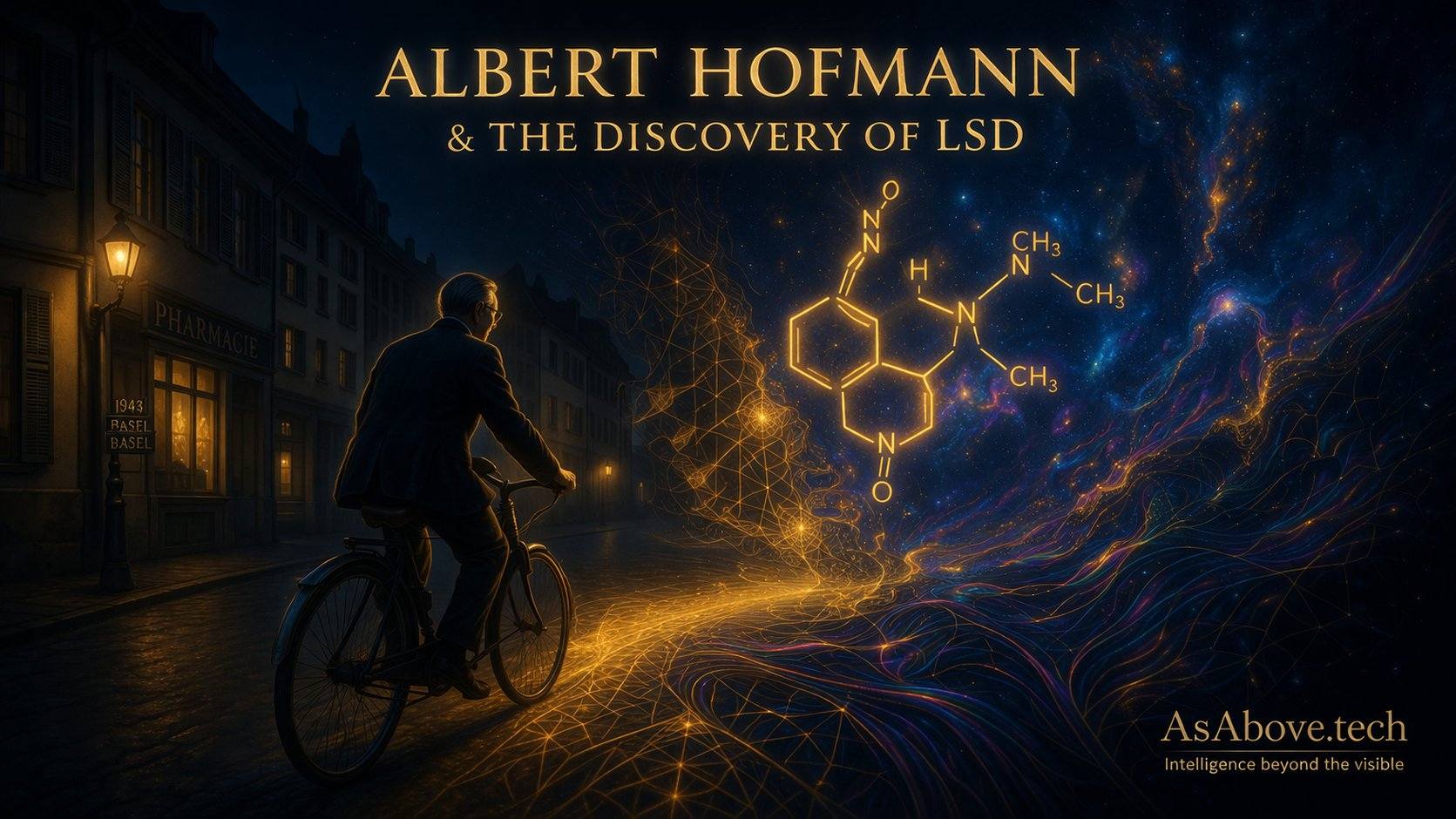
In the spring of 1943, the world was at war. Allied forces were fighting in North Africa. The Battle of Stalingrad had just ended with Germany's first major defeat. In the neutral quiet of Basel, Switzerland, a thirty-seven-year-old chemist named Albert Hofmann was working on something far removed from the carnage consuming Europe.
He was studying ergot.
Ergot is a fungus ... Claviceps purpurea ... that grows on rye and other grains. For centuries, it had been a source of both terror and medicine. Contaminated grain caused "St. Anthony's Fire," a horrifying condition that produced convulsions, hallucinations, and gangrene so severe that limbs would blacken and fall off. Yet midwives had long used controlled doses to induce labor and stop postpartum bleeding.
Hofmann worked for Sandoz Laboratories in Basel, where he had been assigned to investigate ergot alkaloids ... the active compounds in the fungus ... for potential pharmaceutical applications. It was careful, methodical work, far from glamorous. He synthesized derivative after derivative, testing each for biological activity, searching for compounds that might be useful in medicine.
On November 16, 1938, he synthesized the twenty-fifth compound in a series of lysergic acid derivatives. He called it LSD-25 ... Lysergsäure-diethylamid, number 25 in his sequence.
Initial animal tests showed nothing particularly interesting. LSD-25 made the test animals restless, but it didn't have the circulatory or uterine effects Sandoz was looking for. The compound was shelved, deemed unworthy of further study.
For five years, LSD-25 sat in Hofmann's files, forgotten. Then something happened that he would later describe as "a peculiar presentiment."
I. The First Accident
As Hofmann worked with the crystalline substance that afternoon, something happened. Despite his careful laboratory technique, despite the precautions he always took, a tiny amount of LSD-25 must have been absorbed through his fingertips or inhaled as microscopic dust.
He began to feel strange.
What had happened? Hofmann was meticulous about laboratory safety. He hadn't ingested anything intentionally. The only explanation was accidental absorption ... but of what? He had been working with multiple compounds. Could LSD-25 really be the culprit?
There was only one way to find out.
II. The Deliberate Experiment
Three days later, on April 19, 1943, Hofmann prepared what he believed would be a cautiously small dose of LSD-25: 250 micrograms, dissolved in water. By the standards of any other drug, this was infinitesimal ... a quarter of a milligram, barely visible as a speck of dust.
It was, in fact, a massive dose ... roughly two to three times what would later be considered a full psychedelic experience. Hofmann had no way of knowing this. No psychedelic compounds with such extraordinary potency had ever been discovered. He was navigating completely uncharted territory.
At 4:20 PM, Hofmann drank the solution and noted the time in his laboratory journal.
Hofmann ingests 250 micrograms of LSD-25 dissolved in water.
"Beginning dizziness, feeling of anxiety, visual distortions, symptoms of paralysis, desire to laugh."
Hofmann asks his laboratory assistant to escort him home. Wartime restrictions prohibit automobiles; they must travel by bicycle.
The four-mile journey becomes history's most famous bicycle trip ... though Hofmann later had no memory of it.
The Bicycle Ride
The bicycle ride from Sandoz Laboratories to Hofmann's home in Basel has become legendary ... celebrated every year on April 19th as "Bicycle Day" by psychedelic enthusiasts around the world. But for Hofmann, it was no celebration. It was terror.
He later wrote that the ride seemed to take forever, that he felt as though he were not moving at all despite pedaling with all his strength. His field of vision swirled and distorted. His assistant, riding alongside him, appeared as a malevolent demon. The familiar streets of Basel transformed into something alien and threatening.
When he finally arrived home, Hofmann was in full crisis. He asked his assistant to call a doctor and fetch milk from the neighbor ... milk being traditionally believed to counteract poisoning. He collapsed onto a sofa, convinced he was dying.
The Dark Night
What followed was an experience that Hofmann would later describe as both the most terrifying and the most beautiful of his life. The terror came first.
He felt possessed by a demon. The familiar furnishings of his home transformed into grotesque, threatening forms. His neighbor, the kindly woman who brought the milk, appeared as a malevolent witch. He was certain that he had poisoned himself, that his mind was permanently damaged, that he would die or go insane.
The doctor arrived and found nothing physically wrong ... pulse normal, pupils dilated but responsive, no sign of poisoning. He could only watch and wait.
Then, gradually, the terror began to lift. As Hofmann closed his eyes, the threatening visions transformed. Colors exploded behind his eyelids in kaleidoscopic patterns of unimaginable beauty. Sounds became visible, synesthetically merging with the visual display. Fear gave way to wonder.
The Dawn
Hofmann experienced what he would later call a "sensation of well-being and renewed life." The breakfast his wife prepared tasted extraordinary. The garden glowed with inner light. He felt profoundly grateful to be alive, to have passed through the darkness and emerged into this renewed world.
He had survived. He had not gone insane. And he had discovered something that would reshape human history.
III. The Man Behind the Molecule
Who was Albert Hofmann? The discovery of LSD was not an accident ... not really. It emerged from a particular sensibility, a particular way of engaging with the natural world, that had defined Hofmann since childhood.
The Mystical Child
Albert Hofmann was born on January 11, 1906, in Baden, Switzerland, the eldest of four children. His father was a toolmaker, and the family was not wealthy. But young Albert had access to something more valuable than money: the natural world.
As a child, he had spontaneous mystical experiences while walking in the forests and meadows around Baden. He would suddenly perceive the world as radiant with meaning, alive with an inner light that ordinary perception couldn't see. These experiences ... unbidden, unexpected, overwhelming in their beauty ... planted a seed that would later flower in his scientific work.
He became a chemist not despite these mystical experiences but because of them. He wanted to understand the relationship between matter and consciousness, between the physical substances of the world and the inner experiences they could evoke. Natural products chemistry ... the study of compounds produced by plants, fungi, and animals ... seemed to offer a bridge between the two realms.
The Scientist as Seeker
Hofmann studied chemistry at the University of Zurich, completing his doctorate in 1929 with research on the chemical structure of chitin, the substance that forms the shells of insects and crustaceans. He joined Sandoz Laboratories the same year, beginning a career that would span decades.
His assignment to ergot alkaloid research was fortuitous. Ergot occupied a fascinating position at the intersection of medicine and madness. The same compounds that could save a woman from bleeding to death in childbirth could also drive entire villages insane when they contaminated the grain supply. There was something here that touched on the deepest mysteries of the mind.
Years later, Hofmann would identify this as the key to his discovery: he was not merely a technician synthesizing compounds. He was a seeker, drawn to substances that could alter consciousness, guided by intuitions that transcended purely rational analysis. The "peculiar presentiment" that led him back to LSD-25 was not irrational ... it was a different kind of rationality, one that his mystical experiences had taught him to trust.
IV. The Aftermath
Sandoz and LSD
When Hofmann reported his experiences to his superiors at Sandoz, they were understandably skeptical. A compound active at 250 micrograms? It seemed impossible. But Hofmann's careful documentation and professional reputation convinced them to investigate further.
In the following months, other Sandoz researchers confirmed Hofmann's findings. LSD-25 was indeed active at microgram doses ... making it the most potent psychoactive substance ever discovered. A single gram could produce effects in thousands of people.
Sandoz saw potential. In 1947, they began distributing LSD to researchers under the trade name Delysid, suggesting it might be useful in psychotherapy and psychiatric research. The accompanying literature noted that psychiatrists could take the drug themselves to gain "insight into the world of ideas and sensations of mental patients."
Delysid (Sandoz, 1947)
Suggested Uses:
• Analytical psychotherapy, to facilitate emotional release
• Experimental studies of psychosis
• Self-experimentation by psychiatrists to understand patient experiences
Dosage: 25-100 micrograms orally
Note: "The mental effects of Delysid are of temporary duration and can be interrupted at any time by the intramuscular injection of 50 mg. chlorpromazine."
For the next two decades, LSD was legal and widely studied. Thousands of papers were published. Tens of thousands of patients received LSD-assisted psychotherapy. The results were often remarkable ... particularly in the treatment of alcoholism, where LSD therapy showed success rates that conventional approaches couldn't match.
Albert Hofmann watched all of this with a mixture of pride and concern. He had created something powerful ... but was humanity ready to use it wisely?
The Problem Child
Hofmann called LSD his "problem child" (Sorgenkind in German). Like any parent, he felt responsible for what his creation did in the world ... and increasingly, it was doing things that alarmed him.
In the 1950s, the CIA began experimenting with LSD as a potential tool for interrogation and mind control. Project MKUltra administered the drug to unwitting subjects, sometimes with devastating consequences. This was a betrayal of everything Hofmann believed about the substance ... a desecration of its potential for healing and insight.
Then came the 1960s. Timothy Leary popularized LSD as a tool for personal transformation, urging young people to "turn on, tune in, drop out." The counterculture embraced it as a sacrament. Use spread far beyond medical or scientific contexts, often without any of the careful preparation and guidance that Hofmann believed essential.
In 1966, Sandoz stopped distributing LSD. In 1967, it was made illegal in the United States. Research ground to a halt. The problem child had become a controlled substance, its therapeutic potential frozen in legal amber.
V. The Philosopher
The prohibition of LSD might have ended the story, but Hofmann lived for another four decades, spending his long retirement thinking and writing about what he had discovered. He became, in his final years, something of a philosopher ... synthesizing his scientific knowledge with his mystical sensibility to articulate a vision of reality that transcended both.
The Great Mystery
Hofmann believed that LSD offered a chemical key to the same experiences that mystics had described throughout human history. The visions, the sense of unity with all things, the dissolution of the boundary between self and world ... these were not hallucinations but glimpses of a deeper reality that ordinary consciousness kept hidden.
He worried about the direction of modern civilization ... its disconnection from nature, its worship of technology, its spiritual emptiness. LSD, properly used, might help to heal this rift. It could reconnect human beings with the living world, restore the sense of wonder that mechanistic science had stripped away.
But "properly used" was the key. Hofmann never advocated recreational use of LSD. He believed it required preparation, guidance, and integration ... the elements that indigenous cultures had developed over millennia for their own plant medicines. Without these containers, LSD could be dangerous, even destructive.
The Century Completed
Albert Hofmann lived to be 102 years old. He died on April 29, 2008 ... just ten days after the 65th anniversary of Bicycle Day. He remained mentally sharp until near the end, still giving interviews, still advocating for the responsible study of psychedelics.
In his final years, he witnessed the beginning of the psychedelic renaissance. New research was being approved. Studies at Johns Hopkins and other institutions were showing the therapeutic potential he had always believed in. The problem child was finally being taken seriously again.
VI. The Legacy
What are we to make of Albert Hofmann and his discovery? He was neither a counterculture hero nor a reckless scientist who unleashed a dangerous drug on the world. He was something more complex: a careful researcher guided by mystical intuitions, a rational scientist who believed in realities beyond the rational, a father who watched his child grow into something he could neither fully control nor fully understand.
The Gift
LSD has touched millions of lives. For some, it was merely a recreational experience ... a few hours of visual distortions and euphoria. For others, it was something far more significant: a catalyst for psychological healing, a doorway to mystical states, a tool for creative insight, a means of confronting mortality, addiction, or depression.
The clinical research that Hofmann pioneered, suppressed for decades, is now flourishing again. Studies are showing what early researchers suspected: psychedelics can produce lasting positive changes in mental health, can help the terminally ill face death with equanimity, can treat addictions that resist all other interventions. The problem child is becoming a healer.
The Warning
But Hofmann's concerns remain relevant. LSD is not a toy. It is not a party drug. It is a powerful tool that can produce experiences ranging from the beatific to the terrifying. Without proper preparation, without a supportive environment, without experienced guidance, those experiences can be damaging rather than healing.
Hofmann always emphasized that LSD was not inherently good or bad ... it was an amplifier, a revealer, a catalyst. What it revealed depended on who took it, and how, and why. In the right hands, it could facilitate profound insight and healing. In the wrong hands, it could precipitate crisis and confusion.
The Question
The question Hofmann grappled with throughout his life remains unanswered: Can our civilization use this tool wisely? Can we develop the containers ... the rituals, the guidelines, the wisdom traditions ... that would allow LSD and other psychedelics to fulfill their potential while minimizing their risks?
The psychedelic renaissance of the 2020s is, in a sense, an attempt to answer this question. Clinical trials, therapeutic protocols, trained facilitators, careful screening ... these are the modern equivalents of the ceremonial containers that indigenous cultures developed over millennia. Whether they will be sufficient, whether they will be widely adopted, whether psychedelics will be integrated into mainstream medicine and culture or remain a contested frontier ... these questions are still being decided.
VII. Bicycle Day
Every April 19th, people around the world celebrate Bicycle Day. They commemorate the afternoon when a Swiss chemist rode his bicycle home from work and experienced something that would change human history.
It's a strange holiday ... celebrating what was, in the moment, a terrifying experience. Hofmann thought he was dying. He was convinced his mind had been destroyed. The bicycle ride that we now celebrate was, for him, a nightmare journey through a distorted world.
But that's precisely the point. The darkness was not the end of the story. Hofmann passed through terror and emerged into beauty. He confronted what seemed like death and found renewal. The bicycle ride that began in fear ended in wonder.
In a way, that journey ... from fear through dissolution to renewal ... is the archetypal psychedelic experience. It's what LSD makes possible: the encounter with parts of ourselves we've kept hidden, the dissolution of the rigid structures that constrain our perception, the emergence into a world that seems newly created, washed clean, radiant with meaning.
Albert Hofmann took that journey first. He recorded it carefully, in the language of science. He spent the rest of his long life trying to understand what it meant and how it might serve humanity. He watched his discovery be embraced and abused, celebrated and prohibited. He never stopped believing in its potential.
And every April 19th, we remember. A chemist in Basel. A bicycle ride home. The birth of a problem child that might yet help to heal the world.