Core Truth
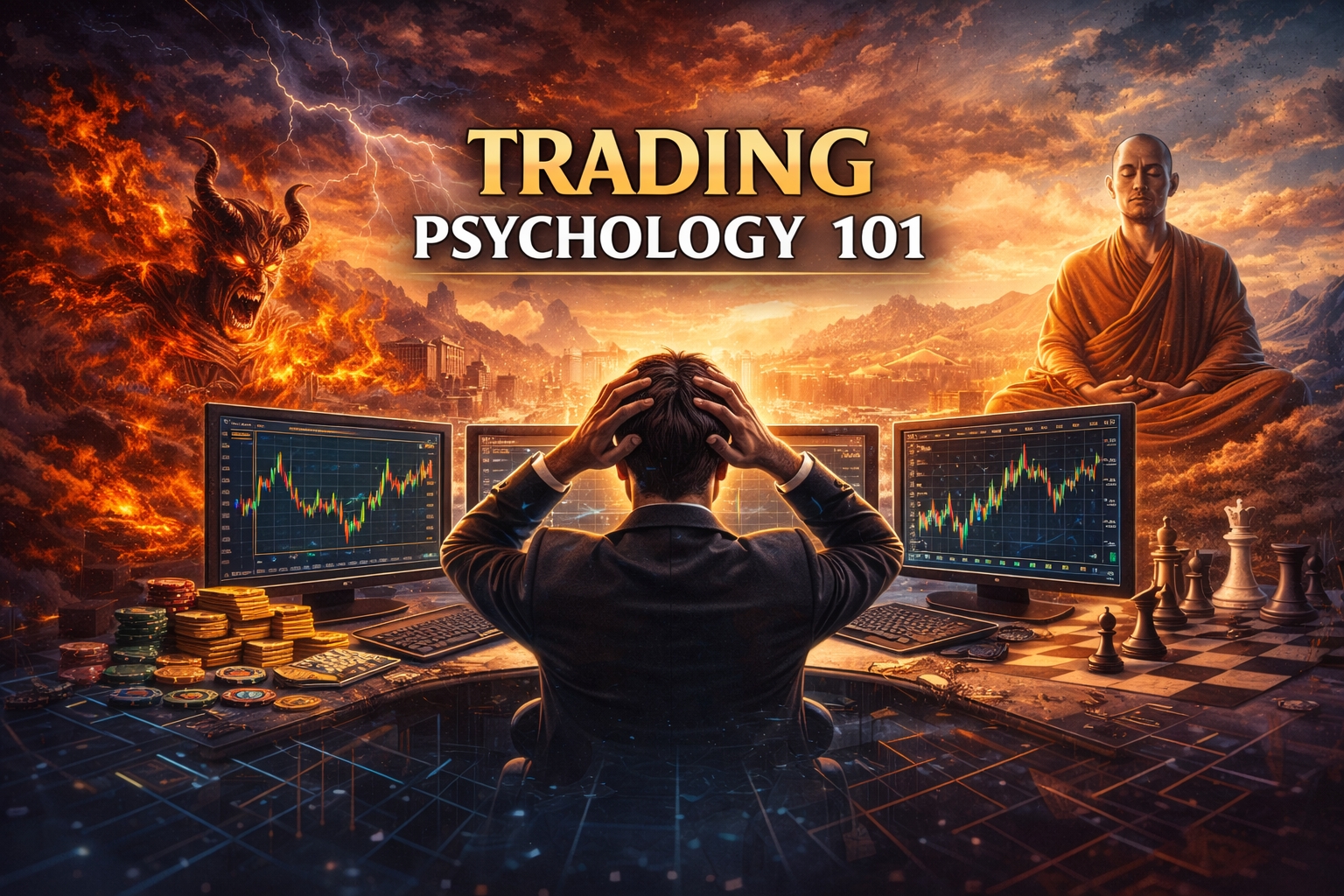
The market is a device for transferring money from the impatient to the patient, from the emotional to the rational. Your edge isn't information...it's emotional regulation.
Why Psychology Matters More Than Strategy
Here's an uncomfortable truth: most traders have winning strategies that they execute poorly. They buy the right assets, at roughly the right times, with reasonable position sizes...and still lose money.
How? They panic sell at bottoms. They FOMO buy at tops. They hold losers too long and sell winners too early. They revenge trade after losses. They size up when they should size down.
The strategy was fine. The execution was sabotaged by psychology.
"The investor's chief problem...and even his worst enemy...is likely to be himself."
... Benjamin Graham
This article is the foundation. We'll cover the major cognitive biases that destroy portfolios, why they exist, and practical techniques to counteract them. Master this, and your strategy...whatever it is...becomes dramatically more effective.
The Evolutionary Mismatch
Your brain evolved for a very different environment than financial markets. For hundreds of thousands of years, our ancestors faced immediate physical threats: predators, rival tribes, starvation. The brain developed rapid-fire emotional responses to survive these threats.
Problem: Markets don't work like the savanna.
- On the savanna, running from a rustling bush (even if it's just wind) has low cost and high potential benefit. In markets, panic selling has massive cost.
- On the savanna, following the herd usually meant safety. In markets, following the herd usually means buying tops and selling bottoms.
- On the savanna, immediate threats required immediate action. In markets, the best action is often no action.
Your emotional responses were optimized for physical survival, not financial decision-making. Understanding this mismatch is the first step to overcoming it.
The Seven Deadly Biases
These are the cognitive biases that cause the most damage in trading and investing. Each one is a pattern of thinking that made sense in our ancestral environment but destroys wealth in markets.
1. Loss Aversion
What it is: Losses hurt approximately twice as much as equivalent gains feel good. A $1,000 loss creates more emotional pain than a $1,000 gain creates pleasure.
How it hurts you: You hold losing positions too long, hoping to avoid "locking in" the loss. You sell winning positions too early to "lock in" the gain. You avoid necessary risks.
2. FOMO (Fear of Missing Out)
What it is: The anxiety that others are profiting from an opportunity you're missing. Intensifies as prices rise and social media fills with gains.
How it hurts you: You buy at tops, after the easy money has been made. You increase position sizes when you should be cautious. You abandon your strategy to chase momentum.
3. Confirmation Bias
What it is: The tendency to seek, interpret, and remember information that confirms your existing beliefs while ignoring contradictory evidence.
How it hurts you: You only follow analysts who agree with your positions. You rationalize red flags. You build conviction when you should be questioning.
4. Recency Bias
What it is: Overweighting recent events and underweighting historical patterns. What happened last week feels more important than what happened over decades.
How it hurts you: You extrapolate recent trends indefinitely. Bull markets make you overconfident; bear markets make you overly fearful. You forget that cycles exist.
5. Anchoring
What it is: Fixating on a reference point (often your purchase price) even when it's no longer relevant to the investment decision.
How it hurts you: You refuse to sell a stock below your purchase price even if fundamentals have changed. You think an asset is "cheap" because it was higher before, regardless of current value.
6. Overconfidence
What it is: Overestimating your ability to predict outcomes, especially after a string of successes. Confusing luck with skill.
How it hurts you: You size positions too large. You stop doing research because you "just know." You take concentrated bets that can blow up your portfolio.
7. Herd Mentality
What it is: The tendency to follow the crowd, assuming that many people can't be wrong. Social proof as a decision-making shortcut.
How it hurts you: You buy what everyone is talking about (usually late). You're afraid to hold positions that others are selling. You abandon contrarian thesis at exactly the wrong time.
The Emotional Cycle of Markets
Markets move through predictable emotional phases. Recognizing where you are in this cycle...and what emotions are appropriate versus dangerous...is a meta-skill that compounds over time.
The Cycle
- Optimism → "This looks promising" (good entry point)
- Excitement → "This is working!" (still reasonable)
- Thrill → "I'm a genius!" (danger zone begins)
- Euphoria → "I can't lose!" (maximum risk, worst time to buy)
- Anxiety → "Wait, what's happening?" (denial)
- Denial → "It'll come back" (holding losers)
- Fear → "Maybe I should sell some" (too late)
- Desperation → "I need to get out" (selling bottoms)
- Panic → "Sell everything!" (maximum pain, best time to buy)
- Capitulation → "I'm never doing this again" (missing the recovery)
- Despondency → "I should have..." (hindsight)
- Depression → "I can't even look at it" (apathy = bottom)
- Hope → "Maybe things are improving" (cycle restarts)
The insight: You want to buy during 9-12 (when it feels terrible) and reduce exposure during 3-4 (when it feels amazing). Your emotions tell you to do the opposite.
Practical Techniques
1. The Trading Journal
Keep a detailed log of every trade including:
- Your thesis (why you're entering)
- Your emotional state (1-10 scale of confidence, fear, excitement)
- What would prove you wrong
- Outcome and what you learned
Review monthly. Patterns will emerge. You'll discover which emotional states lead to your worst decisions.
2. Pre-Commitment Devices
Make decisions in calm states, then commit to them before emotional situations arise:
- Set stop losses before entering positions
- Define position sizes by formula, not feeling
- Create rules like "no trading within 24 hours of major news"
- Use limit orders instead of market orders
3. The 24-Hour Rule
Never make significant portfolio changes immediately. Write down what you want to do and why. Sleep on it. If it still makes sense tomorrow, execute. This single rule will prevent most emotional mistakes.
4. Position Sizing as Risk Management
Size positions so that even a 50% loss doesn't compromise your emotional stability or financial situation. If you're checking prices constantly, your position is too large.
5. Meditation and State Management
You can't think clearly when your nervous system is activated. Practices that calm the body directly improve decision quality:
- Deep breathing before making decisions
- Regular meditation practice
- Physical exercise (reduces cortisol)
- Adequate sleep (seriously, most bad decisions happen when tired)
The Meta-Skill: Knowing Yourself
Ultimately, trading psychology is self-knowledge applied to markets. The better you understand your own patterns...what triggers you, what biases you're most susceptible to, what emotional states lead to mistakes...the better you can design systems to protect yourself from yourself.
This is humbling work. It requires admitting that you're not as rational as you think, that your instincts are often wrong, that your emotions are features from a different era running on hardware that wasn't designed for this.
But it's also empowering. Because once you understand the game, you can play it. You can build systems. You can develop habits. You can, over time, become the kind of investor who buys when others panic and sells when others get greedy.
That's the edge. Not information. Not prediction. Emotional regulation in a world of emotional participants.
The Bottom Line
Your strategy is probably fine. Your psychology is probably the problem. Fix your mind, and your portfolio will follow.