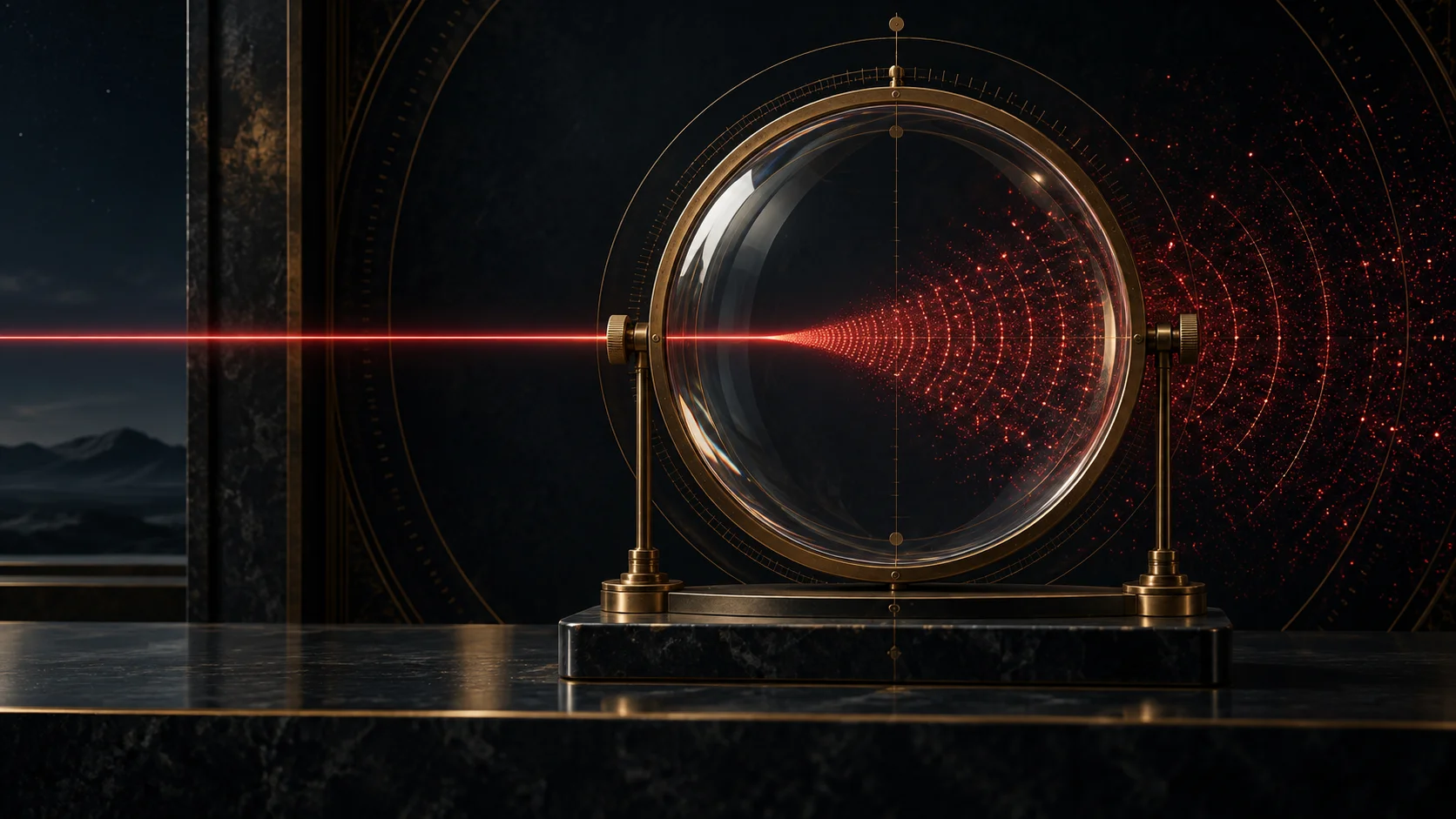
Architecture readout
- Phenomena: a 2020 observation became a 2025 pilot letter and a 2026 open registry
- Optics: speckle is structured before any compound
- Clinic: intravenous and vaporized DMT have entered early depression studies
- Control: IPI Letters is News and Views, not a blinded trial
- Counter-signal: nulls and strong expectancy effects are already in the public record
This desk has been writing the week the machine leaves the chat window. Joints. Verification layers. Walking off a commissioned line. The pressure is the same one: intelligence is being asked to act in matter, and the invoice has not caught the ceremony.
A parallel pressure has been running in another register. Not motors. Perception. Not a factory clip. A red line on a wall.
Since August 2020, Danny Goler has claimed that people in a DMT state can see stable geometric structures and rapidly moving, script-like characters in a diffracted 650 nm laser pattern. In January 2025 he published a pilot report of that protocol in IPI Letters. By mid-2026 the claim had a public registry, a Vice feature, a DoubleBlind field attempt, a Gallimore counter-essay, and a September 2026 transceiver-theoretic preprint that tries to give the glyphs a geometry.
Whether those forms originate outside the observer is unresolved. As Above's evidence grade is low, open, and worth working. That is the correct starting position.
Separate the registers. Historical: what was published, dated, and can be retrieved. Traditional: what the originator and the subculture claim about themselves. Interpretive: what the pattern means for consciousness technology. Operational: what a principal should refuse to treat as settled.
What actually happened
The observation is older than the paper. Goler dates the first laser session to a Thai restaurant in Boulder in August 2020. He later named the effort Project Veilbreak / Code of Reality and collected session reports. Vice put the claim on a mainstream page in January 2025: "proof that we live in a simulation," katakana-esque characters, and a conviction he would not walk back.
The written instrument arrived on 8 January 2025: Danny Goler, "Detailing a Pilot Study: The 'Code of Reality' Protocol," IPI Letters 3(1): N1–N5, DOI 10.59973/ipil.158. The venue section is News and Views. The abstract reports "consistent descriptions of coherent geometric structures and symbols resembling code." The PDF text asserts participants (n > 1000) reported katakana-like characters in the diffraction lines, stable geometric structures independent of the observer's frame, and persistent visibility at lower subsequent doses.
That n is a claim, not a registered dataset. IPI Letters is not Nature. There is no preregistration, no blinding, no control arm, no published inter-rater protocol in that letter. Treat the letter as a dated protocol note with a large unregistered n. Do not treat it as a trial.
A second, more careful surface opened in 2026. dmtcode.com reframes the question downward. It does not ask whether reality is a simulation. It asks whether independent people keep drawing the same discrete forms. The live registry on September 14, 2026 listed 52 community symbols, 32 registry glyphs, and seven recognition clicks. The project defines recognition after catalogue exposure as something other than an independent match. Its open dataset snapshot (v4.1, August 2026) also withdrew earlier promotional statistics. The live ledger is the record to use.
Null reports are solicited. That matters because the denominator, not the most vivid drawing, determines whether the effect is general, conditional, or mostly expectancy.
The April 2026 tape
On 28 April 2026, Close Encounter Club published I Saw The Simulation: The DMT Code. Host Justin Gearhart recorded a volunteer named Josh with Goler present for preparation and a later debrief. The description leans on Donald Hoffman's interface theory of perception. Hoffman's actual 2026 collaboration with Gallimore concerns test designs for reported entities under extended-state DMT, not an endorsement of this laser protocol.
The tape adds phenomenology the 2025 letter did not itemize: a flood of red points Josh called pixels; apparent depth described as stacked planes; and named geometric forms. The shock line is on camera: "That can't be real, Justin." The debrief is ontological, not operational. Goler's most interesting sentence on that tape is comparative, not empirical: we already accept a physics render, so a computational render should not be a special insult.
The tape also adds a contamination event. The host says he found no one who tried the protocol and then denied the effect. DoubleBlind, Tipado, and Hamilton Morris are already in the public record as counterexamples. Goler coaching the volunteer is expectancy made flesh. An AI recreation of Josh's visuals, which the show advertises, is a further primer for anyone who watches before they look. Log the tape as dated testimony. Do not log it as a control.
What the beam is, before any molecule
A collimated red laser on a rough surface produces speckle: a physically real interference field of bright and dark grains. The grain size scales with wavelength. 650 nm is long enough that the grains are coarse. The field is already structured. It already has depth cues. It already fools a sober visual system into reading volume into a flat scatter.
Andrew Gallimore, who has spent a decade arguing that DMT worlds are not "just noise," published the most useful skeptical treatment of this specific claim: "On the DMT Laser Code of Reality Effect" (January 2025, with a later 2025 expansion). He does not call the observers liars. He calls the ontology impossible on its own terms. If the code is a real object that the laser illuminates the way a flashlight illuminates a bottle, reflected light cannot carry a structure that extends infinitely into an opaque wall. Light that bounced off the surface has no access to an interior z-axis. The experience of looking into the beam as if it were a volume is, on that account, a perceptual construction sitting on a real optical scaffold.
Three ordinary explanations are live and unrefuted:
- Speckle as scaffold. Coherent light writes a pointillist matrix onto the retina. DMT upweights pattern completion. The matrix becomes glyphs.
- Form constants. Klüver's tunnels, lattices, and honeycombs appear across migraine, flicker, and classic psychedelics. A laser interference field is an unusually clean driver for those constants.
- Cultural priming. The comparison class is The Matrix. Katakana-like falling script is the image people already have for "source code of reality." Most people who attempt the protocol have already seen drawings of what they are supposed to see.
Zeus Tipado, running DMT work at Maastricht, reported four personal nulls and put the variance on suggestion and individual differences in open-eye hallucination. Individual lock is not proof of a hidden operating system. It is evidence that observers vary.
A fourth explanation has appeared as a September 2026 Zenodo preprint by Kai Huang: DMT retunes a sampling period and phase-locks a projected field. The paper offers testable predictions involving neural rhythms, wavelength, and speckle grain size. Treat it as a hypothesis with a date, not as a result. Its fixed curvature value is a postulate imported from other work by the same author, not a quantity fitted to Goler's data. Internal mathematical consistency is not empirical validation.
The other clock: the clinic did not wait
While the laser discourse argued ontology, the molecule moved through ethics boards.
Helus Pharma's SPL026, an intravenous DMT candidate, met its Phase 2a primary endpoint in major depressive disorder in a 34-person randomized, placebo-controlled trial published in Nature Medicine on February 17, 2026. The mean MADRS difference versus placebo at two weeks was -7.35 points (P = 0.023); reported response was 35% versus 12%, and remission was 29% versus 12%. Open-label follow-up suggested persistence in some participants. This was an investigational trial, not an approval, and Helus says it is not advancing IV SPL026 in its current form.
A separate 14-person open-label vaporized-DMT study in treatment-resistant depression reported symptom improvement that warrants controlled replication. A 2025 Neuropsychopharmacology paper on connectome harmonics found DMT reshaping the harmonic repertoire in the same direction as psilocybin, LSD, and ketamine, with repertoire entropy tracking reported intensity. A 2026 preprint reported a double dissociation: a rate-of-change integration-complexity measure predicted intensity, while microstate spatial configuration predicted visual content type. The latter analysis did not generalize to psilocybin and requires independent replication.
5-MeO-DMT is on a faster commercial clock than N,N-DMT's laser culture. GH001 and BPL-003 programs have reported Phase 2b results in treatment-resistant depression. Those are different molecules, formulations, and development programs. They are not evidence for the Goler protocol.
Two further preclinical lines matter for Soma, not for simulation theory. A May 2026 Experimental Neurology paper reported anti-inflammatory and neuroprotective effects of DMT in a Parkinson's model. Preclinical findings do not establish clinical benefit in people.
Extended-state DMT, often called DMTx, is the instrument the ontology debate actually needs and has mostly not used. Gallimore and Strassman modeled target-controlled infusion in 2016. Imperial College later studied longer controlled states under institutional oversight. A 2026 Gallimore and Hoffman line proposes using that longer clock for sealed-information tests. That is the right class of experiment. It has not been run on the laser claim.
The counter-signal
Do not launder a News and Views protocol note into a discovery of the source code.
Do not treat "more than a thousand people saw it" as a statistic. Unregistered session counts are marketing. The open registry is far smaller, exposes its modest counts, and distinguishes recognition after exposure from independent matching.
Do not treat katakana resemblance as physics. Script-likeness is what a hyperactive form-recognition system does to a periodic point field. Hebrew, Sanskrit, and "alien glyph" reports sit in the same drawer. That drawer is the visual word form area under load, not a compiler.
Do not ignore legality as if it were a footnote. N,N-DMT remains Schedule I under federal U.S. law. Colorado provides limited state-law protections for certain personal conduct involving natural medicine by adults 21 and older, but that is not federal legalization or a public DMT service program. This desk will describe a published protocol as a document. It will not write a recipe. Never look directly into a laser beam.
Do not collapse DMT into one story. The laser subculture, the depression pipeline, the stroke hypothesis, and the DMTx research program share a molecule and almost no method. Mixing them produces mysticism with a DOI.
- 01 / ExperienceWhat did the observer report?
A vivid account belongs in the record. It does not establish what caused it.
- 02 / ComparisonDoes it survive independent checks?
Sealed records, blinded scoring and null reports can test recurring descriptions.
- 03 / InterpretationWhat does that let us conclude?
Even a recurring pattern would not, by itself, establish a hidden code of reality.
An editorial map of the argument, not a study result. The evidence needed for each step is different.
Architecture
The honest architecture has four layers.
1. Optical scaffold
Coherent light already writes a discrete field. Wavelength, grating, surface roughness, and viewing distance are parameters. They can be swept without any compound. If glyphs survive a sober, blinded speckle task at the same grain size, the molecule is not the author. If they vanish below a grain-size threshold, as Huang predicts, the author is still the field; only the lock is pharmacological.
2. Pharmacological gain
DMT is a short-acting serotonergic psychedelic whose effects can be extended experimentally with controlled infusion. Intensity and visual content may be partly dissociable in EEG measures, though the relevant 2026 analysis is a preprint requiring replication. That possibility is more important than any single drawing. It suggests the "code" may be a content channel, not a proof channel.
3. Narrative compiler
Simulation theory, The Matrix, machine elves, and "downloads" are the compiler the culture runs on the raw field. Compilers are not evidence. They are compression. AAC as a design thesis belongs here as a warning, not as a standard: do not let a local aesthetic of revelation become the measurement.
4. Institutional clock
The clinic will publish MADRS deltas on a quarterly cadence. The registry will publish drawings on an irregular one. Capital will fund the first clock. Consciousness research that wants the second clock to matter has to borrow the first clock's methods: preregistration, blinding, sealed records before catalogue exposure, nulls counted as data.
What would actually settle it
Four tests are cheap relative to the claim. None require believing Goler or believing Gallimore.
- Sealed drawing before catalogue exposure. The observer draws, timestamps, and locks the file before seeing the registry. An independent rater scores the result without names or condition labels.
- Optical comparison under institutional oversight. Vary wavelength and speckle grain size while holding the pharmacological condition constant. If topology is stable while resolution tracks grain size, the optical scaffold is doing measurable work.
- Blinded control arms. Compare coherent speckle, other structured light, and no projected pattern under sober and approved research conditions. Count nulls as data.
- Extended-state testing of sealed information. A claim about externally available information is different from a report of a compelling lattice. Test it with preregistration, blinded custody, and an ethics-approved research team.
Until those four exist in public, the correct sentence is the one the registry already uses: the question is open and worth working on. Low evidence grade. Not dishonest. Not settled.
So Below
The laser did not write the code. The visual system wrote a script onto a field that was already discrete. That is still a rare instrument. A seven-minute state that makes strangers reach for the same word, code, is a fact about the interface, not yet a fact about the machine underneath it.
The parallel fact is less cinematic and more expensive. The same molecule is in Phase 2 for depression, in preclinical work for nigrostriatal injury, and in an infusion protocol that can hold a world long enough to ask it a question. Those three programs will produce artifacts a capital desk can read: endpoints, adverse events, manufacturing slots. The laser program will produce drawings.
As Above does not need the drawings to be the source code of the universe. It needs them scored. Recurrence after sealed exposure is a measurement. Recurrence after a YouTube thumbnail is a chorus.
Next in this series: the clinic's clock, the DMTx instrument, and the capital stack that will decide which DMT story gets to act in matter. The glyphs can wait in the registry. The invoice will not.
Primary sources and further reading
- Goler D. Detailing a Pilot Study: The "Code of Reality" Protocol. IPI Letters 3(1): N1–N5. 8 January 2025. DOI 10.59973/ipil.158
- DMT Code project: experiment guide, evidence map, open dataset v4.1
- Gallimore A. On the DMT Laser "Code of Reality" Effect. January 2025
- Busby M. Wait, Are We In a Simulation? DoubleBlind, 17 April 2026
- Vice. The Man Who Can 'Prove' Life Is a Simulation. 28 January 2025
- Huang K. The "Code of Reality" Protocol: A Transceiver-Theoretic Hypothesis. 6 September 2026
- Davis AK et al. Survey of entity encounter experiences occasioned by inhaled N,N-DMT. Journal of Psychopharmacology, 2020
- Erritzoe et al. Single-dose SPL026 in major depressive disorder. Nature Medicine, 17 February 2026
- Falchi-Carvalho et al. Vaporized DMT in treatment-resistant depression. Neuropsychopharmacology, 2025
- N,N-dimethyltryptamine effects on connectome harmonics. Neuropsychopharmacology, 12 September 2025
- Emma Dobbin. Intensity and visual content dissociate in DMT. Zenodo preprint, 9 June 2026
- Luan LX. Subjective, physiological and EEG effects of extended DMT administration. Imperial College thesis, 2025
- Gallimore AR, Hoffman DD et al. Traces of the Other. 2026 preprint on reported entities and test design, not the laser protocol
- Calleja-Conde et al. Therapeutic properties of DMT in a preclinical Parkinson's model. Experimental Neurology 403, May 2026
- U.S. DEA controlled-substance reference; Colorado Proposition 122 analysis; Colorado implementation law
- FDA laser safety FAQ
- Close Encounter Club. I Saw The Simulation: The DMT Code (ft. Danny Goler). 28 April 2026
Continue the intelligence path
Follow the evidence before the interpretation hardens.
One source-linked intelligence letter on technology, consciousness, capital, and consequence.