In 2015, researchers at USC discovered something remarkable: a tiny peptide, just 16 amino acids long, encoded not in your nuclear DNA but in your mitochondrial DNA. They named it MOTS-c (Mitochondrial Open reading frame of the 12S rRNA type-c). What they found was nothing less than a molecular exercise mimetic ... a signaling molecule that tells your cells to behave as if you've been training, even when you haven't.
For high-performance entrepreneurs ... operating under chronic cognitive load, irregular schedules, travel-induced circadian disruption, and metabolic volatility ... MOTS-c represents something profound: an evidence-backed pathway to sustained energy, mental clarity, stress resilience, and long-term healthspan.
🔬 MOTS-c At a Glance
Discovery and Molecular Identity
MOTS-c was identified during a screen for mitochondrial-derived peptides (MDPs) responsive to metabolic stress. Unlike the thousands of proteins encoded in your nuclear DNA, MOTS-c is encoded in the mitochondrial genome ... specifically within the 12S rRNA gene. It's translated in the cytosol and functions both locally and systemically as a "mitokine" (mitochondrial cytokine).
This matters because MOTS-c represents a direct mitochondrial-to-nuclear retrograde signal ... your mitochondria literally talking to your nucleus, coordinating whole-body metabolic response. It's expressed in skeletal muscle, brain, liver, heart, adipose tissue, and circulates in your blood, functioning as a master metabolic regulator.
🔑 Why Mitochondrial Origin Matters
Mitochondria have their own DNA ... a remnant of their ancient bacterial origins. MOTS-c is one of several peptides encoded there that can signal to the nucleus. This retrograde communication system appears to be an ancient mechanism for coordinating cellular energy status with whole-organism metabolism and adaptation.
Core Mechanisms of Action
MOTS-c operates through two primary, interconnected pathways:
⚙️ How MOTS-c Works
Folate-Purine-AMPK Axis
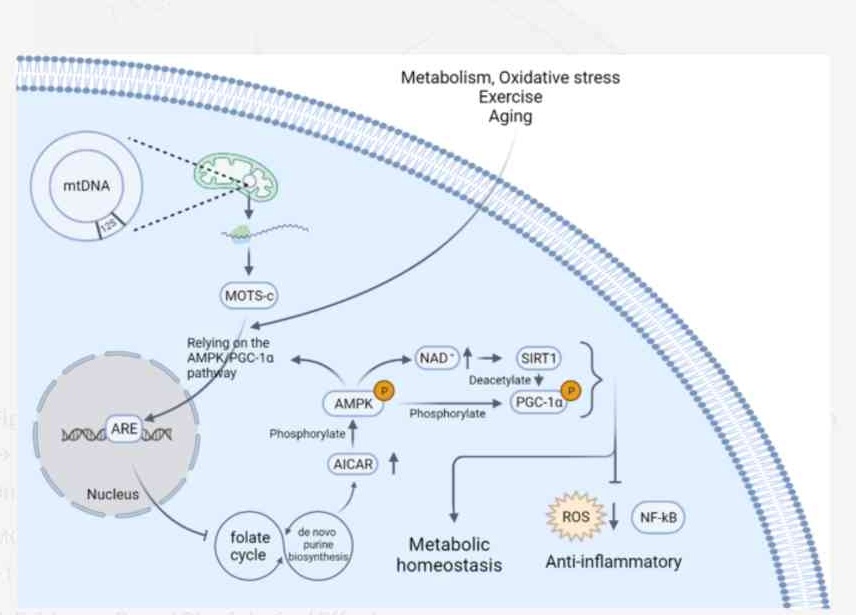
MOTS-c inhibits the folate cycle and de novo purine biosynthesis, which elevates AICAR (5-aminoimidazole-4-carboxamide ribonucleotide). AICAR allosterically activates AMPK ... the master metabolic sensor. AMPK then promotes glucose uptake, fatty acid oxidation, and mitochondrial biogenesis while suppressing energy-consuming pathways. This mirrors the action of metformin and exercise itself.
Nuclear Translocation and Gene Regulation
Under metabolic stress or exercise, MOTS-c physically translocates to the nucleus (AMPK/PGC-1α-dependent). There, it binds antioxidant response elements (ARE) and modulates transcription factors, upregulating genes for stress resistance, proteostasis, and metabolic adaptation.
CK2 Activation (2024 Discovery)
Recent work identified casein kinase 2 (CK2) as a direct binding partner. MOTS-c activates CK2 in skeletal muscle to enhance glucose uptake and preserve muscle mass ... a key mechanism for its exercise-mimetic effects.
MOTS-c is strongly induced by exercise: in young healthy men, skeletal muscle levels rise approximately 11.9-fold post-exercise, with circulating levels remaining elevated for hours.
Evidence-Based Physiological Effects
Metabolic Homeostasis and Insulin Sensitivity
The landmark 2015 studies showed that systemic MOTS-c administration prevents high-fat-diet-induced obesity, insulin resistance, and hepatic fat accumulation in mice ... by boosting energy expenditure and muscle glucose utilization. Critically, it restores insulin sensitivity in aged and obese models without altering food intake.
📊 Human Data
Circulating MOTS-c positively correlates with insulin sensitivity in lean individuals. Levels are significantly reduced in obese children/adolescents and those with metabolic syndrome ... suggesting MOTS-c deficiency may be both a marker and driver of metabolic dysfunction.
Exercise Mimetic and Muscle Preservation
MOTS-c replicates exercise benefits at the molecular level. In a striking study, late-life intermittent dosing (15 mg/kg, 3×/week) in 23.5-month-old mice ... equivalent to humans in their late 70s ... dramatically improved physical capacity, running endurance, and motor coordination. This effectively compressed morbidity, extending the period of healthy function rather than just lifespan.
It also reduces myostatin expression (the muscle-wasting signal) and blocks atrophy signaling in insulin-resistant muscle. Human data confirms: serum MOTS-c levels correlate strongly with lower-body muscle mass, jump force, and power output in healthy adults.
Anti-Aging and Healthspan
Endogenous MOTS-c declines with age ... part of the broader mitochondrial dysfunction that characterizes aging. Supplementation reverses multiple age-related phenotypes:
- Improved mitochondrial fusion and mitophagy (quality control)
- Reduced oxidative stress
- Better metabolic flexibility across tissues
- Protection against D-galactose-induced aging (a model of accelerated senescence)
Additional Targets
Bone Metabolism: MOTS-c stimulates osteoblast differentiation and mineralization via AMPK/PGC-1α/Runx2, while inhibiting osteoclastogenesis. This positions it as a potential intervention for osteoporosis.
Cardiovascular: Improves cardiac function and glucose handling in diabetic cardiomyopathy models ... the heart is deeply dependent on mitochondrial function.
Inflammation: Suppresses pro-inflammatory cytokines while activating anti-inflammatory pathways via AMPK/NF-κB ... addressing the chronic low-grade inflammation ("inflammaging") that accelerates decline.
Cognitive and Neuroprotective Potential
Mitochondrial dysfunction is a core driver of brain fog, reduced executive function, and accelerated cognitive decline ... challenges amplified in high-performance entrepreneurship. The brain consumes ~20% of your metabolic energy despite being ~2% of body weight. Mitochondrial health is cognitive health.
While native MOTS-c doesn't readily cross the blood-brain barrier (BBB), modified analogs that do have shown striking effects:
- Enhanced object and location recognition memory formation and consolidation
- Reversal of Aβ1-42 (Alzheimer's-associated) and LPS-induced memory deficits
- Reduced microglial and astrocyte activation (brain inflammation)
- Lower hippocampal IL-6, IL-1β, and TNF-α (inflammatory markers)
Peripheral MOTS-c supports cognition indirectly via systemic metabolic optimization: sustained brain ATP availability, reduced neuroinflammation, and improved vascular/endothelial function. Anecdotal reports from metabolic clinics note enhanced focus and stress resilience with MOTS-c protocols.
Strategic Relevance to High-Performance Entrepreneurs
Entrepreneurs face unique stressors: chronic decision fatigue, sleep disruption, travel-induced circadian misalignment, and metabolic volatility from irregular nutrition. These erode mitochondrial health, manifesting as energy crashes, impaired focus, slower recovery, and accelerated biological aging ... threatening both short-term output and long-term career longevity.
MOTS-c addresses this at the root:
🚀 The Entrepreneur's Edge
⚡ Sustained Cognitive Fuel
AMPK-driven metabolic flexibility ensures stable ATP in neurons and muscle, countering the "executive energy deficit" common in high-cognitive-load roles. No more 3pm crashes.
🛡️ Stress Resilience
Nuclear translocation under metabolic/oxidative stress upregulates adaptive genes, mimicking the protective effects of consistent exercise ... without requiring perfect training adherence.
💪 Performance Edge
Exercise-mimetic effects preserve muscle power and endurance ... critical for entrepreneurs who prioritize physical vitality for networking, travel, and high-stakes moments.
📈 Longevity Dividend
By mitigating sarcopenia, insulin resistance, and inflammation, MOTS-c supports a compressed-morbidity trajectory ... decades of peak cognition rather than premature decline.
In essence, MOTS-c functions as a "mitochondrial upgrade" for the high-performance operator, translating mitochondrial signaling into real-world advantages in focus, resilience, and sustained output.
Safety, Clinical Status, and Practical Considerations
Preclinical safety is excellent ... no major adverse effects in mice at efficacious doses (5-15 mg/kg). A MOTS-c analog (CB4211) has completed Phase 1a/1b trials in humans for fatty liver disease and was generally safe, though injection-site reactions occurred.
⚠️ Current Limitations
- Research status: Full human trials of native MOTS-c remain limited. It's currently available only as a research peptide, not an approved therapeutic.
- BBB impermeability: Native MOTS-c doesn't readily cross the blood-brain barrier, limiting direct CNS effects without modified analogs.
- Long-term data: Human efficacy and safety data are still emerging.
- Not a substitute: MOTS-c complements but doesn't replace lifestyle fundamentals (sleep, nutrition, training).
💉 Research Protocol Notes
Typical research dosing (extrapolated): 5-10 mg subcutaneous, 1-3×/week, often cycled.
Synergies: Exercise, metformin-like compounds, other mitochondrial supports (NAD+ precursors, CoQ10).
Interactions: May interact with other AMPK-targeting drugs ... use caution with metformin or related compounds.
Important: Consult a qualified clinician before any experimental use. This is not medical advice.
The Bigger Picture: Mitochondrial Medicine
MOTS-c is part of a broader paradigm shift: recognizing mitochondria not just as "powerhouses" but as signaling hubs that coordinate whole-organism physiology. Other mitochondrial-derived peptides (humanin, SHLP1-6) are also being explored.
This connects directly to the emerging thesis we've explored in our Proteome Revolution and Autonomous Health series: biology is becoming programmable, and peptides are the programming language.
📚 Related Reading
- NAD+ and Cellular Longevity NAD+ is critical for mitochondrial function and AMPK signaling ... the same pathways MOTS-c activates.
- The Proteome Revolution MOTS-c is a peptide therapeutic ... part of the broader programmable biology thesis.
- Autonomous Health for Entrepreneurs Bryan Johnson's vision includes continuous multi-omic monitoring of peptides like MOTS-c.
- Hormesis: Strategic Stress MOTS-c mediates some of the adaptive benefits of exercise ... a classic hormetic stressor.
Future Directions
Research is accelerating:
- Brain-penetrant analogs: Modified MOTS-c that crosses the BBB for direct cognitive enhancement
- Tissue-specific delivery: Targeting MOTS-c to specific organs for precision effects
- Combination therapies: Stacking with other mitochondrial interventions
- Biomarker-guided use: Measuring baseline serum MOTS-c to personalize protocols
- Wearable integration: Real-time metabolic monitoring to optimize timing and dosing
Conclusion
MOTS-c stands as one of the most compelling mitochondrial-encoded regulators discovered to date ... bridging ancient mitochondrial signaling with modern demands for peak human performance.
Its evidence-based actions as an exercise mimetic, metabolic optimizer, and stress-adaptive agent make it uniquely suited to the biology of high-performance entrepreneurship. By restoring mitochondrial-nuclear harmony, MOTS-c offers not just incremental gains but a foundational upgrade in energy, cognition, and resilience.
As clinical translation accelerates, it may become a cornerstone of next-generation performance and longevity protocols ... empowering sustained excellence in an unforgiving arena.
🎯 The Core Insight
Your mitochondria aren't just powerhouses ... they're signaling centers that coordinate your entire metabolism. MOTS-c is one of their messengers. When you exercise, you naturally boost MOTS-c. When you're sedentary, stressed, or aging, MOTS-c declines. Understanding this opens a new lever for optimizing performance at the molecular level.