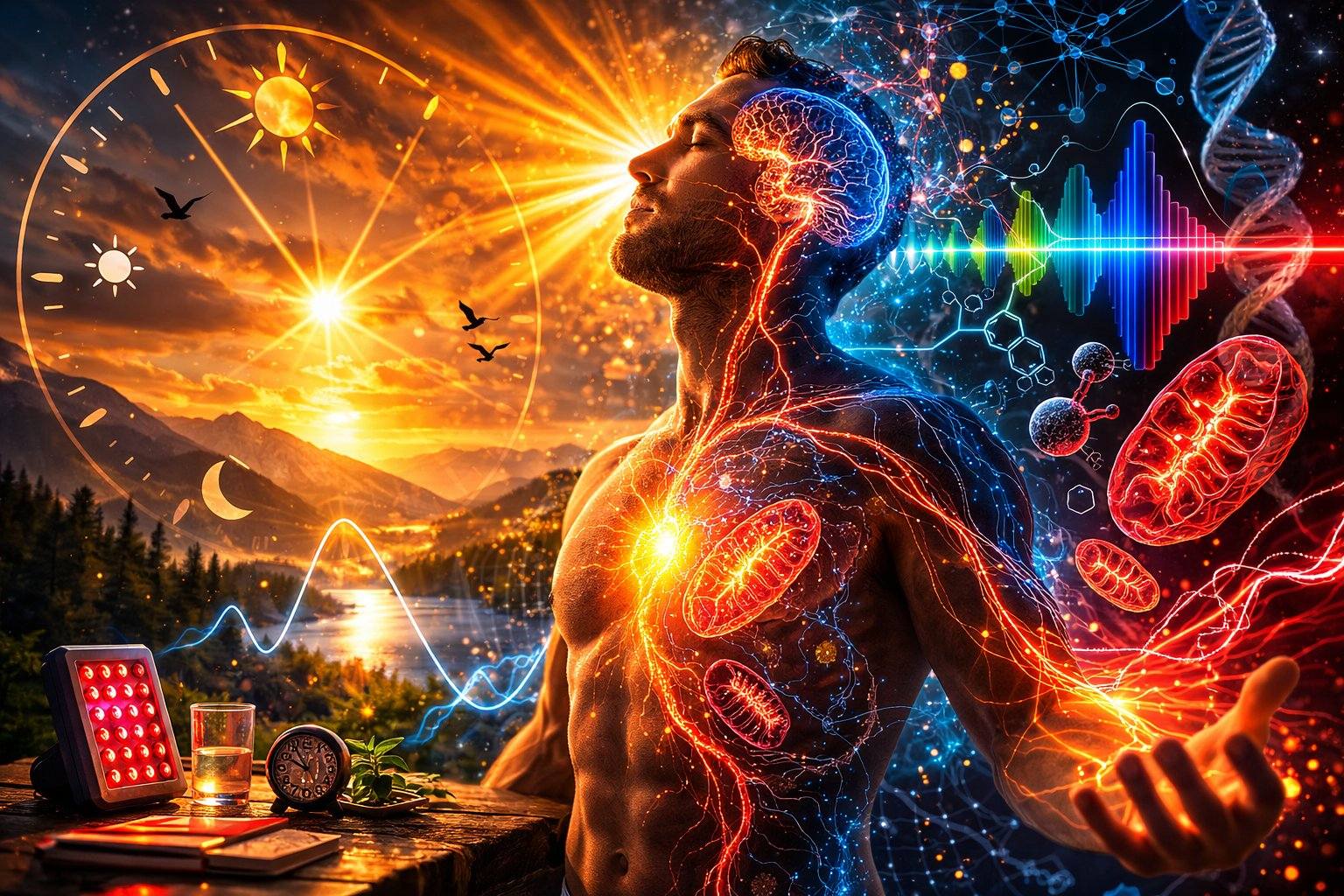
You are bathing in the wrong light.
Every morning, you wake to artificial illumination that delivers a fraction of the photons your biology requires. Throughout the day, you sit under fluorescent tubes or LEDs that emit wavelengths actively damaging your mitochondria. In the evening, you flood your retinas with blue frequencies that suppress the very hormones needed for cellular repair during sleep.
This is not a minor inconvenience. It is a fundamental mismatch between modern environments and human biology...one that accelerates aging, impairs metabolism, and degrades cognitive function at the cellular level. The evidence is now overwhelming: artificial light exposure patterns are a primary driver of mitochondrial dysfunction in the developed world.
But this same evidence reveals an extraordinary opportunity. Light is not merely a hazard to be mitigated...it is a precision tool for cellular optimization. The right wavelengths, delivered at the right times, can enhance ATP production, regulate blood glucose, stimulate tissue repair, and synchronize the master clock that governs all bodily rhythms.
What follows is the complete protocol. Not a single intervention, but an integrated system...a daily architecture of light that works with your circadian biology to achieve what no supplement or drug can replicate: direct communication with your mitochondria in the electromagnetic language they were designed to understand.
Part I: The Cellular Case Against Modern Light
Before building the protocol, we must understand what we're optimizing against. The damage pathways are specific, measurable, and...once you see them...impossible to ignore.
The Blue Light Damage Cascade
Blue light in the 400-500nm range is not inherently harmful. In nature, it arrives packaged with infrared wavelengths that provide a protective counterbalance. The problem is isolated blue light...the kind emitted by LEDs, screens, and fluorescent fixtures...delivered without its natural electromagnetic context.
⚠️ What Happens in Your Cells
When blue light photons strike your mitochondria without accompanying infrared frequencies, they trigger a cascade of damage:
- Reactive oxygen species (ROS) surge: Blue light generates superoxide radicals that overwhelm antioxidant defenses
- Mitochondrial DNA damage: ROS attack the unprotected mtDNA, causing mutations that impair electron transport
- Membrane potential collapse: The electrochemical gradient essential for ATP synthesis breaks down
- ATP production crashes: Studies show near-complete elimination of ATP synthesis at doses as low as 50 J/cm²
- Cell death pathways activate: Necroptosis via RIP1/RIP3 pathways leads to tissue damage
The research is unambiguous. In human dermal fibroblasts, blue light at 50 J/cm² causes significant mtDNA damage, dramatically reduced oxygen consumption rate (OCR), and near-elimination of ATP production...changes that mirror the cellular profile of aging itself. Retinal pigment epithelial cells show collapsed mitochondrial membrane potential, elevated ROS, and triggered apoptosis. In aging model organisms, blue light exposure accelerates neurodegeneration through the same mitochondrial impairment pathways.
This is not a subtle effect. This is direct metabolic sabotage.
The Infrared Deficit
Natural sunlight contains approximately 40% infrared radiation...wavelengths from 700nm to beyond 1000nm that penetrate deep into tissue and interact with mitochondrial enzymes in protective ways. LEDs and fluorescent lights emit virtually zero infrared.
This absence matters because infrared wavelengths:
- Stimulate cytochrome c oxidase (CCO)...the terminal enzyme of the electron transport chain
- Dissociate nitric oxide from CCO, removing a brake on ATP synthesis
- Quench reactive oxygen species generated by blue wavelengths
- Enhance oxygen consumption and mitochondrial respiration
In natural light, blue and infrared arrive together in a balanced ratio. Blue stimulates alertness via melanopsin receptors while infrared protects the mitochondria from oxidative damage. Remove the infrared, and blue light becomes a toxin rather than a signal.
💡 The Core Insight
The problem isn't light. It's incomplete light. Modern artificial lighting delivers the alerting frequencies (blue) while stripping out the protective frequencies (infrared). This is like removing the safety mechanisms from a machine...it still runs, but it destroys itself in the process.
The Circadian Catastrophe
Beyond direct cellular damage, artificial light disrupts the master timing system that coordinates every physiological process in your body.
Your suprachiasmatic nucleus (SCN)...the brain's central clock...relies on light signals to synchronize its roughly 24-hour rhythm to the actual solar day. This synchronization depends on melanopsin-containing intrinsically photosensitive retinal ganglion cells (ipRGCs) that are maximally sensitive to blue light around 480nm.
The system evolved for a world where:
- Blue-rich light only appeared after dawn
- Light intensity dropped dramatically after sunset
- Firelight (red/amber only) was the sole evening illumination
Today, we deliver high-intensity blue light to our retinas until midnight, then wonder why we can't sleep. We suppress melatonin...the hormone essential for mitochondrial repair during sleep...by up to 50% with evening screen exposure. We fragment the circadian rhythm that coordinates metabolism, immunity, and cellular maintenance.
The downstream effects include insulin resistance, impaired glucose regulation, reduced growth hormone release, compromised immune function, and accelerated cellular aging. Every system suffers when the master clock runs wrong.
Part II: The Light Spectrum as Medicine
With the damage mechanisms clear, we can now examine how strategic light exposure reverses them. Each wavelength band has specific cellular targets and therapeutic applications.
Full Spectrum Natural Sunlight
Natural sunlight contains the complete electromagnetic context your cells evolved to expect: UVB for vitamin D synthesis, blue for circadian entrainment, and infrared for mitochondrial protection. No artificial source fully replicates this combination.
630-670nm Red Light
Red light photons are absorbed by the copper centers of cytochrome c oxidase in the mitochondrial electron transport chain. This dissociates inhibitory nitric oxide, increasing electron flow and ATP production by 150-200%. Red light also stimulates fibroblast activity, collagen synthesis, and reduces inflammatory cytokines.
810-850nm Near-Infrared (NIR)
Near-infrared wavelengths target the iron centers of cytochrome c oxidase and penetrate much deeper than red light...through skull bone to reach brain tissue. NIR upregulates brain-derived neurotrophic factor (BDNF), stimulates hippocampal neurogenesis, reduces neuroinflammation, and enhances cerebral blood flow.
3000nm+ Far-Infrared (FIR)
Far-infrared wavelengths don't penetrate tissue for photochemical effects...instead, they transfer radiant heat that raises core body temperature by 1-3°F. This triggers the heat shock response: production of HSP70 and HSP90 proteins that repair misfolded proteins, enhance cellular stress tolerance, and activate longevity pathways.
280-315nm Ultraviolet B (UVB)
UVB converts 7-dehydrocholesterol in skin to previtamin D3...a process no supplement fully replicates, as sun-derived vitamin D comes with additional benefits including nitric oxide release and immune modulation. UVB is only present when the sun is high enough (roughly 10am-3pm at most latitudes).
460-490nm Blue Light (Contextual)
Blue light is essential for circadian entrainment via melanopsin receptors in ipRGCs. Morning blue light properly times cortisol awakening response and programs melatonin release for 14-16 hours later. The key is timing...blue light is medicine in the morning and poison in the evening.
The Metabolic Dimension: Light and Blood Glucose
One of the most striking recent findings in photobiology is the direct effect of red/NIR light on glucose metabolism.
The mechanism: red/NIR light increases mitochondrial oxygen consumption and ATP synthesis, which increases glucose uptake and utilization by cells. A single infrared exposure...even with eyes covered...measurably lowers blood glucose by enhancing mitochondrial function throughout the body.
This has profound implications for metabolic health. If a simple light treatment can reduce glycemic response by nearly 30%, the compounding effects of daily red light therapy on long-term insulin sensitivity and metabolic function become significant.
The Biphasic Dose Response
Critical to effective light therapy is understanding that more is not better. Photobiomodulation follows the Arndt-Schulz curve...a biphasic dose-response pattern where:
- Too little: No measurable effect (sub-threshold stimulation)
- Optimal window: Maximum therapeutic benefit (typically 3-50 J/cm² depending on tissue)
- Too much: Inhibition, increased inflammation, or tissue damage
💡 The Goldilocks Zone
Research consistently shows that lower doses often outperform higher doses. A 10-minute treatment may succeed where a 30-minute treatment fails...or causes harm. The key is hitting the therapeutic window, not maximizing exposure. Start conservative, track response, and resist the urge to assume more is better.
For most applications, the evidence supports:
- Skin/superficial tissue: 3-15 J/cm² at 630-660nm
- Deep tissue/joints: 10-30 J/cm² at 810-850nm
- Transcranial (brain): 6-20 J/cm² at scalp surface
- General wellness: 30-50 J/cm² total with full-body panels
Part III: The Daily Light Ritual
Now we synthesize the science into a complete daily protocol...a choreographed sequence that delivers the right wavelengths at the right times for maximum cellular benefit.
☀️ The Morning Anchor
Primary intervention: Get outside within 30-60 minutes of waking for 10-30 minutes of natural sunlight exposure. No sunglasses. This is non-negotiable...it is the single highest-impact intervention in the entire protocol.
Mechanism: Morning light triggers the cortisol awakening response, suppresses residual melatonin, anchors your circadian phase, and delivers full-spectrum light including the infrared your mitochondria require. It programs melatonin release for 14-16 hours later, ensuring you'll be able to sleep that night.
If sunlight unavailable: Use a 10,000 lux light therapy box at eye level, 12-18 inches away, for 20-30 minutes. This is essential during winter months at latitudes above 37°N.
🔴 Photobiomodulation Session
Full-body protocol: 10-20 minutes with a red/NIR panel (660nm + 850nm combination) at 6-12 inches distance. Target 30-50 J/cm² total dose. Minimal clothing...bare skin for red wavelengths, though NIR penetrates thin fabric.
Transcranial protocol (optional): 10-20 minutes of NIR (810-850nm only) directed at forehead and temporal regions for cognitive enhancement. Target 6-20 J/cm² at scalp surface. NIR penetrates skull to reach prefrontal cortex.
Mechanism: Stimulates cytochrome c oxidase, enhances ATP production, upregulates BDNF and growth factors, reduces inflammatory cytokines, accelerates tissue repair.
🌞 Solar Vitamin Window
Protocol: 10-30 minutes of midday sun exposure with significant skin exposed (arms, legs, torso if possible). No sunscreen during this brief window. Never burn...stop before erythema (redness).
The shadow rule: If your shadow is shorter than your height, UVB is present and vitamin D synthesis is occurring. If your shadow is longer than you are tall, you're getting UVA without UVB...no vitamin D benefit, and increased skin aging/cancer risk.
Latitude consideration: Above 37°N from November-February, the sun never rises high enough for meaningful vitamin D synthesis regardless of exposure time. Supplementation becomes necessary.
🌿 Midday Light Maintenance
Protocol: Take a 40-60 minute break outdoors during the middle of the day. Walk, sit outside, eat lunch in natural light. If this isn't possible, position your workspace near a window for ambient natural light exposure.
Mechanism: Maintains circadian signal strength, provides ongoing mitochondrial support via infrared wavelengths, reduces inflammation markers, supports mood and cognitive function throughout the afternoon.
🔥 Heat Shock Session
Infrared sauna protocol: 15-30 minutes at 130-150°F. Target a core temperature increase of 1-3°F. Allow 2-3 hours before sleep...the body needs time to cool down.
Mechanism: Elevating core temperature activates heat shock proteins HSP70 and HSP90, which repair misfolded proteins, clear cellular debris, enhance stress tolerance, and activate longevity-associated pathways. Far-infrared saunas achieve this at lower ambient temperatures than traditional Finnish saunas.
Frequency: 3-7 sessions per week. Finnish studies show 40% reduced all-cause mortality with 4-7 weekly sauna sessions vs. 1 session per week.
🌅 Circadian Protection Phase
Light environment shift: From sunset until sleep, eliminate blue light exposure and dim overall lighting. This is the defense phase...everything is about protecting melatonin production.
- Blue-blocking glasses: Mandatory after sunset. Amber or red lenses that block wavelengths below 550nm.
- Ambient lighting: Switch to red, amber, or warm incandescent bulbs. Salt lamps, candles, or smart bulbs set to pure red. Target <50 lux ambient.
- Screens: Night mode on all devices (maximum warmth), or better...avoid screens entirely in the final 1-2 hours before sleep.
🔴 Evening Red Light (Optional)
Protocol: 12-20 minutes of red light therapy (660nm) in the 30-60 minutes before bed. Keep intensity moderate...this is not the time for high-powered panels.
Evidence: A study on female athletes found 14 days of 30-minute evening red light sessions improved sleep quality scores, reduced next-day drowsiness, and increased serum melatonin levels. Red wavelengths support cellular repair without suppressing melatonin.
Caveat: If this increases alertness for you, skip it. Individual responses vary. The evening phase is about protection, not stimulation.
🌑 Total Darkness
Protocol: Complete darkness in the bedroom. Blackout curtains or sleep mask. Cover or remove all LED standby lights. If navigation lighting is needed, use red-only night lights.
Zero tolerance: Even small amounts of light during sleep suppress melatonin and disrupt sleep architecture. The room should be dark enough that you cannot see your hand in front of your face.
Part IV: Protocol Specifications
Morning Sunlight Protocol
| Parameter | Specification |
|---|---|
| Timing | Within 30-60 minutes of waking |
| Duration | 10-30 minutes (10 min clear sky, 20-30 min overcast) |
| Eye protection | None (no sunglasses for first 30-60 min) |
| Activity | Walk, coffee outside, or stationary viewing |
| Alternative | 10,000 lux light box, 20-30 min at 12-18 inches |
| Frequency | Daily, non-negotiable |
Photobiomodulation Protocol
| Parameter | Full Body | Transcranial |
|---|---|---|
| Wavelengths | 660nm + 850nm combo | 810-850nm only (NIR) |
| Distance | 6-12 inches from panel | Contact or 1-2 inches |
| Duration | 10-20 minutes per side | 10-20 minutes total |
| Target Dose | 30-50 J/cm² total | 6-20 J/cm² at scalp |
| Frequency | Daily or 5x/week | 3-5x/week |
| Timing | Morning or early afternoon | Morning optimal |
Infrared Sauna Protocol
| Parameter | Specification |
|---|---|
| Temperature | 130-150°F (infrared) or 174-212°F (Finnish) |
| Duration | 15-30 minutes (infrared) or 15-20 minutes (Finnish) |
| Core temp target | Increase of 1-3°F |
| Frequency | 4-7x/week for longevity benefits |
| Timing | Afternoon/early evening, 2-3 hours before sleep |
| Hydration | Electrolytes before and after |
Evening Light Environment
| Phase | Light Conditions |
|---|---|
| Sunset to bedtime | Blue-blocking glasses, amber/red ambient lighting, <50 lux |
| 1 hour before sleep | Minimal screens (red mode only), dim red lighting, relaxation |
| Sleep environment | Total darkness, blackout curtains, no LED standby lights |
| Night navigation | Red-only night lights if absolutely necessary |
Part V: Seasonal Considerations
Light availability varies dramatically by season and latitude. The protocol must adapt accordingly.
Winter Months (High Latitudes)
At latitudes above 37°N during November-February:
- Morning light box becomes essential: Natural daylight is insufficient for circadian anchoring. Use 10,000 lux box for 20-30 minutes within first hour of waking.
- Vitamin D supplementation required: UVB angle is too low for cutaneous synthesis regardless of exposure time. Supplement 2,000-5,000 IU daily (test levels to optimize).
- Near-infrared benefits amplified: With less ambient infrared from natural sunlight, supplemental NIR therapy becomes more impactful. Consider increasing frequency to daily.
- SAD (Seasonal Affective Disorder) prevention: The combination of morning light box therapy and consistent red/NIR sessions addresses both circadian disruption and mitochondrial deficit that contribute to winter depression.
Summer Months
- Natural sunlight takes priority: Maximize outdoor time. The protocol becomes easier...morning sunlight is abundant and vitamin D synthesis is efficient.
- Early morning light critical: Summer sun rises early. Use this to your advantage...earlier light exposure allows earlier melatonin onset.
- Evening light discipline still required: Long summer days make it tempting to stay outside past sunset. Maintain blue-blocking discipline regardless of daylight duration.
Part VI: Implementation Hierarchy
Not everyone can implement the full protocol immediately. Here's the priority order, based on impact per unit cost and effort:
Tier 1: Zero Cost (Start Here)
- Morning sunlight habit: 10-30 minutes outside within first hour of waking. This single intervention has the highest impact of anything in the protocol.
- Evening screen discipline: Night mode on all devices after sunset. Stop screens 1 hour before bed if possible.
- Sleep environment audit: Identify and eliminate light sources in bedroom.
Tier 2: Low Cost ($20-200)
- Blue-blocking glasses: $20-80. Wear from sunset until sleep.
- Red/amber bulbs: $30-100. Replace evening lighting in main living areas.
- 10,000 lux light box: $100-200. Essential for winter months, useful year-round.
Tier 3: Moderate Cost ($300-1,500)
- Red/NIR panel device: $300-1,000. Enables photobiomodulation benefits...ATP enhancement, collagen synthesis, BDNF upregulation.
- Smart bulbs with red mode: $150-300. Automate evening light environment transition.
Tier 4: Premium ($2,000+)
- Infrared sauna: $2,000-8,000. Heat shock protein activation, cardiovascular conditioning, longevity benefits.
- Full-body PBM bed/chamber: $10,000+. Maximum coverage, professional-grade dosing.
💡 The 80/20
Tier 1 alone...free interventions...delivers approximately 60-70% of the total protocol benefit. Morning sunlight and evening blue-blocking are the foundation. Everything else builds on this base. Don't skip the free stuff to jump to expensive devices.
Part VII: Synergies and Stacking
Light therapy integrates powerfully with other longevity and performance interventions:
✓ Synergistic Combinations
- Morning light + cold exposure: Amplifies cortisol and catecholamine response for energy and focus
- Post-workout NIR: Accelerates recovery, reduces DOMS, enhances muscle protein synthesis
- Pre-meal red light: May reduce glucose spike by ~28% (emerging evidence)
- Sauna + cold contrast: Maximizes cardiovascular and hormetic stress adaptation
- BDNF compounds + transcranial NIR: Stacking nootropics that target neuroplasticity (see The Sovereign Mind Stack) with NIR's BDNF upregulation
- Fasting + morning light: Combined circadian and metabolic entrainment
✗ Avoid These Combinations
- Blue light + evening PBM: Undermines circadian benefit of red light
- Sauna immediately before sleep: Core temperature elevation interferes with sleep onset
- NIR + retinol/photosensitizing compounds: May cause irritation or burns
- High-dose PBM + stimulants: Over-activation possible in sensitive individuals
Part VIII: Tracking and Optimization
Measure what matters to optimize your protocol:
Subjective Metrics (Daily)
- Sleep quality: Time to fall asleep, wake events, morning alertness (1-10 scale)
- Energy levels: Morning, afternoon, evening ratings
- Cognitive clarity: Focus, memory, creativity assessment
- Mood: Baseline and variability tracking
Objective Metrics (If Available)
- HRV (heart rate variability): Reflects autonomic balance, recovery status
- Sleep staging: Oura, Whoop, or similar for REM/deep sleep percentages
- Continuous glucose monitor: Track impact of pre-meal red light on glycemic response
- Blood markers: Vitamin D (25-OH), inflammatory markers (hs-CRP), HbA1c
Timeline for Results
- Sleep improvements: 3-7 days of consistent evening light discipline
- Energy/mood shifts: 1-2 weeks of morning light anchoring
- Skin/tissue changes: 4-8 weeks of consistent PBM
- Metabolic markers: 8-12 weeks to see blood marker changes
Coda: Light as Sacred Technology
The ancients were not wrong to worship the sun. They intuited what photobiology now confirms: light is not merely illumination. It is information. It is the primary signal by which your cells understand what time it is, what season it is, and what metabolic programs to run.
For four billion years, life evolved under a predictable rhythm of light and darkness. Your mitochondria speak the language of photons. Your circadian clock expects the sunrise. Your melatonin production assumes the night will be dark.
Modern technology has given us unprecedented control over our light environment...and we have used that control to sever ourselves from the electromagnetic context our biology requires. We have declared independence from the sun and paid the price in metabolic dysfunction, sleep disorders, cognitive decline, and accelerated aging.
The Light Protocol is a reconciliation. It is the deliberate use of technology to restore the light environment our bodies expect. Morning sunlight to anchor the day. Infrared to protect the mitochondria. Red to stimulate repair. Darkness to enable regeneration.
This is not a minor optimization. It is a foundation. Get light right, and every other intervention...from nutrition to exercise to supplementation...works better. Get light wrong, and you fight an uphill battle against your own biology.
"As above, so below; as within, so without." ... The Emerald Tablet
The sun above programs the cells within. The light without shapes the biology within. There is no separation between the cosmos and the body...only electromagnetic information flowing in both directions.
Choose your photons wisely. Your mitochondria are listening.
Further Reading
- The Sovereign Mind Stack ... Multi-system cognitive optimization including BDNF-targeting compounds that synergize with transcranial NIR
- The Synergy Protocol ... Exercise and psychedelics for neuroplasticity and depression