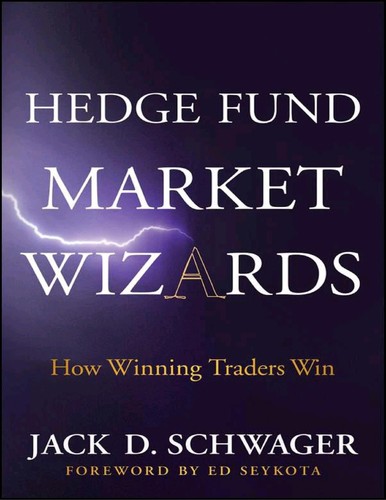
The Essential Question
What survives after the clever trade stops working?
Books about exceptional traders invite the wrong kind of reading. We search for the setup, the indicator, the secret market, the one repeatable move we can extract from another person's career. That hunger is understandable. It is also exactly what Hedge Fund Market Wizards should cure.
Jack Schwager's subjects do not share a method. Some trade macro themes. Some trade events. Some build statistical systems. Some hold for months. Others turn positions over quickly. Their beliefs about markets often conflict. If the book contained one transferable strategy, at least half of its practitioners would have to be wrong.
The common ground sits one level lower. They know where their advantage might exist. They express it in a form that pays more when right than it costs when wrong. They size the expression so uncertainty cannot remove them from the game. They watch the market for evidence that the advantage has changed. Then they cut, adapt, or wait.
This is the Oikos reading: a trading operation is a household of risk. Capital has jobs. Losses have boundaries. Conviction has a budget. The purpose of the architecture is not to avoid uncertainty. It is to keep uncertainty from becoming ruin.
The idea can be brilliant and the trade can still be bad. Price, timing, structure, and size decide whether insight becomes capital or damage.
The Core Framework
The book's deepest pattern is a loop, not a list of traits. The best operators move through the same five decisions even when their research, holding periods, and instruments have nothing in common.
The adaptive risk loop
Locate the asymmetry
Find a condition where the potential gain is meaningfully larger than the amount that must be risked, and where the crowd may be mispricing probability, consequence, or time.
Define invalidation
Name what would make the thesis wrong before money and identity attach themselves to it. A position without invalidation is a belief looking for protection.
Size the uncertainty
Set exposure from the loss the whole portfolio can absorb, not from the excitement of the expected return. Correlation and liquidity belong in the calculation.
Read the feedback
Observe price, volatility, positioning, and the behavior of the thesis. Distinguish ordinary noise from evidence that the trade or the environment has changed.
Adapt without bargaining
Reduce, exit, reverse, or remain patient according to the prior rule. Protect the ability to take the next trade with judgment intact.
The sequence matters. Most amateurs reverse it. They start with a story, imagine the return, choose a large position because the story feels clear, and only search for invalidation after the market moves against them. Risk becomes an argument conducted under pressure.
Asymmetry Hunting
A market edge is often described as superior prediction. That is too narrow. You can make money while being wrong often if the winners are large and the losses stay small. You can also predict correctly most of the time and still fail if the occasional loss is allowed to consume years of gains.
Asymmetry is the relationship between what can be gained, what can be lost, and how those outcomes are distributed. It begins with payoff, but it does not end there. An opportunity may be asymmetric because the crowd treats a temporary problem as permanent. It may exist because a forced seller values immediate liquidity more than price. It may appear when a small, defined cost buys exposure to a large change in regime. It can also come from patience. The person who is not required to act can wait until price carries enough error to create favorable terms.
This reframes research. The question is not simply, "What will happen?" Ask instead: "What is the market already paying for, what would surprise it, how much do I lose if my reading is wrong, and what path can prevent me from collecting even if I am eventually right?"
Path is where beautiful ideas go to die. A thesis can be correct over twelve months and impossible to hold through the fourth month. Financing can vanish. Volatility can force a reduction. Investors can redeem. The security can gap through the intended exit. A paired trade can discover that its two sides were related only in normal conditions.
The asymmetry hunter respects these details because payoff diagrams drawn in calm conditions omit the human and institutional machinery around the position. Real risk includes every reason you may be forced to act before the idea reaches resolution.
Analytical asymmetry
Your estimate of probability or magnitude differs from the market's. This is the form most people imagine when they think about edge.
Structural asymmetry
Mandates, forced flows, career pressure, or liquidity needs cause another participant to accept a price you are free to refuse.
Temporal asymmetry
You can wait longer than the participant on the other side, or you can act faster because your decision chain is shorter.
Behavioral asymmetry
You can follow a tested rule while fear, euphoria, boredom, or the need to appear active pushes others away from theirs.
None of these grants permanent ownership. A visible advantage attracts capital. An institutional rule changes. A market becomes faster. A cheap asset becomes popular. The correct posture is confident enough to act and suspicious enough to keep testing.
Position Sizing Is the Real Alpha
The investment world rewards ideas in public and sizing in private. A manager can explain a thesis on television. The percentage of capital placed behind it, the room left for adverse movement, the treatment of correlated positions, and the response to fresh evidence are where the actual result is made.
A useful edge without sizing discipline is a weapon without a safety. The expected value may be positive across a hundred repetitions, but the operator only receives that expectation if no early loss ends the sequence. Survival is part of the math.
Sizing also tells the truth about conviction. People say they believe in a trade. The portfolio reveals how strongly, under what loss limit, and relative to what other risks. Yet bigger is not always more honest. An oversized position often signals that excitement has replaced calibration. Mature conviction includes awareness of how wrong the best research can be.
The right unit of thought is total portfolio damage. Ten positions can be one position if they depend on the same rate move, funding condition, volatility regime, policy response, or crowded assumption. Labels do not diversify. Independent sources of loss do.
This makes correlation a living variable. Relationships that appear modest during calm periods often tighten during liquidation because participants sell what they can, not only what they want. A portfolio built from historical averages can become concentrated at the exact moment diversification was supposed to matter.
Sizing should therefore answer four questions:
- Thesis risk: How much can be lost if the idea is simply wrong?
- Path risk: What adverse movement can occur before resolution?
- Portfolio risk: What else loses money under the same conditions?
- Exit risk: Can the position be reduced near the assumed price when everyone wants the same door?
This is why position sizing is the real alpha. It converts a fallible stream of judgments into a survivable distribution of outcomes. The entry may produce the opportunity. The size determines whether the opportunity belongs to a repeatable process or a single roll of the bones.
The principle connects directly to Portfolio Construction and Allocation. A portfolio is not a gallery of favorite ideas. It is a designed relationship among risks.
Drawdown Discipline
Drawdowns contain more information than pain. They tell you something about the method, the environment, the portfolio, and the operator. The hard part is identifying which message is arriving.
Every valid strategy loses. If every loss causes reinvention, no method survives long enough to demonstrate an advantage. Yet loyalty to a method can become an excuse for refusing evidence. Drawdown discipline lives between these errors.
The first distinction is expected versus anomalous. Expected loss falls within the tested character of the strategy. Anomalous loss arrives with changed relationships, unusual execution, broken assumptions, or behavior outside the historical range. The second distinction is process versus outcome. A clean loss taken according to plan may deserve no change. A profitable violation may require immediate correction because it rewarded behavior that will eventually collect a larger bill.
The third distinction is financial versus psychological capacity. A fund may have enough capital to continue while the manager has lost the clarity to do so. Fatigue shortens horizons. Shame increases secrecy. The desire to recover quickly makes marginal trades look necessary. Position size begins serving emotional repair instead of expected value.
Professional discipline interrupts that spiral early. Exposure comes down before thought becomes desperate. Loss limits are set when the mind is calm. A pause is treated as an active decision. The manager reviews whether the edge weakened, whether market conditions moved outside the method, whether implementation failed, and whether multiple positions were one hidden bet.
A drawdown limit is not a prediction about the worst possible loss. It is a boundary protecting judgment from the version of you that appears after repeated damage.
The recovery percentage also punishes delay. A modest decline requires a manageable gain to restore capital. As losses deepen, the required recovery grows much faster. This arithmetic gives humility a hard financial value. Cutting exposure is sometimes less about declaring the thesis wrong than about preserving enough capital and emotional range to assess it honestly.
Risk Management for Macro Investors extends this principle from the individual position to the full operating system. Risk control is not an accessory attached after selection. It is the condition that lets selection matter.
Why Most Edges Decay
An edge is a temporary mismatch between reality and the way market participants are processing it. Temporary matters.
Successful strategies teach the market how to remove their own excess returns. Competitors imitate. Capital enters. Spreads narrow. Technology makes execution faster. Data once gathered through patient work becomes commercially packaged. A regulation changes. The market's participant mix shifts. The economic behavior underneath a historical pattern disappears.
Some edges decay because they were never edges. A favorable regime can make random exposure look like skill. A long period of falling volatility can flatter anyone selling insurance against movement. A persistent trend can make concentration look like insight. When conditions change, the supposed method is revealed as a disguised bet on the environment.
Others decay through scale. A small strategy can enter overlooked instruments without moving price. As assets grow, the opportunity set narrows, execution costs rise, and the manager is pushed toward larger, more efficient markets. The record attracts the capital that makes the record harder to repeat.
Edge decay does not mean all knowledge expires. The durable element is usually a research and adaptation process, not a fixed signal. Asking better questions can persist. Strict execution can persist. The willingness to abandon a beloved method can persist. A precise anomaly probably will not.
This suggests an edge audit:
- Who is paying, and why are they willing or required to pay?
- What prevents capable competitors from taking the same return?
- Has recent profitability attracted enough capital to alter the trade?
- Which market condition makes the pattern work, and is that condition still present?
- Does the evidence survive costs, delayed execution, and a less flattering sample?
A trader who cannot explain the source of the payoff is renting a pattern. Rent can still be collected for a while. It should never be mistaken for ownership.
The Institution and the Individual
The title can mislead readers into thinking a hedge fund sits above the individual in an evolutionary hierarchy. Institutions possess resources that a lone investor cannot reproduce: specialist teams, direct data, prime brokerage, research budgets, executive access, and dedicated infrastructure. They can examine more markets and express more complex trades.
They also carry weight.
A large fund must find opportunities large enough to matter. It may need to disclose positions. It answers to investors, boards, risk committees, counterparties, and internal politics. Redemptions can force sales at the worst time. Monthly performance pressure can shorten a sound long-term view. Career risk favors ideas that are defensible in a meeting, even when the less crowded idea offers better terms.
The individual has less information and far less machinery. That is real. But the individual can hold cash without explaining inactivity, concentrate attention in a small circle of competence, buy instruments too small for a fund, wait years for a favorable pitch, and change direction without convening a committee. There are no outside redemptions. The mandate can be rewritten in an afternoon.
These freedoms are usually wasted. The individual tries to imitate the institution's activity while possessing none of its support. More screens. More trades. More opinions. More reaction to every data point. The best individual advantage is subtraction: fewer obligations, fewer positions, longer patience, simpler structures, and no requirement to appear busy.
Institutional strength
Research depth, execution systems, talent density, access, and the capacity to monitor complex exposures continuously.
Institutional constraint
Scale, committees, investor flows, public comparison, mandate limits, crowded positioning, and the business risk of looking wrong alone.
Individual strength
Patience, small scale, a wide opportunity set, privacy, flexible timing, and freedom from the demand to produce a smooth monthly story.
Individual constraint
Limited research, weak execution support, inconsistent discipline, poor feedback, and the temptation to confuse freedom with the absence of rules.
The lesson is to trade your own constraints. Copying another manager's position without copying the research, sizing, portfolio, liabilities, and exit plan is cargo cult finance. The same ticker can represent a prudent trade in one architecture and reckless exposure in another.
Conviction Without Identity
Great trading requires enough conviction to act against consensus and enough detachment to accept that consensus may be right. Those qualities pull in opposite directions.
Weak conviction produces hesitation, premature exits, and a portfolio filled with tiny positions that cannot affect the result. Identity-bound conviction produces denial. The thesis becomes proof of intelligence. Contrary evidence feels personal. Adding to the position begins as rational improvement and ends as an attempt to force reality into agreement.
The answer is to bind conviction to evidence and size. A trader can believe strongly while limiting damage. In fact, a predefined risk budget makes genuine independent thought easier because being wrong no longer threatens the whole enterprise. The ego has less to defend.
Written premises help. Record why the opportunity exists, what the market seems to believe, what must happen for value to emerge, what would invalidate the thesis, and which conditions require an exit regardless of opinion. Then update the document when the facts change. Do not rewrite history after the position moves.
This joins the psychological work in Trading Psychology 101. Markets are expensive mirrors. They expose the difference between a view and a self-image.
The Quiet Skill of Doing Nothing
The book is populated by action, but its practitioners often distinguish themselves through refusal. They refuse mediocre setups. They refuse to increase risk merely because recent performance is good. They refuse to trade a market they do not understand. They refuse to remain in a position after the reason for owning it disappears.
Waiting is difficult because professional markets turn activity into evidence of work. Screens move all day. Clients pay fees. Colleagues produce ideas. A quiet portfolio can feel like a confession that no edge is present.
Cash preserves optionality. Attention preserves judgment. Both are positions. The ability to wait for favorable terms is valuable only when waiting has not been psychologically coded as failure.
This is where the individual may hold the cleanest structural advantage. Nobody requires a trade today. There is no benchmark committee. There is no quarterly letter that must turn patience into a persuasive narrative. The investor can close the screen and allow price to become more generous.
Where the Book Is Weak or Dated
The interviews remain valuable. The hedge fund world surrounding them has changed substantially since 2012.
Electronic execution has accelerated. Alternative data has become an industry. Cheap computation has spread methods that once required institutional resources. Passive flows have grown. Central bank intervention, social media coordination, zero-commission trading, short-dated options activity, and faster information cycles have altered who moves markets and how quickly a visible idea gets crowded.
The book also inherits selection bias from its form. We meet successful survivors who can explain their careers coherently. The failed managers who held similar beliefs, used similar language, and met a different sequence are mostly absent. Good interviews reveal process. They do not establish which traits caused the outcome or how much luck amplified them.
Retrospective narrative creates another hazard. Human beings compress years of uncertain decisions into a clean arc. The remembered rationale can become sharper than the rationale available in real time. Readers should value the risk principles without assuming every career was consciously designed from the beginning.
The manager's business receives less attention than it deserves. Asset gathering, fee structure, investor concentration, team incentives, operational risk, tax, compliance, and the terms under which capital can leave all shape the strategy. A trading record is produced by a business system, not a mind floating above one.
Finally, the wizard frame encourages personality worship. Exceptional returns tempt us to search for exceptional temperament. Yet many lessons are ordinary and unglamorous: control losses, stay within competence, test assumptions, keep records, avoid forced decisions, and do not confuse a good outcome with a good process. The magic is repeated governance.
These limits do not break the book. They improve the way it should be read. Treat every interview as a case study in adaptation under particular constraints, not a recipe or proof of universal genius.
What Marc Actually Uses
The Oikos application is a risk constitution. It belongs in writing before a position is opened and before a drawdown makes memory political.
Name the payer
Explain why the opportunity exists and what pressure, mistake, or constraint creates the other side. "It looks cheap" is not enough.
Start with damage
Choose size from acceptable portfolio loss under adverse conditions. Expected return comes after survival.
Group hidden bets
Tag positions by their shared dependence on rates, liquidity, volatility, policy, growth, and crowd behavior. Count economic exposures, not ticker symbols.
Write invalidation
State the evidence that ends the trade, the price behavior that demands review, and the maximum loss that closes discussion.
Reduce after damage
Use staged drawdown limits that lower exposure before urgency controls the next decision. Earn back size through clean execution.
Audit the edge
Track whether returns still come from the claimed source. Distinguish process drift, regime change, capacity limits, and ordinary variance.
The Book's Real Mechanism
Hedge Fund Market Wizards appears to be a collection of exceptional people and specialized methods. Its real mechanism is governance under uncertainty.
The practitioner builds a small constitution around capital. The constitution defines which opportunities qualify, how claims are tested, how much any claim may risk, how positions interact, what evidence forces change, and when the operator must stop. Freedom exists inside those boundaries because catastrophe has been denied an easy path.
This is a deeply Hermetic idea without requiring mysticism. The outer portfolio reflects the inner order of the person managing it. Confused premises become confused exposure. Inflated identity becomes excessive size. Fear becomes premature exit. Discipline becomes optionality. As within, so within the book of positions.
The purpose of the system is not perfect prediction. It is to transform uncertainty into a sequence of bounded experiments. A loss purchases information. A gain adds capital. Neither receives permission to rewrite the rules by itself.
The Oikos Lineage
This is the fourth study in a twelve-book wealth sequence. Its role is to move the Market Wizards tradition into modern institutional practice and make the risk architecture visible.
- Behavioral finance: Morgan Housel and Richard Thaler explain why the operator cannot be treated as rational machinery.
- Market practitioners: Schwager's three interview volumes show different expressions of edge, adaptation, and survival.
- The mechanical floor: George Clason establishes the reserve and restraint without which market skill has no durable base.
- Mental models: Charlie Munger widens the decision frame and attacks the single-lens thinking that creates hidden exposure.
- The hinge: George Soros explains how beliefs alter action, action alters price, and price feeds back into belief.
This volume belongs near the center of the sequence because it tests ideas against consequence. Mindset may direct attention. Analysis may identify the opening. The result still passes through position size, liquidity, correlation, and the willingness to admit change.
Read Alongside
The Psychology of Money
Housel explains why survival, room for error, and freedom matter across a financial life. Schwager shows the same truths under the compressed feedback and sharper consequences of professional trading. Read together, behavior becomes risk architecture.
Risk Management for Macro Investors
The working companion for translating drawdown control, correlated exposure, and sizing discipline into portfolio rules.
The Grid Model
A regime lens for the problem of edge decay. A method can remain internally consistent while the financial weather that rewarded it disappears.
Mental Models for Alpha and Edge
A wider account of how independent models reveal structural asymmetry, and why every model requires a boundary of competence.
The Bottom Line
Hedge Fund Market Wizards earns its place because its methods refuse to collapse into one formula. The disagreement is the lesson. Markets support many forms of intelligence, but only when intelligence is paired with a structure that can survive being wrong.
Hunt asymmetry. Make loss finite. Size the whole portfolio, not the story. Treat a drawdown as evidence. Assume the edge is already aging. Use your actual constraints instead of borrowing someone else's style.
The trade gets attention. The architecture keeps the trader alive.
Sources and Further Reading
This is an original interpretation, not a chapter summary. It contains no purported quotations from the book and no page-number claims. The source spine is Jack D. Schwager's Hedge Fund Market Wizards: How Winning Traders Win (2012), read in conversation with the risk, behavior, and portfolio studies linked above.