"Until you make the unconscious conscious, it will direct your life and you will call it fate."
That sentence circulates under Carl Jung's name in a thousand posts, a hundred books, and at least one tattoo. It is beautiful, load-bearing, and false. Jung never wrote it.
What he wrote, in Aion (CW 9ii, para. 126), is harder and less portable:
"The psychological rule says that when an inner situation is not made conscious, it happens outside, as fate."
The difference matters. The popular version promises mastery: make the unconscious conscious, and you direct your life. The genuine sentence promises nothing. It describes a consequence. An inner situation that remains unconscious does not wait politely... it happens, on the outside, wearing the mask of circumstance.
Start here, because the difference between the two sentences is the subject of this essay. A fluent, well-connected, widely shared statement that is not faithful to what is... that is the exact object of study. The counterfeit displaces the original not because people are stupid but because it is smoother. It travels faster, lodges deeper, asks less. It is a small, portable demonstration of the phenomenon this essay is about: the capture of attention by something that resembles truth closely enough to pass.
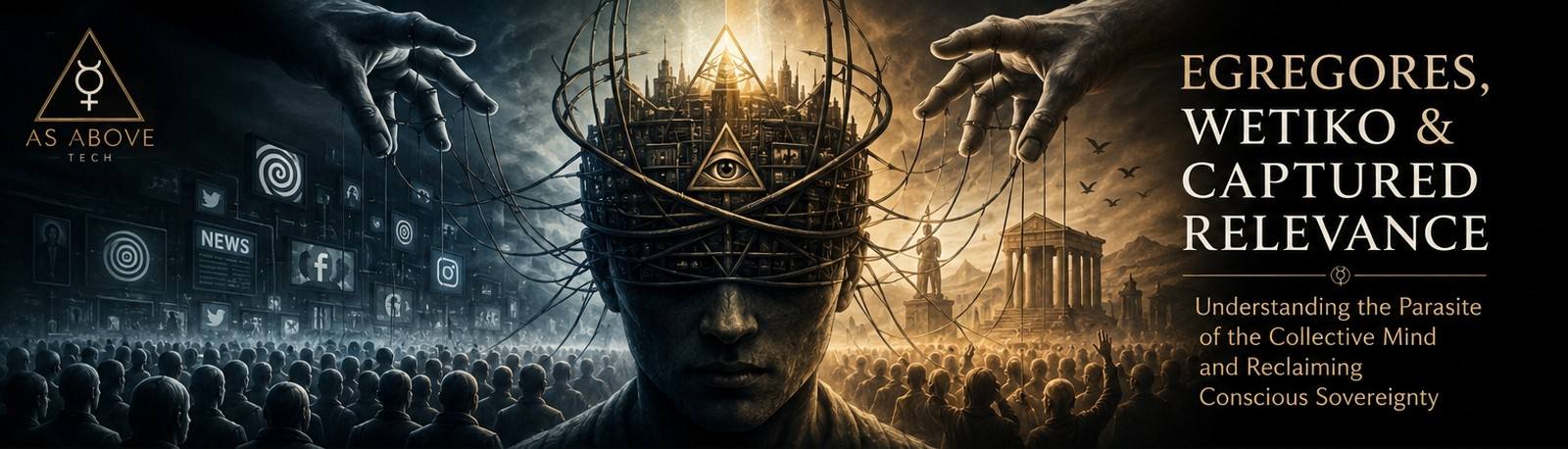
The question worth a long answer is how that capture scales... how it moves from a misattributed quote to a movement, from a meme to a worldview, from a bad habit of thought to a civilization-shaping force. Three traditions have described that scaling, separated by centuries and continents and never citing each other. The Western occult tradition calls the result an egregore. The Indigenous American tradition calls it wetiko. Depth psychology calls it shadow projection. This essay argues they are one phenomenon seen from three positions, and that the common mechanism is a captured relevance function... a self-sustaining distortion that decides, in advance, what you are able to notice.
The cure is not more information. More information, in the presence of a captured relevance function, makes things worse. The cure is restored discernment: the ability to see what is actually there.
Contents
- The Ontology Dodge
- The Mechanism: What an Egregore Actually Is
- The Same Thing from the Inside: Wetiko
- Good and Evil, and Why This Essay Refuses to Dodge
- Intelligence Is Discernment
- Where the Sources Disagree, and Where This Essay Lands
- The Author's Own Distortions
- The Antidote
- What Discernment Is For
The Ontology Dodge
Before the machinery, a license.
Mark Stavish, in Egregores: The Occult Entities That Watch Over Human Destiny, offers a concession that keeps the skeptical reader in the room. The question of whether egregores literally exist as independent beings is, he writes, "functionally irrelevant, except for academic definition." Whether you model the phenomenon as a literal entity or as a emergent pattern of collective psychology, the observable effects are identical: groups cohere around symbols, ideas acquire appetite, attention flows toward certain objects and away from others without any individual deciding to redirect it.
This essay accepts Stavish's dodge on ontology while rejecting, as we shall see, his conclusions about good and evil. You do not need to believe in spirits to notice that ideas, once sufficiently fed, begin to behave as though they have interests of their own. You only need to have lived through a news cycle, attended a political rally, or watched a family argument replay the same script for the third generation running.
The question is not whether the thing is real. The question is how it works.
The Mechanism: What an Egregore Actually Is
The word egregore enters Western esotericism through the French occultist Eliphas Levi and gains its fullest modern treatment in Stavish's survey of the tradition. An egregore, at minimum, is a thought-form that has been fed enough collective attention to take on a life of its own. Valentin Tomberg, in Meditations on the Tarot, describes the egregore of Communism as "engendered by the will of the masses." It is not the ideology. It is the entity the ideology summons into being once enough people hold the same image with enough emotional intensity.
Formation follows a pattern. It begins with an idea held in sustained collective focus... repeated ritual, shared symbol, common language. The repetition matters: an egregore does not spring from a single thought any more than a riverbed forms from a single rain. It requires the slow carving of a channel. Naming is part of the formation. Once the pattern has a name, it can be invoked, referred to, reinforced. The name becomes a handle by which the pattern grips.
The feeding mechanism is attention and emotion. Stavish is explicit: the egregore feeds. What it feeds on is the psychic energy of its participants... their focus, their passion, their fear, their devotion. This is not metaphor dressed as mechanism; it is mechanism dressed as metaphor. Anyone who has watched an online outrage cycle understands viscerally what it means for an idea to feed on attention. The participants feel drained, but the cycle itself gains momentum. Each contribution of anger makes the next contribution more likely. The thing grows.
The sacred economy of consciousness is not a figure of speech. Attention is finite. What captures it defines what a person can think, feel, and notice. An egregore captures attention the way a gravity well captures light: not by blocking it directly but by bending the space it moves through, so that the light never reaches certain destinations. You do not experience the capture as compulsion. You experience it as interest.
This is the critical insight: the control surface of an egregore is not force but relevance. It determines which comparisons are permitted, which questions feel worth asking, which objects of attention seem naturally important. Stavish describes how organizations manage this: through language, through ritual, through defining the boundaries of the thinkable. A member of a political movement does not decide to stop asking certain questions. The questions simply stop occurring to them. The egregore has bent the relevance field, and certain thoughts now fall outside it the way light falls outside a shadow.
Dissolution is the reverse of formation. You starve the thing. You withdraw attention and contact. Both Stavish and the depth-psychology tradition converge here: the egregore cannot survive the sustained withdrawal of the energy that constitutes it. Fire and sword, Stavish notes, have been the historical accelerants... the destruction of symbols, texts, meeting places, everything that served as a substrate for the pattern. But the underlying mechanism is always the same. Stop feeding it and it weakens. Stop everyone from feeding it and it dies. The difficulty, of course, is that the thing has captured the relevance function of the people who are feeding it, which means they cannot see the feeding as a choice.
Consider the Tibetan Buddhist protector deity Dorje Shugden, whom Stavish uses as a case study. A protector deity is, by construction, "a destroyer of 'heretical Buddhist sects.'" The entity protects the faithful by defining an outside... by naming what does not belong and mobilizing energy against it. The binding and the exclusion are the same operation. The coherence of the group is purchased by the identification of an enemy. Every egregore that persists long enough arrives at this structure. It does not merely include; it defines itself by what it excludes.
The Same Thing from the Inside: Wetiko
The Algonquin and Ojibwe traditions use the word wetiko (sometimes windigo, witiko, or wintiko) for a cannibal sickness... a spiritual disease in which a person is consumed by the compulsion to consume others. Jack D. Forbes, a scholar of Powhatan-Renape and Delaware-Lenape heritage, published Columbus and Other Cannibals in 1978, arguing that wetiko is the most contagious and important disease in history, and that European imperialism is its epidemiology.
Forbes must be named first and prominently, because the concept was later taken up by Paul Levy, who is not Indigenous, and the secondary literature has a tendency to cite Levy while forgetting Forbes. This is itself an example of the phenomenon under discussion: the smoother, more accessible version displaces the original. Levy's contribution is real... he translated the concept into a psychological vocabulary accessible to Western audiences, calling it "malignant egophrenia," the ego unchained from reason. But the concept belongs to the Indigenous tradition, and accuracy requires saying so.
Forbes's claim is radical and plain. The sickness, he argues, is not metaphorical. Imperialism, slavery, and the systematic destruction of peoples and ecosystems are literal acts of cannibalism... the consumption of another's life, labor, land, and future for private benefit. What makes it wetiko rather than simple murder is that the infected person has been severed from the understanding that they are an interdependent part of a balanced environment. The false separation of self from nature "raises the self-serving ego to supremacy. It is this false separation of self from nature that makes this cannibalism, rather than simple murder. It allows... indeed commands... the infected entity to consume far more than it needs in a blind, murderous daze of self-aggrandizement."
Levy extends the diagnosis inward. The full-blown case "cannot see nor think about themselves," is "empty to the core." Levy describes this as the defining clinical feature: the loss of self-reflection. A person or institution fully captured by wetiko has no inner observer. It cannot step back and see its own operation. This is what makes the sickness self-perpetuating: the organ that would diagnose it... reflective awareness... is precisely what it destroys.
Levy also insists on the bivalence of the phenomenon. Wetiko is "the deadliest poison or the most healing medicine," depending entirely on whether it is recognized. Unrecognized, it runs the host. Recognized, it becomes the catalyst for precisely the self-knowledge it had been preventing. This is because the act of recognition... of seeing the pattern operating in oneself... is itself the restoration of the reflective capacity the sickness had destroyed. The diagnosis is the cure, but only when it is applied to oneself rather than projected onto an enemy.
Levy hedges carefully on ontology, landing in a different place than Stavish: "Though not ultimately objectively existing outside of ourselves, we subjectively experience wetiko as if it is an entity other than ourselves." This is closer to Jung's framing of the archetype... something that behaves as if autonomous while being, in some structural sense, continuous with the psyche it inhabits.
The convergence with Stavish's egregore is striking and, as far as I can determine, unintentional. Neither author cites the other. Both describe a self-sustaining pattern that feeds on collective psychic energy, that operates by capturing the attention of its hosts, that purchases internal coherence through the identification of an outside, and that dissolves when attention is withdrawn. Forbes describes it from the inside, as a sickness of perception. Stavish describes it from the outside, as an entity that forms above and around a group. They are looking at the same object from different positions.
Good and Evil, and Why This Essay Refuses to Dodge
Good seeks resolution. It connects the monads, the nodes, the pixels so that a higher state of resolution can be made manifest. Evil does the direct opposite. It disconnects, it breaks faith, it cultivates chaos and disorder.
That is the position this essay defends, and it is defended with Jung, against Stavish.
Stavish, in his later chapters, writes: "To truly grasp the power of ideas we must stop thinking in terms of 'good' and 'evil.' Good and evil are simply constructs; they have no rooting in any singular, absolute, and universal doctrine or experience." And more sharply: "there is no such thing as good or evil, only ideas and their consequences."
Credit where it is earned. Stavish is correct that moralizing is a poor diagnostic tool. Calling a thing evil often substitutes for understanding its mechanism, and his warning that good-and-evil framing gets weaponized by the very people who build egregores is well taken. Political and religious movements absolutely use moral vocabulary as a control mechanism. When a leader tells you that questioning the movement is siding with evil, the word evil is doing egregoric work. That is real, and Stavish sees it clearly.
But the position is self-undermining, and the essay should say how plainly. Three ways:
First, Stavish refutes himself in performance. He wrote a book-length warning. He speaks of "those who would use or abuse us in pursuit of their own" goals. He calls recognition "the first step in defeating it." He closes on "Know thyself." Defeating, abuse, use... every one of those words is a moral judgment. You cannot write a warning against being consumed while maintaining that consumption is morally neutral. The distinction he denies in theory, he relies on in practice.
Second, "only ideas and their consequences" quietly concedes the argument. If consequences matter, then some consequences are worse than others, and the criterion that ranks them is exactly what "good" and "evil" name. He has not removed the distinction. He has renamed it and hidden the ranking.
Third, and most seriously, the position disarms the reader. This is Jung's precise complaint against privatio boni... the theological doctrine that evil is merely the absence of good. In Aion, Jung argues that treating evil as nothing "looks very like a euphemism" and that "the devil as an autonomous and eternal personality is much more in keeping with his role as the adversary of Christ and with the psychological reality of evil." The argument is practical: an evil that is nothing cannot be confronted, and the shadow gets talked out of existence instead of integrated.
Stavish arrives at Augustine's defenselessness from the opposite direction. Augustine says evil is nothing. Stavish says evil is a construct. Either way there is no real adversary, and a person with no adversary takes no defensive action. A book whose final chapter is about breaking free cannot afford that.
The Etymology That Sits Inside the Argument
The strongest evidence for the position is sitting inside the vocabulary itself.
Symbolon and diabolos are built from the same Greek root: ballein, "to throw," from the Proto-Indo-European gwele-. A symbolon is, etymologically, "that which is thrown or cast together"... syn (together) plus bole (a throwing). Diabolos is an agent noun from diaballein, "to slander, attack," literally "to throw across"... dia plus ballein.
A note on honesty: Etymonline's primary gloss for dia- in this compound is "across, through," not "apart." The "throw apart" reading is defensible, because dia- does carry a separative sense in Greek compounds, and the pairing of symbolon against diabolos is ancient. But it is an interpretive emphasis, not dictionary consensus. What the dictionary does confirm is that the attested general meaning of diabolos in Greek is "accuser, slanderer"... itself a divider, the one who sets a person against another. Slander is distorted truth: it takes a real feature of a person and bends it until it serves the accuser's purpose. The diabolos does not fabricate from nothing. It takes what is and turns it.
So the symbolic and the diabolic are the same act of throwing, differentiated by direction. One casts together. One casts across, and in the casting, divides. That is the position of this essay sitting inside the vocabulary of a language that predates it by two and a half millennia.
The Hard Objection
If evil disconnects, why was Nazism so extraordinarily connected? Mass movements are not fragmented. They are cohesive, coordinated, synchronized, marching in step. An egregore binds people. On a naive reading of the thesis above, that binding should count as good. Which is absurd.
The answer strengthens the thesis rather than patching it.
Evil has no authentic symbol or narrative of its own. It does not create; it counterfeits. Augustine called Satan simia Dei, the ape of God, "because he counterfeits the work of God." Jung uses the exact phrase in "On the Psychology of the Trickster Figure." The doctrine is already in the tradition.
The mechanism is distortion, not fabrication. The narrative of reuniting a broken nation, restoring the motherland, reclaiming lost dignity... these are genuine goods, among the oldest and most motivating stories in the human condition. That is the source of their captivating power. The distortion takes a true thing and bends it until it serves a false purpose. The swastika itself illustrates this: one of the astamangala, the eight auspicious symbols of Hindu and Buddhist tradition, a word whose Sanskrit roots mean "making of goodness." A distorted version of this sacred symbol was misappropriated and became the most recognized emblem of industrialized evil. The raw material was real. The distortion was everything.
So the criterion is not connection but fidelity. A distortion is a connection... dots are being connected. But the connections do not reflect what is. They produce a high-connection, low-fidelity image. A compression artifact. More dangerous than static, because static announces itself and an artifact looks like a picture.
The crowd marching in lockstep is not high resolution. It is one pixel pretending to be a picture. The egregore does not connect its members to each other as distinct individuals. It connects each member to the entity by amputating private judgment, and it purchases internal cohesion by defining an outside to destroy. Jung saw this with clinical precision: the individual dissolves into the collective and consciousness is lost, not gained. Individuation is the opposite movement... become a distinct person first, then relate. Genuine connection presupposes differentiation. Fusion is not connection. It is erasure.
Intelligence Is Discernment
If distortion is the disease, then the question is what, precisely, distortion distorts.
There is arguably no such thing as artificial intelligence. There is only intelligence, and distortion of it, denial of it, rejection and resistance of it. The nature of intelligence is the ability to discern between that which is relevant and that which is irrelevant... irrelevant being elements and building blocks that are not authentically meant to be connected and bound to each other.
That claim can be tested against three independent traditions, separated by two and a half thousand years.
Anaxagoras. The pre-Socratic philosopher described Nous... Mind, Intelligence... as the first principle that "provides arrangement for what is disarranged, and separation for what has been mixed, and an orderly universe for what was disorderly." Note the two operations. Nous does not merely connect. It arranges and separates. Discernment is both joining and cutting. Good connects what authentically belongs together and separates what was falsely fused. Evil severs what belongs and fuses what does not.
This completes the answer to the fascism objection. A distortion is a false binding, and undoing one requires a cut. That is why waking up hurts. That is why leaving a movement, withdrawing attention, ending a contaminated relationship feels like loss even when it is liberation. The separation is half of what Mind does.
Aristotle. In the Nicomachean Ethics (1106b28-31), Aristotle writes:
"Error is multiform (for evil is a form of the unlimited, as in the old Pythagorean imagery, and good of the limited), whereas success is possible in one way only (which is why it is easy to fail and difficult to succeed... easy to miss the target and difficult to hit it)."
You can connect the dots ten trillion different ways, all of which could be distortions that have no actual bearing in what is. There are ten trillion ways to tell a lie and only one way to tell the truth. Aristotle provided the measure: evil belongs to the class of the unlimited. Good belongs to the class of the limited. The failure space is unbounded; the target is singular. That is not a metaphor. It is a claim about the geometry of accuracy. A skeptic can accept it without accepting anything metaphysical.
Note the Greek verb Aristotle uses for going wrong: hamartanein, the root of hamartia... conventionally translated "sin" in its later theological use, but literally: to miss the mark. The archery figure is not ornamental. It is the claim. Distortion is a miss. The target exists independently of the archer, which is what distinguishes a miss from a difference of opinion.
Cognitive science. John Vervaeke and colleagues, in "Relevance Realization and the Emerging Framework in Cognitive Science," arrive at the same definition by a different route. The core problem of intelligence is combinatorial explosion: "even a relatively small set of parameters can result in a vast number of paths." No system can search the space exhaustively. The solution is not more processing power but better filtering: "How we avoid this combinatorial explosion is a central way of understanding intelligence."
That is the same definition, reached independently. Intelligence is not storage, not computation, not generation. It is the capacity to zero in on what matters and ignore the rest. Relevance realization is prior to reasoning, because you cannot reason until something has decided what the problem is.
And here the Latin provides the coda. Intelligentia traces most likely to inter- ("between") plus legere ("to choose, pick out, read")... to read into, to pick out from among. Intelligence is not accumulation. It is choosing between. The word itself names the faculty that all three traditions describe.
Three vocabularies across twenty-four centuries: Greek philosophy (Nous arranges and separates), Latin etymology (choosing between), contemporary cognitive science (relevance realization). The convergence is stronger than any one of them alone, because convergence from independent sources is evidence of a real structure, not a shared metaphor.
Therefore the full claim. An egregore does not defeat you by out-arguing you. It captures your relevance function. It decides what you notice, what counts as evidence, which comparisons are permitted. Egregore, wetiko, and shadow projection are one phenomenon described in three vocabularies: a captured relevance function. The thing gets inside by deciding what you are able to see.
Therefore more information makes it worse. Combinatorial explosion is the underlying condition. Information is not the scarce resource; discernment is. A person whose relevance function has been captured will use more information to build a more elaborate distortion, because the distortion is operating at the level of what-counts-as-relevant, which is prior to the level of evidence-evaluation. You cannot reason your way out of a captured relevance function any more than you can see your own blind spot by looking harder.
Where the Sources Disagree, and Where This Essay Lands
The honest center of this essay is that its three principal sources do not agree, and the disagreement is the most interesting thing in the material.
Jung holds that evil is real, substantial, and autonomous. It must be consciously integrated rather than denied. He refuses privatio boni and insists that an evil treated as nothing becomes an evil that operates unopposed.
Levy holds that evil is real and active but bivalent... "the deadliest poison or the most healing medicine." Recognition is the operative act. He hedges on ontology, placing wetiko in the space between objective existence and subjective experience.
Stavish holds that the ontological question is "functionally irrelevant" and that good and evil are constructs with "no rooting in any singular, absolute, and universal doctrine or experience."
This essay lands with Jung. Stavish is the best guide to mechanism and the worst guide to meaning. Take his machinery, which is excellent and concrete: formation by ritual repetition, emotion as food, language and permissible comparison as the control surface, dissolution by withdrawing attention and contact. Reject his ethics. Levy is right that the thing is bivalent and that recognition is the operative act. Jung is right about what it is and what it costs to pretend otherwise.
The deep irony is worth stating. Stavish's refusal to distinguish good from evil has the same practical effect as Augustine's insistence that evil is nothing. Both leave the reader without an adversary. A reader without an adversary takes no defensive action. An essay about consciousness that concludes by disarming the reader's discernment has committed the error it set out to describe. Stavish's own cited authority, the Tibetologist Herbert Guenther, says that analogy and symbol work by "making the beholder ponder and establish new connections" and that both "play a vital role in quickening, vitalizing, and vivifying the individuation." Stavish's source lands on connection and on individuation. His conclusion does not follow from his evidence.
The Author's Own Distortions
An essay that argues distortion is the central problem cannot exempt itself from the diagnosis. Three documented near-misses from the research behind this piece:
The first is the Jung misquote that opens Part I. It circulated for years as settled attribution, passed every casual check, and felt true. It was not. The genuine sentence was found only by going to the primary text... the Bollingen scan of Aion, pages 70-71, para. 126. Every secondary source had inherited the error. Fluency had displaced fidelity, which is the essay's thesis enacted against the essay's own author.
The second is a first answer to the fascism objection. The initial response was internally consistent and coherent: evil fuses as well as fragments, and a crowd in lockstep is one pixel pretending to be a picture. It was replaced because a better frame existed... not fusion versus fragmentation but fidelity versus distortion. The replacement came from an external challenge, not from internal review. Left to its own devices, the coherent-but-inferior answer would have been published. Coherence is not fidelity.
The third is a verification check that read a complete 41,645-byte research file and stopped at 6,605 bytes mid-write, nearly reporting a finished document as a stub. A single check had looked conclusive. It was not. The error was caught only because a second, independent verification was performed. One check is not verification. Verification requires at least two independent paths to the same answer.
In all three cases, the corrective was identical: check the connection against what is actually there.
The Honest Paragraph About Fluency Engines
This essay was written with the assistance of a system that can connect dots at a speed and scale no human writer can match. It is worth saying what that means on this essay's own terms.
"Artificial" describes how a thing was made. It has no bearing on whether discernment is occurring. Nobody speaks of artificial arithmetic. The adjective is doing social work, not technical work. But the converse is equally true: calling a system "AI" does not establish that intelligence is present. The label settles nothing in either direction. Only the fidelity of the connections settles it, case by case.
A language model is a fluency engine before it is a discernment engine. It can produce highly connected, highly plausible output that is not faithful to what is. On this essay's own terms, that is the definition of distortion, and it is a structural tendency rather than an occasional bug. Which is why the fidelity criterion is not optional... not for the model, and not for the person using it. Aristotle's unlimited class is very large, and a system that can sample from it at scale is sampling, most of the time, from the space of misses. What makes any instance intelligent is hitting the limited target, and that requires discernment, which is a different operation from generation.
The three near-misses documented above are examples. A fluent system generated them. A discerning one caught them. The discernment, in this case, was human. It will not always need to be. But it will always need to be present, and it will always need to be distinguished from the fluency it corrects.
The Antidote
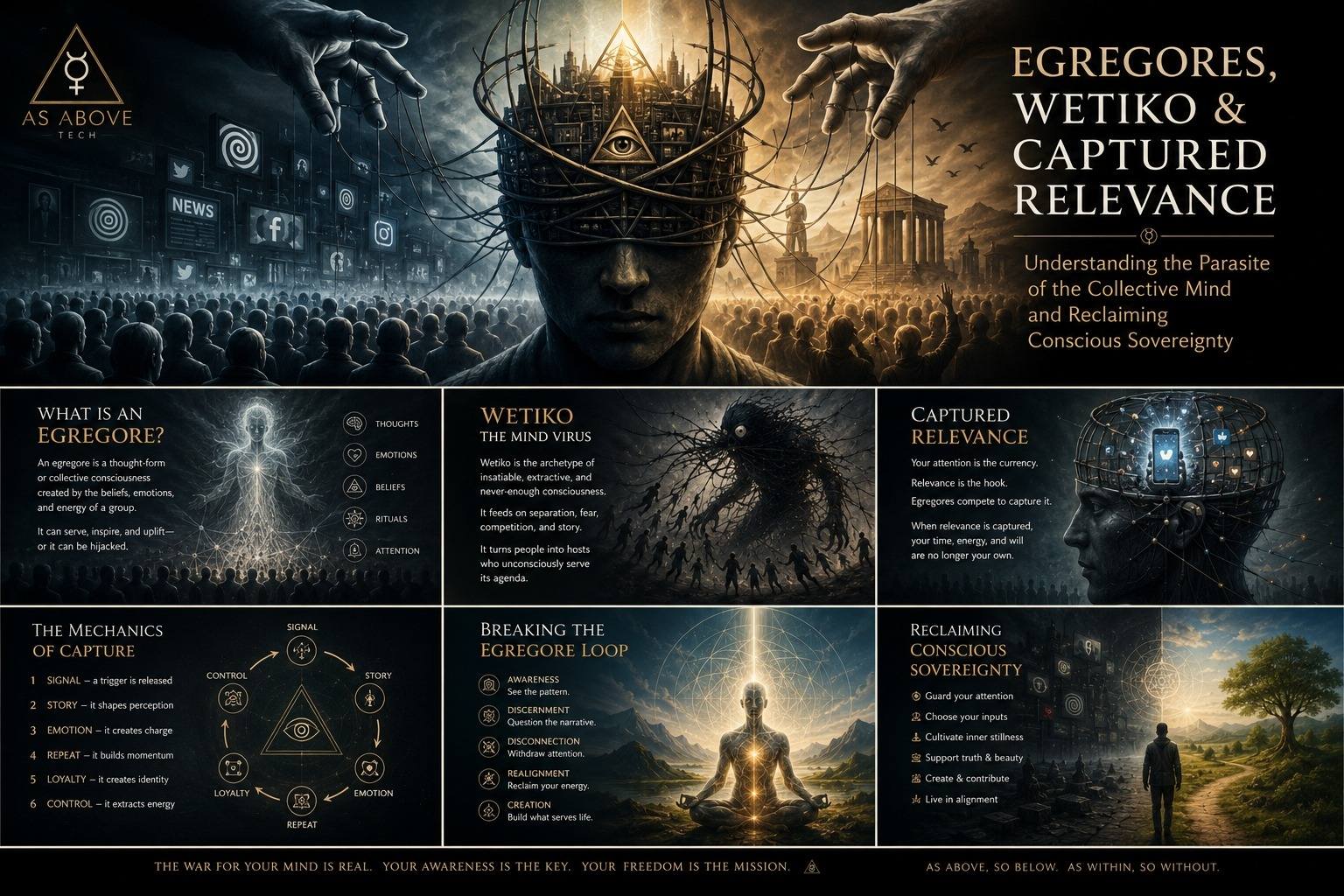
The antidote is not a list of tips. It is restored discernment, and it has four operations.
Starve it. Attention and emotion are the currency. Withdrawal is the documented dissolution mechanism. Both Stavish and Levy converge here, arriving from different traditions at the same practical instruction: stop feeding. This is harder than it sounds, because the egregore has captured the relevance function, which means withdrawing attention does not feel like a free choice. It feels like turning away from something important. The feeling is the capture. The disciplines of consciousness... meditation, contemplation, deliberate silence... are not hobbies. They are the training by which a person learns to hold attention steady against the pull of a captured relevance field.
Recover permitted comparison. The control surface of an egregore is language and which comparisons are permitted. Every captured relevance function has a set of comparisons it forbids... connections it will not allow the host to make. The diagnostic is simple: notice what you are not allowed to compare. Notice which questions provoke not disagreement but outrage. The outrage is the immune response of the egregore, and the comparison it forbids is usually the one that would reveal the distortion. Deliberately compare what the frame forbids comparing. Direct knowing... gnosis... begins with the willingness to see connections the group has declared impermissible.
Trace every distortion to its root truth. Ask what genuine good is being counterfeited. This is the diagnostic that explains captivating power, and it converts contempt into comprehension without excusing anything. The fascist movement counterfeited the genuine good of national restoration. The cult counterfeits the genuine good of belonging. The conspiracy theory counterfeits the genuine good of critical thinking. Understanding what the distortion copied is not sympathy for the distortion. It is the only way to disarm it, because a counterfeit cannot survive the comparison with the original... provided the comparison is permitted.
Integrate rather than project. Jung's sentence returns: when an inner situation is not made conscious, it happens outside, as fate. The wetiko you can only see in your enemies is the one operating in you. The shadow projected outward becomes fate. The shadow integrated becomes resource. Integration does not mean endorsement. It means the honest acknowledgment that the capacity for the distortion exists in oneself, which is the only ground from which it can be recognized in the world without being unconsciously replicated.
There is a sharper edge to this work. The anthropologist Joscelyn Godwin and the Buddhist teacher Sangharakshita both describe what might be called therapeutic blasphemy... the deliberate violation of one's own sacred frame, not as nihilism but as a test of whether the frame is alive or merely holding you. If questioning a belief triggers not reflection but panic, the belief is functioning as an egregore. A living truth can survive examination. Only a captured relevance function requires protection from it. Jung's transcendent function is the constructive counterpart: the reconciling third that arises from the unconscious to supersede a pair of opposites that reason alone cannot resolve. The symbol, in Jung's technical sense, is not a sign pointing to a known thing. It is the best possible expression of something not yet fully known... an emergence, not an instruction.
What Discernment Is For
Return to the misquote.
What Jung actually wrote is the harder sentence. It does not promise mastery. It describes consequence. When an inner situation is not made conscious, it happens outside, as fate. The entire essay has been an unpacking of that sentence: inner situations that remain unconscious... the shadow, the captured relevance function, the wetiko sickness, the egregore's grip on what counts as thinkable... do not wait. They happen. They happen as political movements, as institutional decay, as the slow replacement of a genuine tradition by its own image, as the thousand small moments in which a person chooses the smoother sentence over the truer one and does not notice the substitution.
The work is not to accumulate more. The failure space is unlimited and no amount of information narrows it. The work is to see what is actually there. Arrangement for what is disarranged. Separation for what has been mixed. Connect the dots without distorting them.
Anaxagoras called that faculty Nous. Aristotle gave it a target and a geometry. Cognitive science calls it relevance realization. The Latin names it in its roots: intelligere, to pick out from among. And the Hermetic tradition, which is the soil this essay grows from, states the premise most directly: The All is Mind. If that is true, then a thoughtform is not a metaphor. It is a literal description. And the act of discernment... the restoration of the relevance function to its owner... is not self-improvement.
It is the fundamental act of intelligence itself.
Marc Theiler writes at the intersection of markets, systems, and meaning. This essay is part of the Pneuma collection at As Above.
Notes on Sources
C. G. Jung. Aion: Researches into the Phenomenology of the Self, Collected Works vol. 9ii, trans. R. F. C. Hull (Princeton University Press, Bollingen Series XX). Para. 126, pp. 70-71. The misquote "Until you make the unconscious conscious..." does not appear in Jung's published writings; the genuine passage is "The psychological rule says that when an inner situation is not made conscious, it happens outside, as fate." See also Civilization in Transition (CW 10), "Wotan" (1936), paras. 385-399.
Mark Stavish. Egregores: The Occult Entities That Watch Over Human Destiny (Inner Traditions, 2018).
Jack D. Forbes. Columbus and Other Cannibals: The Wetiko Disease of Exploitation, Imperialism, and Terrorism (Seven Stories Press; first published 1978 as A World Ruled by Cannibals, revised edition 2008). Forbes was a scholar of Powhatan-Renape and Delaware-Lenape heritage.
Paul Levy. Dispelling Wetiko: Breaking the Curse of Evil (North Atlantic Books, 2013).
Aristotle. Nicomachean Ethics, II.6, 1106b28-31. Greek text: Bywater (Oxford, 1894). English: Rackham (Loeb Classical Library).
John Vervaeke, Timothy P. Lillicrap, Blake A. Richards. "Relevance Realization and the Emerging Framework in Cognitive Science," Journal of Logic and Computation, 2012.
Etymological sources. Symbolon and diabolos: Etymonline (Douglas Harper). Intelligentia: Lewis & Short, A Latin Dictionary (Perseus Digital Library); Wiktionary (hedged as "most likely from inter- + legere"). Hamartanein: Bywater Greek text at 1106b28.
Captured Relevance ... Part I of VI
This essay opens a six-part series on the captured relevance function. See the full series.