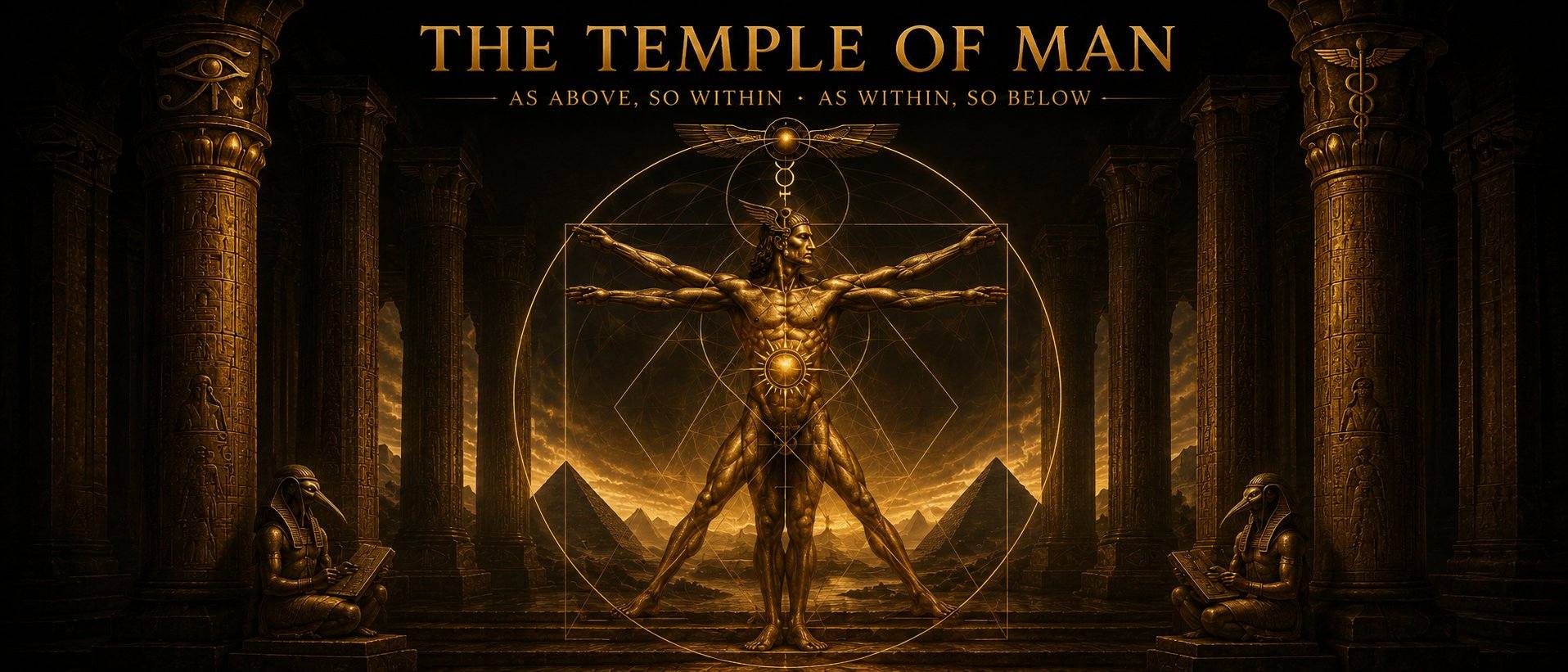
I'm going to Egypt in September. I've been reading about it for years, collecting maps and references and fragments of other travelers' notes, but in six weeks I'll actually be standing inside the Temple of Luxor. Walking the corridors. Touching the stone. And the reason I keep coming back to that particular building, among all the buildings I could visit in a country that has more monumental architecture per square mile than anywhere else on earth, is a book I first picked up almost a decade ago and have never quite been able to put down.
The book is The Temple of Man by R.A. Schwaller de Lubicz. Two volumes. Over a thousand pages. Four hundred illustrations, many of them hand-drawn geometric overlays of temple plans and hieroglyphic inscriptions. Twelve pounds, physically. It sits on a shelf in my office, and I have read it in pieces over years, returning to different chapters as different questions surfaced. It is the kind of book that changes depending on what you bring to it, and I don't say that as flattery. I say it as warning.
Because The Temple of Man is not really a book you read. It is a book that reads you. It asks questions about how you perceive number, proportion, symbol, and consciousness, and if you cannot answer those questions, whole chapters simply will not open. They will sit there, dense and geometric and patient, and wait for you to grow into them. I am still growing into several of them.
Schwaller de Lubicz spent fifteen years of his life inside the Temple of Luxor, measuring it stone by stone, wall by wall, inscription by inscription. What he concluded was this: the temple is not a monument to a dead civilization's political power. It is not an administrative building. It is not even, in the conventional sense, a place of worship. The temple is a human body rendered in stone at architectural scale. Every proportion corresponds to an anatomical ratio. Every chamber maps to an organ. Every carved hieroglyph aligns with the body part it physically occupies in the layout. The pharaonic builders did not decorate a building with symbolic images. They built the symbol. They became the building.
That is either the most important claim anyone has made about ancient architecture, or it is the most elaborate misreading of a ruin in the history of archaeology. Both possibilities are worth taking seriously. And both require you to understand the man who made the claim before you can evaluate the claim itself.
The Man Before the Temple
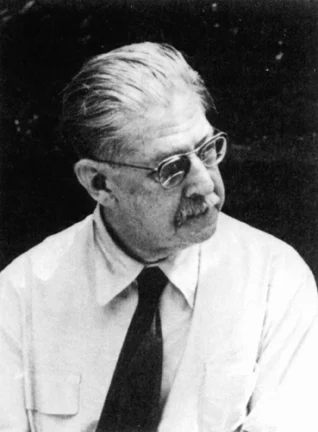
René Adolphe Schwaller was born in 1887 in Alsace-Lorraine, the Franco-Germanic borderland that has been traded back and forth between France and Germany so many times that the people who grow up there tend to think in two languages and belong fully to neither nation. His father was a pharmacist and chemist. The household was practical, scientific, and, apparently, tolerant of a strange child.
At age seven, holding a coin, the boy had what he would later describe as his first philosophical experience. He stared at the coin and realized that "one" was not just a quantity. One implied two, because the coin had two sides. Two implied relationship. Relationship implied a principle that was neither side but held both sides together. He was seven. Most of us at seven were trying to figure out multiplication tables. Schwaller was already thinking about the metaphysics of number.
At fourteen he had another formative moment, this time in his father's laboratory. An experiment with hydrochloric acid and metals produced a reaction that fascinated him, not because of the chemistry but because of what happened to the light. The color changes. The way matter seemed to shift its visible nature under specific conditions. He became obsessed with the relationship between light, color, and the fundamental nature of substance. This obsession never left him. It led him to alchemy. It led him to Egypt. It led him, eventually, to a theory of consciousness that is still difficult to categorize, because it sits at the intersection of physics, metaphysics, anatomy, and architecture, and refuses to be reduced to any single discipline.
At seventeen he fled to Paris. Alsace-Lorraine was under German control, and German military service was the alternative to leaving. Paris in 1904 was the center of the Western world's artistic and intellectual ferment, and young Schwaller threw himself into it with the appetite of someone who had been starving in the provinces. He studied painting under Henri Matisse. He absorbed Henri Bergson's philosophy of the élan vital, the creative impulse that Bergson argued was the engine of evolution, something that could not be reduced to mechanism. He engaged with Theosophy. He read the alchemical literature. He found his way into the Parisian occult underground, which in the early twentieth century was a genuine intellectual scene, not yet the commercialized New Age industry it would later become.
It was in Paris that he met the pseudonymous Fulcanelli, the mysterious figure whose identity has been debated for a century and whose book The Mystery of the Cathedrals proposed that the Gothic cathedrals of France were alchemical texts written in stone. Whether Schwaller was Fulcanelli's student, his collaborator, or his rival depends on which account you believe. What is clear is that Schwaller absorbed the central idea: that sacred architecture is a language, that buildings can encode knowledge, and that the knowledge encoded in stone is different in kind from the knowledge written in books. It is spatial. It is proportional. It requires the body to move through it in order to be understood.
He also worked on alchemically stained glass during this period, attempting to recreate the specific reds and blues of medieval cathedral windows using processes that involved metallic transmutation. Whether he succeeded is contested. That he tried tells you something about the kind of mind at work here: empirical, hands-on, willing to spend years on a single experiment, but aimed at questions that most empiricists would refuse to ask.
In 1917, at age thirty, he published A Study of Numbers, a short, dense, Pythagorean essay on the metaphysical meaning of mathematics. The book argues that numbers are not merely quantities. Two is not one plus one. Two is polarity, tension, genesis, the principle by which the undivided becomes divided and thereby creates a world. Three is reconciliation, the return of the divided to a higher unity. And so on. Each number is a function, an operator, a cosmic verb. This was not original to Schwaller; it came from Pythagoras and from Plato's Timaeus and from a thousand years of Neoplatonic mathematics. But Schwaller wrote it with the conviction of someone who had experienced it, not merely studied it.
The Metaphysics of Number
For Schwaller, number is not quantity but quality. Two is not "one plus one." Two is polarity: tension, opposition, genesis. Three is not "two plus one." Three is reconciliation: the return to unity at a higher level. Every number is a cosmic function. Mathematics, in this reading, is not a tool for counting. It is a language for describing the structure of creation itself.
During and after the First World War, Schwaller founded an organization called Les Veilleurs, "The Watchers," a group that mixed esoteric study with social idealism. He was given the honorific title "de Lubicz" by the Lithuanian diplomat and poet Oscar Vladislas de Lubicz Milosz, a gesture of recognition for his intellectual work. From that point on he was R.A. Schwaller de Lubicz, the name under which all his major works would be published.
In the 1920s and early 1930s he ran an esoteric community called Suhalia in Switzerland, part school, part laboratory, part intentional community. They studied color theory, plant alchemy, sacred geometry, and the philosophy of ancient civilizations. They tried to live the integration they studied. Like most intentional communities, Suhalia eventually ran its course and dissolved. But by then Schwaller had already turned his attention south. To Egypt. To the temple that would consume the next fifteen years of his life and produce the work for which he is remembered.
Everything before Luxor was rehearsal.
The Fifteen Years at Luxor
In 1936, Schwaller de Lubicz and his wife, Isha, traveled to Egypt. They had been before, briefly, but this time was different. Schwaller had a theory, formed during his study of Gothic cathedrals, that the Egyptian temples operated on the same principle he had glimpsed in Chartres and Notre-Dame: architecture as encoded knowledge, buildings as books written in proportion and stone rather than ink and paper. He wanted to test the theory. Not abstractly. Physically. Measurement by measurement, wall by wall.
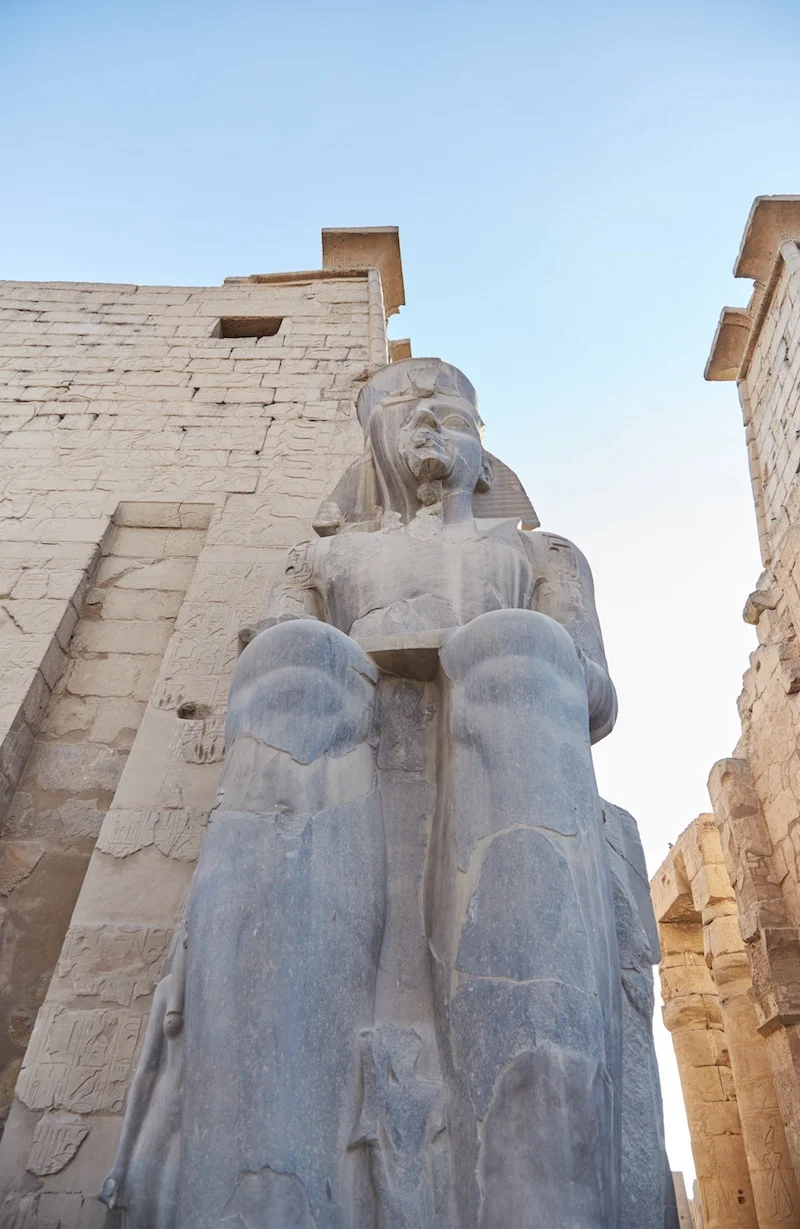
They settled in Luxor in 1937. Schwaller took up residence in a wing of the Winter Palace Hotel, which sits on the east bank of the Nile with a direct view across to the Valley of the Kings. It is still there. You can still stay there. The terrace where Schwaller presumably sat in the evenings, reviewing his notes and sketches, looks out over the same river, the same palms, the same western hills where the pharaohs were buried.
For fifteen years, until 1951, he walked the Temple of Amun-Mut-Khonsu at Luxor. Every day. Measuring. Sketching. Photographing. Analyzing the proportional relationships between walls, columns, doorways, inscriptions, and statuary. He did not do this alone. He collaborated with the French archaeologist Clément Robichon and the Egyptologist Alexandre Varille, both of whom brought conventional scholarly tools to the project even as Schwaller was asking unconventional questions. His stepdaughter Lucie Lamy produced hundreds of precise geometric drawings, overlaying proportional analyses onto architectural plans and carved reliefs. It was a family enterprise as much as an intellectual one.
The output was enormous. Over a thousand pages of text. More than four hundred illustrations. Detailed measurements of every significant wall, column, and passage in the temple complex. Geometric analyses showing the proportional relationships embedded in the architecture. Translations and symbolic interpretations of the hieroglyphic inscriptions, read not as administrative records but as a coordinated program of knowledge encoded in specific spatial locations within the building.
His alchemical reading of the Gothic cathedrals had prepared him for this, but Egypt went further than France. The cathedrals encoded knowledge about spiritual transformation. The Egyptian temple, Schwaller argued, encoded something more fundamental. It encoded the principle of god incarnating as man. The entire building was a diagram of the anthropocosmos: the universe as a human body, the human body as a universe.
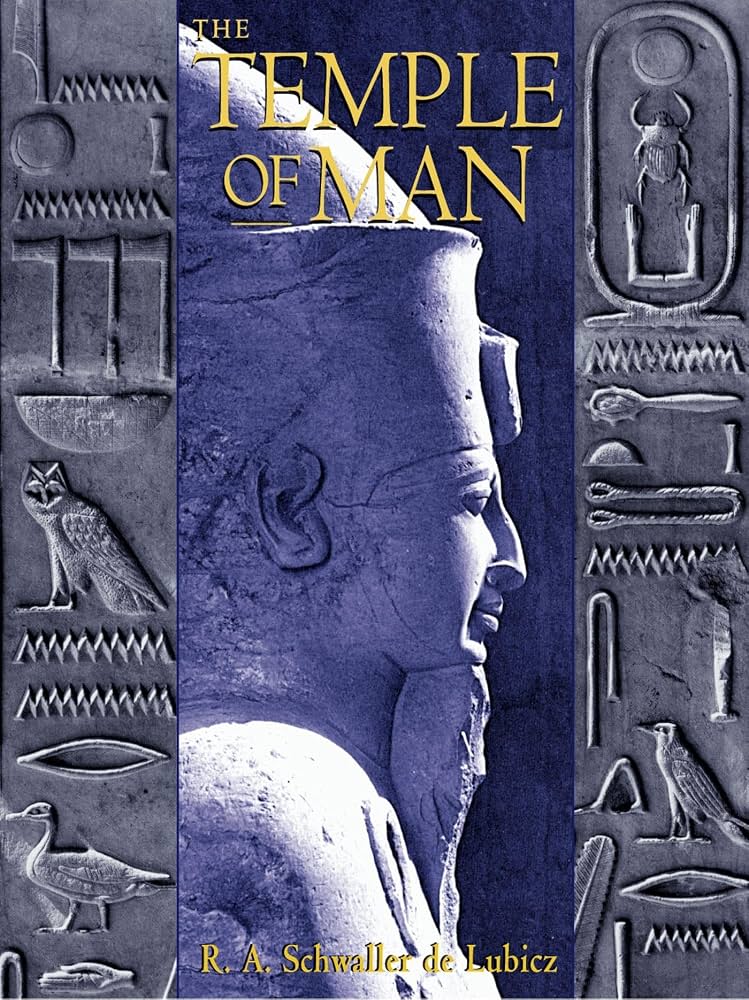
Le Temple de l'Homme / The Temple of Man
R.A. Schwaller de Lubicz
Original: Published in French in 1957 by Caractères, Paris, as Le Temple de l'Homme. The culmination of fifteen years of fieldwork at the Temple of Luxor (1937-1951).
Translation: English edition translated by Robert and Deborah Lawlor, published 1998 by Inner Traditions International. The translation took approximately twenty years to complete.
Scope: Part architectural survey, part philosophical treatise, part geometric proof, part esoteric manual. Covers pharaonic mathematics, sacred proportion, the symbolic function of hieroglyphics, the anatomy of the temple as a diagram of the human body, and the philosophical framework Schwaller called "the Pharaonic mind."
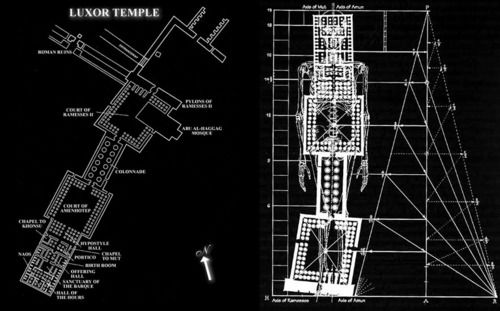
The Anthropocosm: Temple as Human Body
Here is the central claim, the one that makes people either lean forward or walk away.
Schwaller de Lubicz overlaid a human skeleton onto the ground plan of the Temple of Luxor. The alignment is extraordinary. The temple stretches approximately 258 meters in length, which Schwaller calculated as 140 "meridian fathoms," a unit he argued was derived from the measurement of the earth's meridian. The proportion is not arbitrary. It is the human body scaled to the planet.
Walk through it. The entrance colonnade corresponds to the legs. Where the temple narrows at a specific architectural transition, the proportional location matches the knees. The great hypostyle hall corresponds to the chest cavity. The inner chambers narrow and deepen as you move toward the sanctuary, which corresponds to the head, the cranium. The holy of holies, the most sacred room, the place where only the high priest could enter, sits at the location of the pineal gland.
Six pillars in the innermost chamber stand precisely where the eye sockets would fall in the overlaid skeleton. Those pillars are engraved with texts about spiritual perception, about seeing with the inner eye. The longest colonnade in the temple corresponds, proportionally, to the femur, the longest bone in the human body. The temple's covered halls correspond to the rib cage. The open courtyards correspond to the lower abdomen.
It keeps going. The hieroglyphic carvings on each wall depict subjects that correspond to the body part that wall represents in the overall plan. Inscriptions about generation and reproduction appear in the chambers that correspond to the reproductive organs. Inscriptions about breath and spirit appear in the chambers that correspond to the lungs. Inscriptions about divine thought and royal authority appear in the chambers that correspond to the head. The coordination is systematic. It extends across hundreds of walls and thousands of individual inscriptions.
Schwaller's argument is that this is not coincidence, not vague symbolism, not a pattern imposed by a wishful interpreter. The builders planned it. They designed a building that IS a human body at architectural scale, and they populated every surface of that building with inscriptions that are keyed to the anatomical location they occupy. The temple is a teaching instrument. You do not read it like a book, left to right, beginning to end. You walk through it like a body walks through itself, moving from the feet to the head, from the gross to the subtle, from the physical to the spiritual.
The placement of carvings also aligns with what later traditions would call energy centers. Whether or not you accept the chakra framework, the spatial correspondence is there in the architecture. Schwaller himself did not use the Sanskrit terminology. He used pharaonic terms and concepts. But the structural parallel is difficult to ignore: a vertical axis through the building, with specific locations along that axis corresponding to specific qualities of consciousness, ascending from the material to the spiritual, from the dense to the refined.
This is either a remarkable discovery about how the ancient Egyptians designed their most important buildings, or it is an extraordinarily detailed act of projection by a brilliant man who saw what he wanted to see. That tension has never been resolved. It may not be resolvable from the outside. You may have to stand inside the building.
The Anthropocosmic Principle
The anthropocosm is Schwaller's term for the ancient Egyptian understanding that the human body and the cosmos are not analogous but identical in principle. The same proportional laws that govern planetary orbits govern the growth of a femur. The same ratios that structure a crystal structure a skull. The temple makes this identity visible by rendering the body at the scale of a building and the building at the scale of the earth. "Man is the measure of all things" is not, in this reading, a humanist slogan. It is an architectural specification.
Sacred Number and the Golden Section
Phi. The golden ratio. Approximately 1.618. Most people encounter it as a curiosity, a mathematical oddity that shows up in sunflower spirals and Renaissance paintings and the proportions of the Parthenon. For Schwaller de Lubicz it was something else entirely. Phi was the root note of creation. The harmonic function by which unity divides itself into multiplicity without losing its unity. The mathematical signature of life itself.
Start with what phi actually is, mathematically. Take a line. Divide it so that the ratio of the whole line to the longer segment equals the ratio of the longer segment to the shorter segment. That ratio is phi. It is irrational, meaning it cannot be expressed as a simple fraction. Its decimal expansion never terminates and never repeats. And yet it appears everywhere in the natural world: in the spiral of a nautilus shell, in the branching of a tree, in the arrangement of leaves around a stem, in the proportions of the human body.
Your navel divides your height at approximately the golden ratio. The ratio of your forearm to your hand. The ratio of each successive phalanx in your fingers. The spiral of the cochlea in your inner ear. Life grows according to phi because phi is the most efficient way to pack information into space without redundancy, the closest thing nature has to a universal algorithm for self-similar growth.
Schwaller argued that the pharaonic builders understood this and built it into every proportion of the temple. The width-to-length ratios of chambers. The height-to-width ratios of doorways. The spacing of columns. The proportional relationships between successive rooms as you move deeper into the building. Phi is everywhere, not as decoration but as structure, the way a skeleton is structured by the ratios between bones.
But here is where Schwaller goes further than most writers on sacred geometry, and where his work becomes genuinely difficult to follow for anyone trained in modern mathematics. For Schwaller, phi is not just a number. It is the principle of "irrational scission," the way the One becomes the Many. In his framework, unity, the undivided source of all things, cannot divide itself rationally. Rational division produces fragments, pieces that have lost their connection to the whole. Irrational division, division by phi, produces parts that remain connected to the whole because the ratio between part and whole is the same as the ratio between part and part. Nothing is lost. Nothing is separated. The division is real, but the unity is preserved.
Irrational Scission
Rational division fractures: you cut something in half and get two pieces that no longer imply the whole. Phi division preserves: the ratio between the part and the whole is identical to the ratio between the parts. This, for Schwaller, is how unity becomes multiplicity without ceasing to be unity. It is the mathematical structure of creation. And it is written into the load-bearing walls of the temple.
This leads to his understanding of the Egyptian cubit. For most Egyptologists, the royal cubit is simply a unit of measurement, roughly 52.4 centimeters, the length from elbow to fingertip. Schwaller argued that different cubits were used for different functions and different deities, and that the cubit itself was not an arbitrary convention but a living relation between the human body and the cosmos. The cubit is not just a stick you measure with. It is the embodied ratio between flesh and universe. Measure with your forearm and you are measuring with a proportion that phi built into your skeleton.
Number, for Schwaller, is never quantity. Number is quality, function, operator. The Neter, the Egyptian word usually translated as "god" or "divine principle," is in Schwaller's reading an angle, an invariant geometric relation. The divine is not a personality sitting on a cloud. The divine is a proportion, a law, a ratio that holds constant while everything around it changes. The gods are functions. The temple is a calculator. The body is the proof.
The Intelligence of the Heart
If the anthropocosmic temple is Schwaller's most dramatic claim, the intelligence of the heart is his most radical one. And it is the one with the most implications for how we think about thinking.
Schwaller argued that there are two fundamentally different forms of intelligence. The first is cerebral intelligence, the kind we are trained in, the kind our civilization prizes. It is analytical. It takes things apart. It names and classifies and measures. It operates through the senses, through language, through sequential logic. It is extraordinarily powerful. It built the modern world. And it is, in Schwaller's account, only half the picture.
The second form is what he called the "intelligence of the heart." Not sentimentality. Not emotion in the greeting-card sense. A direct, simultaneous, intuitive apprehension of the whole, prior to analysis. The pharaonic mind, as Schwaller described it, was not our visualizing, analytical mentality. It was what he called a "sonar-intuitional mode." It did not look at things from the outside and describe them. It knew things from the inside, the way you know the taste of salt without being able to describe it to someone who has never tasted it.
The clearest expression of this duality, Schwaller argued, is in the Egyptian hieroglyphic system. Modern linguistics treats writing as a system of arbitrary signs: a word points to a referent, and the connection between the sign and the thing is conventional, agreed-upon, replaceable. Schwaller argued that hieroglyphics work on a completely different principle. He called it symbolique.
When an ancient Egyptian saw the hieroglyph of a bird, they did not merely decode a sign. They simultaneously held together multiple layers of meaning: the bird as a physical creature, the bird as a symbol of the cosmic function of flight, the bird as an embodiment of all the qualities associated with that particular species, the bird as a sound-value contributing to a larger word, the bird as a geometric form whose proportions carried their own meaning. All at once. Not sequentially. Not analytically. Simultaneously.
This is what Schwaller means by symbolique: the capacity to hold sense-perception and inner knowing together in creative polarity, without collapsing one into the other. The symbol is not a code to be cracked. The symbol is an experience to be inhabited. You do not translate a hieroglyph. You resonate with it. The translation kills precisely what the symbol was designed to keep alive.
He compared this to what Niels Bohr was discovering in quantum physics at roughly the same time Schwaller was working in Luxor. Complementarity. Light is both a wave and a particle, not one or the other, not alternately, but simultaneously, depending on how you observe it. Schwaller argued that the pharaonic mind operated on the same principle: holding complementary truths in simultaneous awareness rather than forcing a choice between them. Modern science fragments. It isolates variables. It controls conditions. It produces extraordinary precision about parts. Ancient Egypt unified. It held everything together. It produced extraordinary wisdom about wholes.
Complementarity and the Pharaonic Mind
Schwaller compared Egyptian symbolic thought to Bohr's complementarity principle in quantum mechanics. Just as light is simultaneously wave and particle, the hieroglyph is simultaneously sign and thing, sound and image, local meaning and cosmic function. The pharaonic mind did not choose between analytical and intuitive knowledge. It held both at once. That, Schwaller argued, is why Egyptian civilization sustained itself for three thousand years without fundamental disruption. The holding is the stability.
The Egyptians' word for the heart was ib. It appears in their texts not as the seat of emotion (that is our mapping, not theirs) but as the seat of intelligence, will, and moral judgment. In the weighing-of-the-heart ceremony depicted in the Book of the Dead, it is the heart that is placed on the scale against the feather of Ma'at, truth. Not the brain. The brain, in Egyptian funerary practice, was pulled out through the nose with a hook and discarded. The heart was preserved. That is not ignorance of anatomy. That is a statement about where intelligence lives.
Schwaller took this seriously. If the Egyptians said intelligence was in the heart, and their civilization lasted three millennia, and their architecture encodes mathematical relationships we are still discovering, then perhaps their epistemology, their theory of how knowledge works, deserves examination rather than dismissal.
What the Academics Got Wrong
The academic establishment's response to Schwaller de Lubicz has been, for seventy years, a combination of silence and occasional hostility. This is understandable. He was not trained as an Egyptologist. He came out of the occult tradition. His language is dense, difficult, and full of metaphysical claims that no peer-reviewed journal would publish. His books do not have abstracts, methodology sections, or literature reviews. They have geometric proofs embedded in philosophical arguments embedded in alchemical allusions.
But the dismissal has a problem. His measurements hold up.
Later scholars who have examined the Temple of Luxor with modern survey equipment have confirmed Schwaller's dimensional measurements, even when they reject his interpretations. The proportional relationships he identified in the architecture are there. The phi ratios are there. The anatomical correspondences in the ground plan are there. The coordination between inscription content and spatial location within the temple is there. You can argue about what it means. You cannot argue that he measured incorrectly.
Orthodox Egyptology, for most of the twentieth century, treated temples as political monuments. Pharaohs built them to demonstrate power, to house the state religion, to employ workers, to organize the economy. Hieroglyphics were administrative records, royal propaganda, funerary instructions. The symbolic and mathematical dimensions of the architecture were either ignored or treated as decorative. When Schwaller argued that every proportion in the building was intentional, that every inscription was placed in its specific location for reasons that integrated anatomy, mathematics, cosmology, and theology into a single coherent system... the response was mostly to look the other way.
The real disagreement is not about the data. The real disagreement is about what kind of mind produced the data. If you assume that the ancient Egyptians thought the way we think, analytically, sequentially, mechanistically, then Schwaller's readings look like projection. If you allow for the possibility that they thought differently, that their symbolic intelligence was a genuine cognitive mode and not a primitive version of our analytical mode, then his readings become at least plausible and possibly necessary.
John Anthony West did more than anyone to bring Schwaller's work to a wider audience. His 1979 book Serpent in the Sky is a readable distillation of the core arguments from The Temple of Man, stripped of much of the geometric technicality and written for an intelligent general reader. West also produced the Emmy-winning 1993 NBC documentary Mystery of the Sphinx, which argued, following Schwaller's earlier observation, that the water erosion patterns on the Great Sphinx of Giza indicate a construction date far earlier than orthodox Egyptology accepts. The geologist Robert Schoch provided the technical analysis. The claim remains contested but has never been refuted on geological grounds.
Graham Hancock and Robert Bauval built on Schwaller's foundational insight, that Egyptian civilization may be far older and far more sophisticated than the academic consensus allows, to produce their own investigations of astronomical alignments in the Giza pyramid complex and the possibility of a pre-dynastic source civilization. Whether you follow them all the way to their conclusions or not, the door they walked through was opened by Schwaller de Lubicz, standing in the Temple of Luxor with a measuring tape and a theory that no one in the academy wanted to hear.
The Temple of Man is a thousand pages of rigorous geometric proof mixed with philosophical speculation. Some of those pages are impenetrable. Some of them are among the most brilliant things anyone has written about the relationship between number and form. The book does not separate the provable from the speculative, and that is either its greatest flaw or its most accurate reflection of how the pharaonic mind actually worked. Everything at once. No fragments.
Why It Matters Now
We live in an age of maximum analytical intelligence and minimum symbolic intelligence. We can sequence a genome. We can image a brain down to individual neurons firing. We can model climate systems and protein folds and the trajectory of a spacecraft to within centimeters across millions of miles. Our measuring intelligence has never been sharper. And we cannot read a hieroglyph the way it was meant to be read.
That is not a sentimental complaint. It is a diagnostic observation. Something was lost. Not information, we have more information than any civilization in history, but a mode of knowing. The mode that holds the parts together. The mode that sees the building and the body simultaneously. The mode that hears a number and knows it as a quality, a function, a cosmic verb, not just a quantity to be manipulated.
Schwaller's work is a challenge. Can you hold the rational and the intuitive at the same time? Can you see a building as a body? Can you experience a number as a living principle? Can you look at a proportion and feel it as a law, not just measure it as a ratio? These are not rhetorical questions. They are practical ones. They describe a cognitive skill that can be developed, the same way analytical reasoning can be developed. And they describe a skill that our civilization has almost entirely stopped developing.
The fragmentation is everywhere. Science over here, art over there. Religion in its box, philosophy in its department, mathematics in its abstraction. Each discipline more precise within its own boundaries, each more disconnected from the others. The gains are real. Nobody wants to go back to a world without antibiotics or calculus or the ability to communicate instantaneously across the planet. But the losses are real too, and we are less equipped to see them precisely because the thing we've lost is the capacity to see wholes.
Schwaller's work suggests that the highest form of knowledge is not information but integration. The fusion of art, science, religion, and philosophy into one coherent system. That fusion, he argued, is what sustained Egypt for three thousand years. Three thousand. We have difficulty maintaining a political consensus for three decades. The Egyptians maintained a coherent civilization, with continuous artistic and architectural production, with stable social structures, with a functioning relationship between the sacred and the political, for three millennia. Whatever they were doing worked. And whatever they were doing, it was not what we are doing.
Their knowledge was not stored in databases. It was stored in buildings. In the proportions of columns and the placement of inscriptions and the ratios between rooms. The knowledge was the building. You could not download it, copy it, abstract it, or separate it from the physical form in which it was embedded. You had to walk through it. You had to enter the body of the temple the way consciousness enters the body of a human being: through the feet, upward, inward, toward the sanctuary, toward the place where the outer world and the inner world are the same place.
That is not efficient. That is not scalable. That is not optimized. And that, I suspect, is exactly the point.
Integration vs. Fragmentation
Egyptian civilization did not separate knowledge into disciplines. Art was mathematics. Architecture was anatomy. Religion was physics. Philosophy was geometry. The temple is the proof: a single building that is simultaneously a work of art, a mathematical treatise, an anatomical diagram, a cosmological model, and a spiritual instruction. Our age produces specialists who know more and more about less and less. Egypt produced generalists who knew everything about everything, because for them it was all one thing.
There is a personal dimension to this, and I will name it directly. I build things. Companies, systems, strategies. I spend most of my working life in the analytical mode, optimizing, measuring, iterating. It works. It is powerful. And every few years I hit a wall where the analytical mode stops producing returns, where the next level of insight requires a different kind of seeing, and I have to go find it. Books like The Temple of Man are where I find it. Not because they give me answers I can apply on Monday morning. Because they remind me that the mode of knowing I default to is only one mode, and that the other mode, the one that sees the whole, that holds contradictions in tension without resolving them, that feels proportion as meaning... that mode is not mystical decoration. It is an operational capability. And it can be trained.
The temple is still standing. Twenty-five hundred years after the last pharaoh, the walls are there, the columns are there, the inscriptions are there. The question is not whether the building has survived. The question is whether we can still read it. Whether we have the cognitive equipment to perceive what the builders encoded. Whether the intelligence of the heart is something we can recover, or whether it died with the civilization that cultivated it.
I don't know the answer. I think you have to go stand in the building to find out.
🌿 The As Above View
I'm going to walk these corridors in September. I've read about them for years and now I'll be inside them, and I expect the experience to be different from the reading in ways I cannot predict. That is, in fact, Schwaller's entire point. Some knowledge is spatial. Some knowledge requires the body. Some buildings have to be walked.
The Temple of Man weighs twelve pounds and spans two volumes. It took Schwaller fifteen years to write and the Lawlors twenty years to translate. It is not efficient. It is not optimized. It is the opposite of everything our age values. And that is precisely why it matters. We have gotten very good at compressing information. We have gotten very good at moving data at speed. What we have gotten worse at, steadily, for about four hundred years, is the kind of knowing that cannot be compressed, that requires time and space and physical presence, that lives in proportion and stone and the felt sense of a body moving through a building that is also a body.
Schwaller spent fifteen years in a temple to produce a book that takes years to read. The Egyptians spent centuries building the temple to encode knowledge that was meant to last millennia. Our attention spans are measured in seconds. Something in that contrast deserves examination, not as nostalgia for the ancient world, but as a practical question about what kinds of knowledge survive and why.
The temple is still standing. The companies I built ten years ago have already been reorganized. The strategies I wrote five years ago are already obsolete. The tweets from last week are already forgotten. But the temple is still standing. The phi ratios are still in the walls. The body is still in the ground plan. Whatever the builders knew about durability, about encoding knowledge into form, about building things that last... we could use some of that.
I'll report back from Luxor. Some things you have to see with your feet.
... Marc Theiler