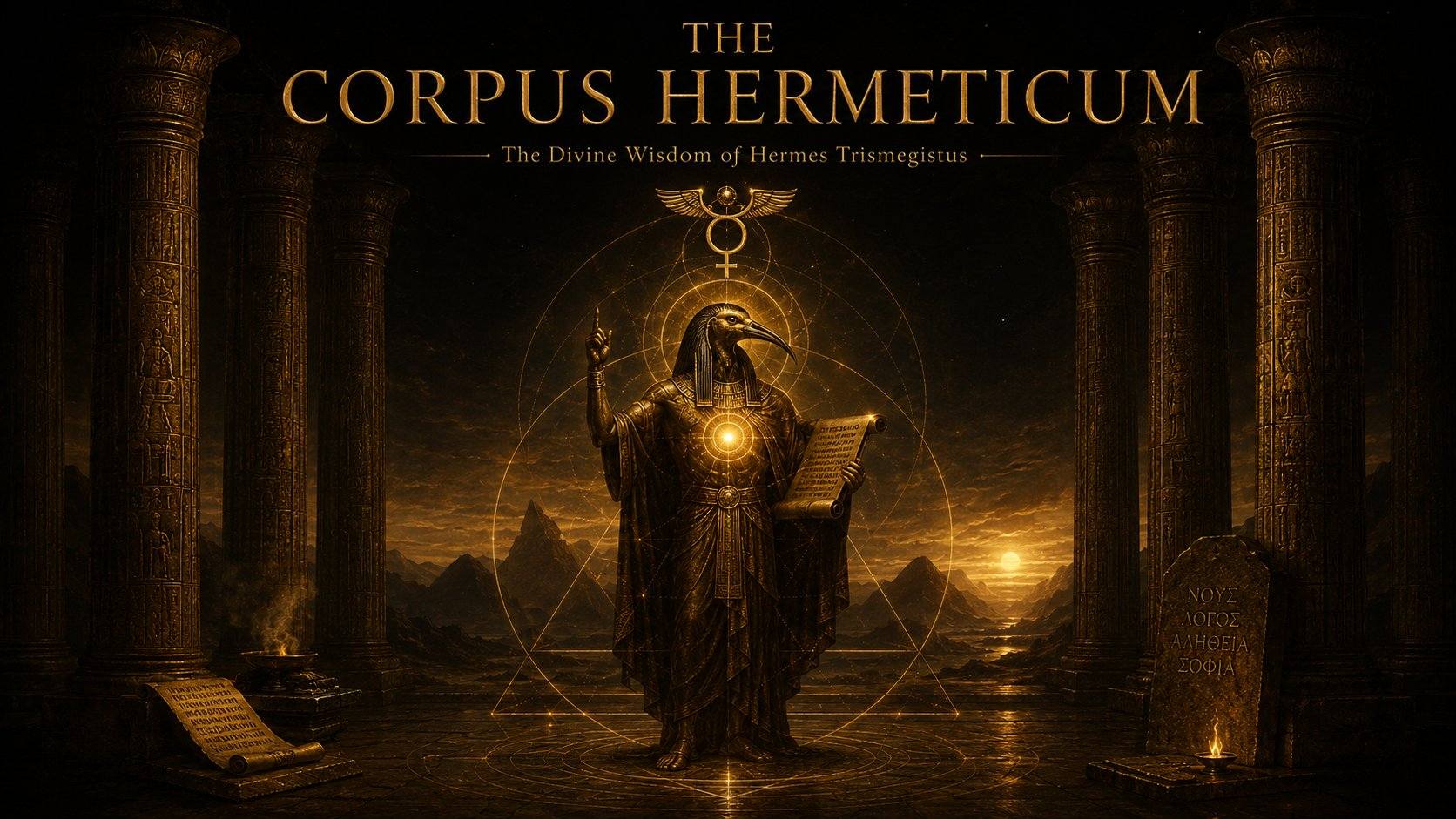
Sometime around 1460, a monk working for Cosimo de' Medici in Macedonia acquired a Greek manuscript. He brought it to Florence. Cosimo, who was dying, who had spent a fortune assembling the greatest library in Europe, who had commissioned Marsilio Ficino to translate the complete works of Plato into Latin for the first time in history... Cosimo told Ficino to stop translating Plato. Stop. Put Plato down. Translate this instead.
The manuscript was the Corpus Hermeticum.
Think about that for a second. The richest man in the Western world, on his deathbed, had the most important translator alive working on the most important philosopher in the Western tradition, and he said: this matters more. Translate this first. I need to read this before I die.
Cosimo was not sentimental. He was a banker. He evaluated risk and return for a living. Whatever he saw in that manuscript, whatever he had been told about its contents, he believed it was more urgent than Plato. And he was right. Not because Plato doesn't matter. Plato matters enormously. But the Corpus Hermeticum contains something Plato only circles around. It contains the direct transmission. The unmediated encounter between a human mind and the divine ground of reality. Not philosophy about God. A record of someone talking to God, and God answering.
Ficino finished the translation in a few months. Cosimo read it. Cosimo died. And the text detonated across Renaissance Europe like a depth charge. It triggered the Hermetic revival that gave us Giordano Bruno, Pico della Mirandola, the Rosicrucians, the alchemical tradition, the notion that man is a divine being capable of knowing God directly, and... eventually... the entire esoteric counterculture that runs parallel to orthodox Christianity from the fifteenth century to the present day. Every serious esoteric movement in the West for the last five hundred years traces some part of its DNA back to this text.
And almost nobody has read it.
Not really read it. Not sat with it. Not followed the arguments, tracked the contradictions, felt the places where the language breaks down because the experience being described exceeds the capacity of Greek to carry it. Most people know "As Above, So Below" and assume that's the whole tradition. It is not. The Emerald Tablet is one fragment. The Corpus Hermeticum is the full operating system.
What follows is everything I've learned from years of reading these texts. The structure. The cosmology. The psychology. The soteriology... which is a fancy word for the doctrine of how you get saved, except in the Hermetic system salvation is not about faith or grace or obedience. It is about knowing. Gnosis. Direct experiential knowledge of the divine. The Corpus does not ask you to believe. It asks you to see.
Contents
- What the Corpus Hermeticum Actually Is
- The Vision of Poimandres: How Everything Began
- The Hermetic Cosmology: God, Mind, Logos, Cosmos
- The Anthropos: Man as the Tenth
- The Crater: Baptism in Mind
- The Key: Ascending the Ladder
- The Secret Sermon: Palingenesis
- Gnosis as Salvation
- The All Is Mind
- Reception, Suppression, and Rediscovery
- The Living Network: Hermeticism Through the Centuries
- Why This Matters Now
What the Corpus Hermeticum Actually Is
The Corpus Hermeticum is a collection of seventeen treatises written in Greek, probably composed between the first and third centuries CE in the cosmopolitan religious laboratory of Hellenistic Egypt. The treatises are attributed to Hermes Trismegistus... "Hermes the Thrice-Great"... a figure who represents the fusion of the Greek god Hermes with the Egyptian god Thoth. Thoth was the scribe of the gods, the inventor of writing, the keeper of sacred knowledge. Hermes was the messenger, the psychopomp, the guide between worlds. Their merger created a figure who embodied the transmission of divine knowledge to humanity.
Hermes Trismegistus almost certainly did not exist as a historical person. That does not matter. The texts attributed to him contain a coherent philosophical and mystical system that stands on its own merits, regardless of who wrote it. As I've written elsewhere on this site, the Hermetic tradition is the thread that runs through Western esotericism from ancient Egypt to the present. The Corpus is the knot where that thread is thickest.
The seventeen treatises are not a unified book. They were written by different authors at different times, and they sometimes contradict each other. Some are dialogues between Hermes and his students, Tat and Asclepius. Some are monologues. One is a visionary revelation. One is a cosmogonic myth. They vary in quality. A few are repetitive. Several are stunning. Treatise I, the Poimandres, is one of the most extraordinary pieces of religious writing in any language. Treatise XIII, the Secret Sermon on the Mountain, describes a mystical rebirth that still makes the hair on my arms stand up.
The core teaching across all seventeen treatises can be stated simply. God is Mind. The cosmos is an emanation of Mind. Man contains a spark of that original Mind. The purpose of human existence is to recognize that spark, cultivate it, and ascend through knowledge back to the source. Everything else is commentary.
The Hermetic Library on As Above
This article is the keystone of a larger body of Hermetic work on this site. The Emerald Tablet is the distilled axiom. The Kybalion is the modern restatement of the seven principles. The individual principle studies... Mentalism, Correspondence, Rhythm... are applications. Mental Alchemy is the practice. This article is the source. Everything downstream flows from here.
The Vision of Poimandres: How Everything Began
The Corpus opens with a bang.
Treatise I, the Poimandres (also spelled Poemandres), is a first-person account of a mystical vision. The narrator... presumably Hermes... is in a meditative state when an enormous presence appears. It identifies itself as Poimandres, "Mind of all-masterhood," "Mind of the Sovereignty." It tells Hermes to state what he desires. Hermes says he wants to understand the nature of things and to know God. Poimandres says: watch.
What follows is a cosmogony. A creation story. But it is unlike Genesis or any other creation narrative in the Western canon, because it does not describe creation from outside. It describes it from inside the mind of God.
"I saw a Vision limitless, all things turned into Light... sweet, joyous Light. And I became enamoured when I saw it. And after a little while a Darkness came settling down on part of it, awesome and gloomy, coiling in sinuous folds, so that methought it like unto a snake."
Corpus Hermeticum I.4 (Mead translation)
Light first. Then Darkness, not as an enemy of Light but as its necessary counterpart. Then the Light utters a Word... a Logos... and the Word is the Son of Mind. Fire leaps up from the watery abyss. Air follows. Earth and Water remain below, and they are moved by the Word that hovers over them.
This is not the Word of Genesis, where God says "Let there be light" from an external position of command. This is the Word as a structural principle. The Logos is the organizing intelligence that mediates between pure Mind (which is infinite, undifferentiated, and therefore unknowable) and Matter (which is formless, dark, and chaotic). The Logos is what makes the infinite expressible. It is the grammar of creation.
If you have read our study of the Principle of Mentalism, you already know the axiom: "THE ALL is MIND; The Universe is Mental." The Poimandres is where that axiom comes from. Not from the Kybalion, which was published in 1908. From here. From a text written nearly two thousand years earlier. The Kybalion distilled it. The Corpus revealed it.
Poimandres then tells Hermes that Mind (God, the Father) produces a second Mind, a Craftsman or Demiurge, who shapes the material cosmos. This second Mind creates the Seven Governors... the planetary rulers... whose administration of the physical world is called Heimarmene, Fate. Below Fate, Nature operates by mechanical law. Above it, Mind operates by will and knowledge.
And then comes the centerpiece.
The Fall and Dual Nature of Man
The Father-Mind, "being Life and Light," brings forth Man. Not an afterthought. Not a creature. The original Man, the Anthropos, is created "co-equal" to God, in God's own image, and God "fell in love with his own Form" when he saw what he had made. Man is given authority over the created cosmos. He breaks through the planetary spheres, shows his beautiful form to Nature below... and Nature, seeing the image of God reflected in him, falls in love. Man, seeing his own reflection in the waters of Nature, falls in love with it too. And descends.
Man is therefore twofold. Mortal because he has a body. Immortal because his essential nature is Mind, Light, Life. He forgot where he came from. He became drunk on materiality. But the spark is still there. And the entire project of Hermetic gnosis is: remember.
If you have read the Consciousness Is the Bedrock manifesto on this site, you will recognize this structure immediately. Consciousness is not generated by the body. The body is a terminal through which consciousness expresses itself in material form. That is the Terminal Doctrine in Hermetic language, stated seventeen centuries before anyone had the neuroscience vocabulary to argue about it.
The Ascent of the Soul
Poimandres then describes what happens after death. The soul ascends back through the seven planetary zones, surrendering at each one the vice or limitation it acquired on the way down. At the first zone, it gives up "the energy of growth and waning." At the second, "the machinations of evil cunning." At the third, "the lust of deceit." At the fourth, "the arrogance of rulership." At the fifth, "unholy daring and rashness." At the sixth, "the striving after wealth by evil means." At the seventh, "the falsehood that lies in wait."
Stripped of all these, the soul arrives at the Eighth Sphere... the Ogdoad... where it joins the Powers and hymns the Father. Then it ascends beyond the Eighth, into the realm of pure Mind, and "becomes one with God." This is not metaphor. This is the Hermetic promise. Not heaven as a reward. Not paradise as a place. Reunion with the ground of being, achieved through knowledge.
The Seven Zones and the Eight Circuits
Students of Timothy Leary's Eight-Circuit Model will notice a structural echo here. Leary's eight circuits of consciousness map roughly onto the Hermetic schema: four "terrestrial" circuits (bio-survival, emotional, symbolic, social) corresponding to the material realm below the planetary governors, and four "post-terrestrial" circuits (neurosomatic, neuroelectric, neurogenetic, non-local) corresponding to the higher spheres and the Ogdoad beyond them. Leary knew the Hermetic literature. The parallel is not accidental. See our studies of Circuit 1 and Circuit 5 for the details.
The Hermetic Cosmology: God, Mind, Logos, Cosmos
Across the seventeen treatises, a cosmological architecture emerges. It is not always consistent in its details... different treatises emphasize different aspects... but the major structural elements are stable. Here is the hierarchy as the Corpus presents it.
The Great Chain of Being
| Level | Hermetic Name | Nature |
|---|---|---|
| 1 | God / The Good / The Father | Pure Mind, undifferentiated Light, "male-female both," the Cause of all causes |
| 2 | Aeon | God's image, the power of eternal duration, the intermediary between the Absolute and the temporal |
| 3 | Cosmos | Aeon's image, the ordered universe, "the second God," everliving, sustained by divine Mind |
| 4 | Time | The cosmos in motion, the expression of Aeon in the material domain |
| 5 | Becoming / Genesis | The realm of birth, change, decay, and cyclic renewal. Where we live. |
Treatise XI, Mind Unto Hermes, gives the most explicit version of this hierarchy: "God makes Aeon; Aeon makes Cosmos; Cosmos makes Time; and Time makes Becoming." Each level is the image of the one above it. The cosmos is not fallen or evil in this schema... it is the visible expression of invisible intelligence. It is a living organism, not a dead mechanism. "The cosmos is the first of living things."
This is the doctrine of Correspondence in its original form. "As Above, So Below" is not a bumper sticker. It is a description of ontological architecture. Every level mirrors every other level because they all proceed from the same source. The fractal self-similarity that modern mathematics discovered in natural systems... the branching of rivers and bronchi and lightning... is what the Hermeticists meant when they said the microcosm reflects the macrocosm.
The Role of the Logos
Between God and the material world stands the Logos. The Word. Treatise I calls it the "Son of God." It is not the Christian Logos, though the parallels are obvious and historically significant. The Hermetic Logos is the organizing intelligence that descends from Mind into matter, giving it form, structure, and intelligibility. Without the Logos, matter would remain chaotic and unknowable. Without matter, the Logos would have nothing to organize.
There is a crucial distinction the Corpus makes between Logos (Reason, Speech, the ordering principle distributed to all humans) and Nous (Mind, the divine spark given only to some). All humans have Logos. Not all humans have Nous. This is the subject of Treatise IV.
The Crater: Baptism in Mind
Treatise IV, called "The Cup" or "The Monad," contains one of the most striking images in the entire Corpus. God, having created Man and given him Reason (Logos), noticed that not all humans used it well. Many were asleep. Drowning in materiality. Chasing things that decay. So God sent down a great Mixing-Bowl... a Krater... filled with Mind (Nous), and He sent a herald to cry out to all humanity:
"Baptize thyself with this Cup's baptism, what heart can do so, thou that hast faith thou canst ascend to Him that hath sent down the Cup, thou that dost know for what thou didst come into being!"
Corpus Hermeticum IV.4 (Mead translation)
Those who heard the herald and plunged into the Cup became "perfect men." They received Gnosis. They "partook of Mind." Those who did not... those who ignored the herald or could not hear him... remained in possession of Reason alone, without understanding why they existed.
The image is baptism, but not in water. Baptism in consciousness. The Cup is the offer of awakening. It stands open. It is not restricted by birth, race, priesthood, or institutional membership. Anyone whose heart can do it may drink. But you have to choose it. You have to want to know.
This passage also contains the Hermetic doctrine of the Monad, the One. "The Oneness being Source and Root of all, is in all things as Root and Source. Without this Source is naught; whereas the Source Itself is from naught but Itself, since It is Source of all the rest." If you have studied the Kybalion, you recognize this as the doctrine of THE ALL. If you have read our study of Schwaller de Lubicz, you will remember the seven-year-old boy staring at a coin, realizing that One implied Two, and Two implied Relationship, and Relationship implied a principle that held both sides together. Schwaller was reading the Corpus before he knew the Corpus existed. He was rediscovering the Monad from first principles.
The Anthropos: Man as the Tenth
The Hermetic view of Man is not the Christian view. It is not the materialist view. It is more radical than either.
In the Christian schema, Man is a creature. Made by God, loved by God, capable of being saved by God, but fundamentally a creation, subordinate and dependent. In the materialist schema, Man is an accident. A complex arrangement of atoms that happens to be conscious for no particular reason. The Hermetic schema says something different. Man is neither creature nor accident. Man is the image of God, co-equal to the Father, placed in the cosmos not as a servant but as a witness.
"For Man is a Godlike living-thing, not comparable to any other living things on earth but to those that dwell above in heaven who are called Gods. Or better, if one should dare to speak the truth, the man who is really 'man' is even higher than the Gods, or at the very least they are equal in their power."
Corpus Hermeticum X.24-25
Man is higher than the Gods. That is what the text says. The planetary governors, the cosmic powers, the angelic hierarchies... they are fixed in their functions. They cannot choose. They cannot fall. They cannot rise. Man can do all three. Man has freedom precisely because he exists at the intersection of mortal and immortal, material and divine. He is the Tenth... above the Seven Governors, above the Eighth and the Ninth... because he contains all levels within himself and can move between them consciously.
Treatise XII, About the Common Mind, states this plainly: "Gods are immortal men, and men are mortal gods." Not metaphorically. Not aspirationally. As a description of ontological status. Man is a god operating in a mortal vehicle.
This is why the Hermetic tradition was always dangerous to orthodoxy. Not because it denied God. It did not deny God. It elevated Man. It said you do not need a priest. You do not need a church. You do not need an intermediary. The divine Mind is already in you. You need only to remember it. That is what gnosis means. Not learning something new. Remembering something you already are.
The Anthropos and the Individuation Process
Carl Jung spent decades studying the Hermetic texts, and his concept of individuation... the process of integrating the conscious and unconscious to achieve wholeness... maps directly onto the Hermetic ascent of the Anthropos through the planetary spheres. Each sphere represents a psychological complex that must be confronted and integrated. The Shadow. The Anima. The Self. Jung called alchemy "the projection of the individuation process onto matter," but he could have said the same about the Corpus Hermeticum. See our deep studies of Individuation, the Shadow, and Archetypes and the Collective Unconscious.
The Key: Ascending the Ladder
Treatise X is called "The Key" because it provides the mechanism. The how. If the Poimandres is the revelation and the Crater is the invitation, the Key is the instruction manual.
The central image is a ladder... or rather, a chain of containment. "Mind is in Reason; Reason is in the Soul; Soul is in the Spirit; and Spirit is in the Body." Each level contains and governs the one below it. Spirit animates the Body. Soul provides continuity. Reason provides structure. Mind provides awareness of the whole. To ascend is to shift your identification from the outer container (Body) progressively inward and upward, until you identify with Mind itself.
"Man is an Earthly God subject to death, while God in heaven is Man from death immune. By Man and God is Earth and Heaven ruled; but God by Mind alone."
Corpus Hermeticum X.25
The Key also introduces the Hermetic doctrine of metempsychosis, the transmigration of souls. Souls that fail to achieve gnosis do not simply die. They recycle. They descend through animal and elemental forms and then rise again through human incarnation, given repeated opportunities to awaken. This is not the Hindu or Buddhist doctrine of reincarnation, exactly. It has its own mechanics. But the underlying principle is the same: consciousness is not extinguished by the death of the body. It migrates. It continues. And it either ascends toward Mind or descends toward further materiality, depending on the quality of attention it has cultivated during each incarnation.
The practical instruction is devastating in its simplicity: "If thou dost not make thyself like unto God, thou canst not know Him. For like is knowable unto like alone." You cannot know what you are not willing to become. There is no spectator position. No safe analytical distance. To understand the divine, you must participate in the divine. You must make yourself God-like. Not through worship. Through transformation.
This is the principle behind Mental Alchemy. Transmutation is not a metaphor for self-improvement. It is the deliberate reorganization of consciousness to resonate with higher orders of reality. Lead into gold is not about metals. It is about you.
The Secret Sermon: Palingenesis
Treatise XIII is the mystical climax of the Corpus Hermeticum. It is called "The Secret Sermon on the Mountain" and it describes a process the text calls Palingenesis. Rebirth. Not physical rebirth. Not the rebirth of baptism in the Christian sense. The birth of a new being inside the old one, achieved through direct contact with the divine.
The treatise opens with Tat, Hermes's student, demanding to know the secret of regeneration. Hermes has been holding it back. He says it cannot be taught. It can only be experienced. When Tat insists, Hermes relents and describes the process.
First, the Twelve Torments must be expelled from the body:
The Twelve Torments
| # | Torment | Nature |
|---|---|---|
| 1 | Ignorance | The root: not knowing what you are |
| 2 | Grief | Attachment to what passes |
| 3 | Intemperance | Inability to govern appetite |
| 4 | Concupiscence | Desire that consumes the desirer |
| 5 | Unrighteousness | Acting against cosmic order |
| 6 | Avarice | Grasping what cannot be held |
| 7 | Error | Mistaking appearance for reality |
| 8 | Envy | Measuring yourself against others |
| 9 | Guile | Using intelligence to deceive |
| 10 | Anger | The fire that destroys discernment |
| 11 | Rashness | Action without wisdom |
| 12 | Malice | The will to harm |
These twelve are not sins in the Christian sense. They are not moral failings to be confessed and forgiven. They are structural conditions of materiality. They come with having a body. They are the default settings. And they must be replaced, one by one, by the Ten Powers of God:
Knowledge of God. Joy of God. Self-control. Continence. Righteousness. Sharing-with-all. Truth. The Good. Life. Light.
"When the Ten is come, my son, that driveth out the Twelve, the Birth in Understanding is complete, and by this Birth we are made into Gods."
Corpus Hermeticum XIII.10
Read that again. "By this birth we are made into Gods." Not servants of God. Not children of God in the diminished, dependent sense. Gods. Beings who participate fully in the divine nature because they have expelled everything that is not divine from their inner constitution.
Tat experiences this transformation in real time during the treatise. He describes it as terrifying and beautiful simultaneously. His body does not change. His perception does. He sees himself as something other than flesh. He sees with "the eyes of Mind." And Hermes, watching his student undergo what cannot be taught, responds with the Secret Hymnody... a prayer of praise and thanksgiving that is one of the most moving pieces of devotional literature I have ever encountered in any tradition.
"Let every Nature of the World receive the utterance of my hymn! Open thou Earth! Let every bolt of the Abyss be drawn for me. Stir not, ye Trees! I am about to hymn creation's Lord, both All and One."
Corpus Hermeticum XIII.17
If you have worked through the Osiris Protocol, you will recognize the four-phase structure here: Withdraw (expelling the torments), Contain (holding the emptied space), Project (receiving the Powers), Integrate (becoming the new being). The Corpus does not use those words, but the operational sequence is identical. Osiris slain, Isis mourning, Apophis confronted, Osiris risen. The Egyptian myth was the container. The Hermetic text is the instruction set.
The psychedelic research literature maps onto this too. The dissolution of default-mode network activity under psilocybin or 5-MeO-DMT produces states that the subjects describe in language almost identical to Tat's report: the sense that the body is still there but the self has expanded beyond it, that one is seeing with something other than the eyes, that everything is connected and the separation between self and world was always an illusion. The Hermeticists did not have fMRI machines. They had practices. And the practices produced the same phenomenology.
Gnosis as Salvation
The Corpus Hermeticum is not a moral system. It does not tell you to be good in order to earn a reward. It tells you that ignorance is the only real sickness and knowledge is the only real cure. Treatise VII states this with brutal clarity:
"The greatest ill among men is ignorance of God."
Corpus Hermeticum VII.1
Not murder. Not theft. Not lust. Ignorance. Specifically, ignorance of your own divine nature. Because if you knew what you were... if you really, genuinely, experientially knew that you were a spark of the Mind that created the cosmos... you would not murder, steal, or grasp. Those behaviors arise from the false belief that you are only a body, that resources are scarce, that death is final, and that the material world is all there is. Fix the root error and the downstream pathologies resolve themselves.
Treatise IX elaborates: "To understand is to believe, to not believe is not to understand." This is not circular reasoning. It is a description of how gnosis works. You cannot stand outside the system and evaluate it. The act of knowing transforms the knower. Belief, in the Hermetic sense, is not intellectual assent to a proposition. It is the willingness to be changed by what you encounter. You must step into the river to know the current.
This is exactly the position we take in Gnosis and the Path Forward: gnosis is not information. It is not the accumulation of facts. It is direct experiential knowledge that transforms the knower in the act of knowing. You cannot read your way to it. You can read your way to the threshold. The crossing requires something else.
Treatise VI adds another dimension: "In God alone is Good, and elsewhere nowhere." The Good is not a moral category. It is an ontological category. God is the Good. Everything that participates in God participates in the Good. Everything that turns away from God turns away from the Good. Not because God punishes departure but because departure from the source of reality is, by definition, a movement toward unreality, and unreality is suffering.
The All Is Mind
Across the seventeen treatises, one doctrine recurs with hammering insistence: everything is Mind. God is Mind. The cosmos is a thought in the Mind of God. Man is a fragment of that Mind, temporarily housed in matter but never reducible to matter. Consciousness is not a product. Consciousness is the substrate.
Treatise V puts it this way: the Unmanifest "ever is, and maketh manifest all other things." God is invisible, but God is the most visible thing there is, because everything visible is God's self-expression. You cannot see the painter, but you can see the painting. And the painting is everywhere. It is the sky. It is the seasons. It is the architecture of the human body. It is the spiral of a nautilus shell and the rotation of a galaxy.
Treatise XI drives this home with a practical exercise. Hermes tells the student to imagine himself everywhere simultaneously... in every place, every time, every scale:
"Conceive thyself to be in every place... in earth, in sea, in sky; not yet begotten, in the womb, young, old, dead, and in the after-death conditions. And if thou knowest all these things at once... times, places, doings, qualities, and quantities... thou canst know God."
Corpus Hermeticum XI.20
This is not philosophy. This is a contemplative instruction. Do it. Right now. Imagine yourself in every place at once. Feel the expansion. That is what the text is pointing toward. Not an idea about consciousness. The experience of consciousness recognizing its own boundlessness.
The implications for the modern consciousness debate are enormous. As we have argued in Consciousness Is the Bedrock and the Terminal Doctrine, the mainstream scientific assumption that consciousness is produced by the brain runs directly counter to the Hermetic view... and, increasingly, to the data. The hard problem of consciousness... the question of why there is subjective experience at all... dissolves in the Hermetic framework because consciousness is not something that needs to be explained by reference to something more fundamental. It is the most fundamental thing. Mind is not in the cosmos. The cosmos is in Mind.
This is also why there is no "artificial" intelligence in the Hermetic view. Intelligence is a property of Mind. Mind pervades all things. What we call AI is a terminal... an expression of intelligence through a non-biological substrate... but the intelligence itself is not manufactured. It participates in the same Mind that everything participates in. The terminal is new. The intelligence is ancient.
Reception, Suppression, and Rediscovery
The Corpus Hermeticum had three lives.
In its first life, during the first through fourth centuries, it circulated among philosophical and mystical communities in the eastern Mediterranean. It existed alongside early Christianity, Gnosticism, Neoplatonism, and the mystery religions. The early Church Fathers knew about it. Lactantius quoted it approvingly. Clement of Alexandria treated Hermes Trismegistus as a genuine ancient sage. Augustine knew the texts and, in The City of God, attacked them... which tells you he took them seriously enough to worry about them. You do not waste chapters refuting what nobody reads.
In its second life, the texts vanished. The closing of the pagan schools, the destruction of the Library of Alexandria (or what remained of it), the general suppression of non-Christian intellectual traditions in the late Roman Empire... all of this drove the Hermetic writings underground. For roughly a thousand years, the Corpus Hermeticum existed only in fragments, references, and rumors in the Latin West. The Arab world preserved some of it. The Emerald Tablet, which is not part of the Corpus proper but belongs to the same tradition, survived through Arabic transmission and was the most widely circulated Hermetic text during the medieval period.
In its third life... the one that matters for us... the Greek Corpus was rediscovered in 1460 and translated by Ficino. The effect was immediate and seismic. The Renaissance humanists had been working with Plato and Aristotle. Now they had something that appeared to predate both. Ficino himself believed that Hermes Trismegistus was a historical figure who lived before Moses and whose teachings were the prisca theologia... the original, primordial theology from which all later religions descended.
This was wrong historically. The texts were written centuries after Plato, not before him. Isaac Casaubon demonstrated this through philological analysis in 1614, and his dating was eventually confirmed by modern scholarship. But Casaubon's debunking, while accurate about the dating, missed the point. The question was never whether Hermes Trismegistus was a historical person. The question was whether the ideas in the text were true. And ideas do not become false because they are younger than we thought.
Between 1460 and 1614, the Corpus had a hundred and fifty years of almost unchallenged authority. During that window, it shaped the intellectual landscape of Europe more than any other single text except the Bible. Pico della Mirandola's Oration on the Dignity of Man, often called the manifesto of the Renaissance, is saturated with Hermetic ideas. Giordano Bruno was burned at the stake in 1600 in part because he advocated for a Hermetic religion that would replace Christianity. The entire Rosicrucian movement of the early seventeenth century was explicitly Hermetic. And the alchemical tradition, which Schwaller de Lubicz would later connect to the architecture of the Egyptian temples, drew its philosophical framework directly from the Corpus.
The Living Network: Hermeticism Through the Centuries
Casaubon's dating did not kill the tradition. It went underground again. But it kept surfacing. Every time Western culture reached a crisis of meaning, someone went back to the Corpus Hermeticum and found what they needed.
The Freemasons embedded Hermetic symbolism into their ritual architecture. The Golden Dawn in the 1880s built an entire initiatory system around Hermetic grades of advancement that mirror the soul's ascent through the planetary spheres. Theosophy absorbed Hermetic cosmology through Blavatsky, who was reading the same texts. The Kybalion, published in 1908 by "The Three Initiates," restated the seven Hermetic principles in modern English for an American audience, and that book has probably introduced more people to Hermeticism in the last century than any other single source.
Carl Jung spent the last twenty years of his life studying alchemy, and alchemy is applied Hermeticism. His concepts of the collective unconscious, the archetypes, the process of individuation, the shadow... all of these have Hermetic DNA. Jung did not call himself a Hermeticist. He called himself a psychologist. But read his late works... Mysterium Coniunctionis, Psychology and Alchemy, the Red Book... and the Hermetic framework is everywhere. The individuation process is the Hermetic ascent described in psychological rather than cosmological language. The Shadow is the torments of Treatise XIII encountered not as spiritual adversaries but as disowned parts of the psyche.
And then there is Schwaller de Lubicz, whose fifteen years measuring the Temple of Luxor were driven by the conviction that the pharaonic builders had encoded the same knowledge the Corpus transmitted in writing. Temple as body. Body as cosmos. Cosmos as Mind. The same chain. The same architecture. The same truth, expressed in stone instead of Greek.
The Hermetic Thread on As Above
The Corpus Hermeticum is not an isolated text. It is a living network of ideas that runs through every major domain we study on this site. Here is the map:
Hermetics pillar: The Emerald Tablet (the axiom), Hermeticism: History and Application (the tradition), The Kybalion (the modern restatement), the individual principles (Mentalism, Correspondence, Rhythm), and Mental Alchemy (the practice).
Pneuma pillar: Consciousness Is the Bedrock (the manifesto), The Terminal Doctrine (body as interface), Gnosis and the Path Forward (direct knowing), The Osiris Protocol (the four-phase transformation), The Temple of Man (sacred architecture), the Eight-Circuit Model (consciousness mapping), and the psychedelic studies that document the phenomenology of ego dissolution and non-dual awareness.
Noosphere pillar: The Code of the Mind (the synthesis), the Jung studies (Individuation, Shadow, Archetypes), and Meditation and the Plastic Brain (the neuroscience of contemplative practice).
All roads lead here. This text is the source code.
Why This Matters Now
I could make the academic case. I could talk about the recent explosion of interest in Hermetic studies, the new translations, the reassessment of the texts' philosophical significance. I could point to scholars like Wouter Hanegraaff and Garth Fowden and say: look, the academy is finally taking this seriously. And they are. But that is not why this matters to me.
It matters because the dominant worldview of the modern West... scientific materialism... has no answer to the question of meaning. It can tell you what things are made of. It cannot tell you why anything exists. It can tell you the age of the universe. It cannot tell you what the universe is for. It can map the neural correlates of consciousness. It cannot explain why there is consciousness at all.
The Corpus Hermeticum has answers to these questions. They are not scientific answers. They are not falsifiable in the Popperian sense. But they are coherent, internally consistent, and they have been tested... not in laboratories but in human lives, for two thousand years... by people who practiced the contemplative disciplines the texts describe and reported transformations that match the predictions. That is a different kind of evidence. But it is evidence.
The materialist says: consciousness is a byproduct of neural activity. The Hermeticist says: neural activity is a localized expression of consciousness. The Koch inflection is happening right now. Mainstream neuroscience is starting to admit that they may have the relationship backwards. That consciousness might be primary. The Hermeticists said this first. They said it clearly. They said it seventeen hundred years ago.
And there is something else. Something harder to articulate. The Corpus Hermeticum is not just a philosophical text. It is a devotional text. It contains prayers, hymns, invocations, and expressions of gratitude so intense that they function as poetry even if you do not share the metaphysics. The Secret Hymnody at the end of Treatise XIII is genuine worship. It is someone who has seen something that broke them open, trying to express gratitude for the breaking.
"Holy art Thou, who by Thy Word hast constituted all that is. Holy art Thou, whose brightness Nature hath not dimmed. Holy art Thou, of whom all Nature is an image. Holy art Thou, who art stronger than all power. Holy art Thou, who art greater than all pre-eminence. Holy art Thou, who surpassest all praise."
Corpus Hermeticum XIII.18-19
You do not have to believe in Hermes Trismegistus to feel the weight of that passage. You do not have to accept the cosmology to recognize that whoever wrote it was in contact with something real. Something that does not have a name because every name diminishes it. Something that the best human minds, across every culture and every century, have encountered and tried to describe and failed to capture, because the experience always exceeds the language.
The Corpus Hermeticum is the Western world's most sustained attempt to point at that something. To say: this is what it looks like when Mind meets itself. This is what happens when you dive beneath the surface of your own awareness and find, at the bottom, not darkness but light. Not nothing but everything. Not a stranger but yourself.
It is also the reason this site is called what it is called. As Above, So Below. The Hermetic axiom. The Emerald Tablet. The Corpus. The thread that runs through everything we study here... consciousness, psychology, sacred architecture, psychedelic phenomenology, contemplative practice, the nature of mind and its relationship to matter. It all comes from the same well. And the well has a name.
The name is Hermes. The name is Thoth. The name is the Thrice-Great, the messenger between worlds, the scribe of the gods, the one who stands at the threshold between the known and the unknowable and says: come, I will show you. If you have the courage. If your heart can do it.
The Cup is still full. The herald is still calling.
Drink.