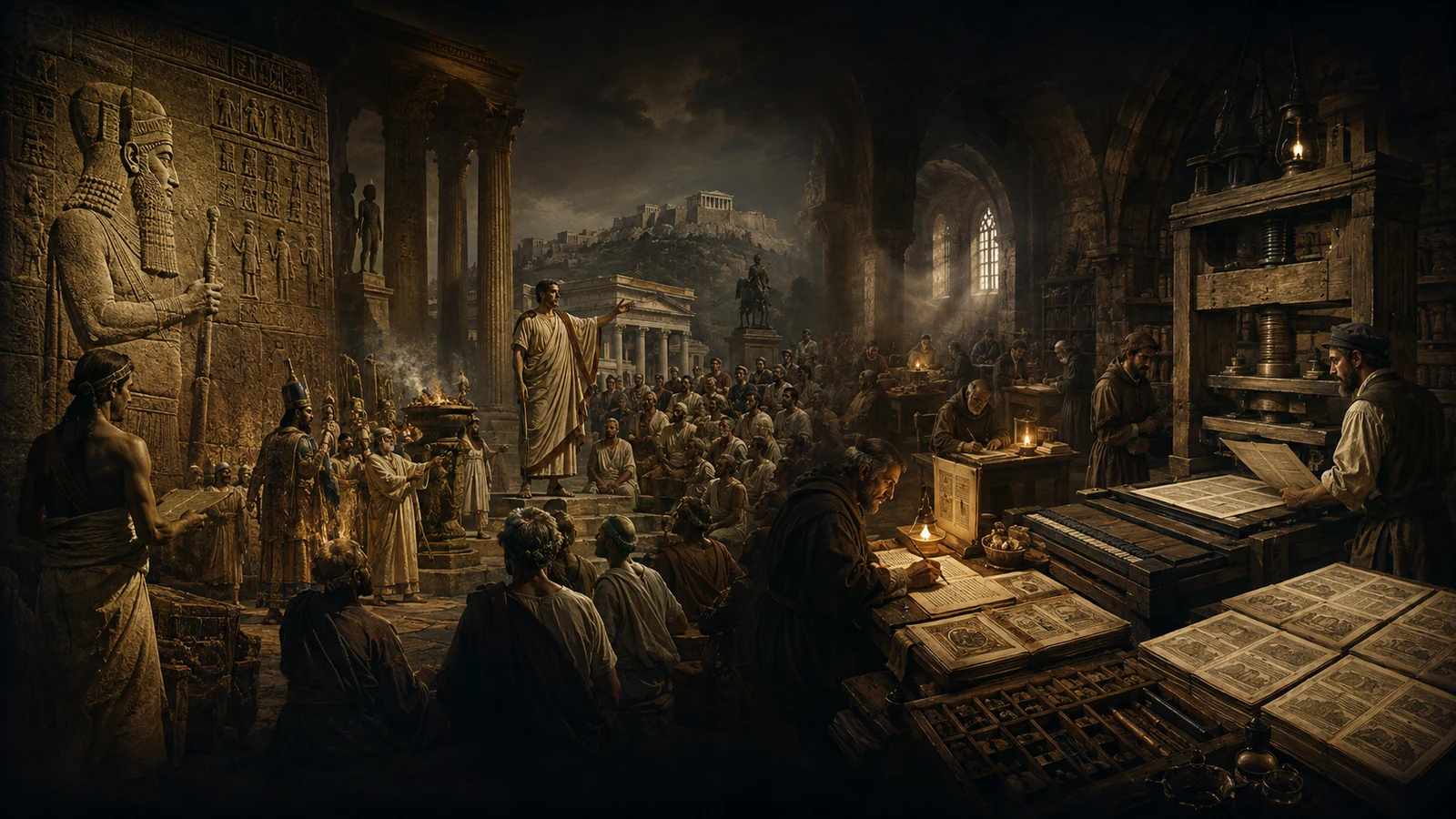
Before propaganda had a name, power already understood staging. A ruler did not merely issue a law. He carved it into stone, placed a god above it, and made authority look permanent. An emperor did not merely govern. His face moved through markets on coins, crossing distances he never would. A preacher, orator, general, and scribe all worked within the same constraint: a message could change behavior only if an audience received it, remembered it, and recognized some reason to obey.
The temptation is to call all of this psychological warfare. That is too easy. It flattens radically different societies into one modern category, erases religious and civic meanings, and mistakes any persuasive artifact for an operation. The more useful question is narrower: which parts of influence architecture existed before the modern word, and what changed when a new medium altered the cost of repetition?
The answer is not that the techniques were ancient and constant. The techniques changed because audiences, institutions, literacy, transport, and media changed. What recurs is a structure: authority, audience, encoding, distribution, reinforcement, and feedback.
The history of influence is not a parade of secret tricks. It is the history of who could make a version of reality travel.
The architecture readout
- Monument: power joins text, image, scale, location, and sacred legitimacy.
- Assembly: rhetoric turns the audience’s character and emotional state into explicit variables.
- Portable authority: coins and standardized portraits move the sovereign through everyday exchange.
- Manuscript: copying remains slow, expensive, and controlled by institutions that choose what survives.
- Print: reproducibility lowers the cost of identical messages, expands reach, and makes contest between narratives faster.
- Evidence rule: a persuasive artifact proves that someone communicated. It does not, by itself, prove centralized coordination, reception, or behavioral effect.
The category error comes first
Modern psychological operations are organized activities. They involve an intended audience, an objective, authorized actors, planned media, and some attempt to assess effect. Ancient kings and religious institutions certainly tried to shape belief and behavior, but they did not operate inside modern military doctrine, mass polling, broadcast systems, or algorithmic feedback.
So the responsible historian separates three claims. First, the artifact exists. Second, its design plausibly served influence. Third, it measurably changed behavior. The first may be documented. The second is often a strong inference. The third is usually the hardest to establish, because reception data rarely survives.
| Layer | Question | Ancient form | Evidence needed |
|---|---|---|---|
| Authority | Who is permitted to define reality? | King, god, senate, priesthood, civic office | Authorship, patronage, legal or ritual status |
| Audience | Whose perception or conduct matters? | Subjects, soldiers, rivals, allies, worshippers | Placement, language, access, described target |
| Encoding | What makes the message memorable? | Image, myth, ceremony, speech, law, genealogy | Form, symbols, sequence, repeated motifs |
| Distribution | How does it travel? | Roadside monument, coin, envoy, sermon, manuscript | Copies, find locations, routes, circulation |
| Reinforcement | What makes it consequential? | Ritual, taxation, force, status, repeated performance | Institutional practice and enforcement record |
| Feedback | How does the sender know it worked? | Tribute, compliance, allegiance, revolt, imitation | Administrative records, responses, counter-texts |
Stone made authority look eternal
The Louvre’s account of the Code of Hammurabi describes a 2.25-meter basalt stela created around 1750 BCE. Its 282 judgments are often described loosely as a law code, but the museum emphasizes that it is a collection of legal decisions. At its summit, Hammurabi stands before Shamash, god of justice, receiving the insignia of power.
The communication is doing several things at once. The judgments present order. The stone presents durability. The relief presents divine authorization. The scale presents hierarchy. Even an observer unable to read every line can read the social grammar: justice descends through the ruler.
That does not prove a coordinated psychological operation. It does establish an engineered fusion of law, image, sacred authority, and public display. The medium is part of the claim. A rule scratched on disposable material would not mean the same thing.
Darius I’s inscription at Behistun adds distribution strategy. The multilingual monument was cut high above a major route linking the Iranian plateau and Mesopotamia. An ICOMOS evaluation published by UNESCO describes it as a dynastic declaration tied to the restoration of the Persian Empire and notes that versions of the message were copied and circulated, including a copy found at Babylon’s Ishtar Gate.
Location, language, image, and duplication formed one system. The mountain declared permanence. The road supplied audience. Multiple languages widened legibility. Copies detached the claim from the original stone. Behistun was not merely a text about victory. It was infrastructure for making one account of victory authoritative.
Aristotle made the audience part of the machine
In the fourth century BCE, Aristotle’s Rhetoric formalized three modes of persuasion: the character of the speaker, the emotional disposition of the audience, and the argument presented in the speech. The familiar shorthand is ethos, pathos, and logos.
The important move was not a list of tricks. It was a model of the receiver. Judgment changes with trust. It changes with anger, fear, affection, and hope. It changes with how an argument is arranged and delivered. Persuasion is therefore not stored only in sentences. It is produced by a relationship among speaker, audience, occasion, and form.
That insight is foundational to every later influence system. A message has no fixed force outside the audience state into which it arrives. The same speech delivered by a trusted citizen, a defeated rival, and an occupying power is not the same intervention.
The enduring shift
The sender stops asking only, “What is true?” and begins asking, “What can this audience hear from this speaker, in this emotional condition, at this moment?” That is the birth of audience analysis as an explicit craft, even though it is not yet modern behavioral science.
Rome put the sovereign in your hand
Monuments required people to approach them. Coins traveled to the people. The Metropolitan Museum of Art notes that widely distributed Roman coins publicized imperial portraits and conveyed ideals through images and inscriptions. Portrait types were not casual likenesses. The museum’s survey of Roman imperial portraiture explains that official images projected ideas about the emperor, his family, and his authority in support of legitimacy.
This is portable political media embedded inside economic life. A coin does not ask for attention as a speech does. It arrives through wages, trade, taxes, gifts, and military payment. It joins message and utility. Repetition happens because the object must circulate.
Augustus’s Res Gestae Divi Augusti shows a parallel technique in text: the ruler becomes curator of his own record. The inscription enumerates offices, gifts, public works, victories, and settlements in the first person. It is evidence about what Augustus wanted remembered, not a neutral audit of his reign.
The distinction is essential. Self-description is a primary source for the speaker’s presentation. It is not automatically a primary source for every event as presented. In modern language, the document is both archive and positioning.
The manuscript world controlled memory through scarcity
Before industrial reproduction, each copy demanded materials, skilled labor, time, and institutional support. That made selection power visible. Libraries, courts, monasteries, temples, and wealthy patrons decided which texts were copied, translated, illustrated, displayed, or allowed to disappear.
The Bayeux Tapestry, recognized by UNESCO’s Memory of the World program, demonstrates how a long visual sequence can organize political memory. It narrates the Norman conquest of England through recurring figures, captions, omens, oaths, violence, and succession. Historians debate patronage and interpretation, which is precisely why it belongs here. It is a surviving narrative architecture, not a verified transcript of what every viewer believed.
A linear sequence imposes causality. One scene makes the next feel earned. Characters are introduced before their actions are judged. Symbols establish providence and status. The viewer moves through an argument even when no single panel states the thesis.
Scarcity also creates survival bias. The messages of institutions most capable of preserving objects are overrepresented in the record. Absence of a counter-narrative may mean it never existed. It may also mean nobody with a scriptorium chose to copy it.
The legend test: what the cats of Pelusium actually prove
Popular histories often begin ancient psychological warfare with a cinematic story: when Cambyses II attacked the Egyptian city of Pelusium in 525 BCE, Persian forces supposedly placed animals sacred to Egyptians before their line, preventing defenders from firing.
The story comes from Polyaenus’s Stratagems, composed in the second century CE, roughly seven centuries after the event. Herodotus, writing much closer to the conquest, describes the campaign and Pelusium but does not include the sacred-animal tactic.
Cambyses won Pelusium by exploiting Egyptian reverence for cats and other sacred animals.
Late literary tradition. It is valuable evidence that later writers considered cultural belief exploitable in war. It is not secure contemporary evidence for how Pelusium fell.
This is the series method in miniature. A vivid story can preserve a real strategic principle while remaining historically uncertain. The principle is target knowledge: beliefs, taboos, identities, and sacred commitments can constrain behavior. The anecdote’s evidentiary weakness does not make that principle false. The principle’s plausibility does not make the anecdote true.
Print changed the supply curve of repetition
Gutenberg did not invent printing, movable type, or the first printed book. Any serious account begins in East Asia.
The British Library’s International Dunhuang Programme describes the Diamond Sutra of 868 CE as the earliest dated printed book. Its seven sheets were printed from woodblocks and joined into a scroll more than five meters long. Its colophon states that Wang Jie commissioned it for broad distribution. Reproducibility was already serving religious transmission centuries before Gutenberg.
Korea’s Jikji, printed in 1377, is recognized by UNESCO as the oldest surviving book printed with movable metal type. That matters not as a footnote, but as protection against a false civilizational story in which communication technology advances only when Europe discovers it.
What Gutenberg’s system did in mid-fifteenth-century Western Europe was combine movable metal type, presswork, ink, paper, skilled production, and a receptive commercial environment into a powerful replication system. The Library of Congress describes the Gutenberg Bible as the first great Western book printed from movable metal type and notes the rapid growth of presses and books in the following decades.
The crucial shift was economic. Copying a manuscript makes most costs recur with every copy. Printing requires substantial setup, then lowers the marginal cost of the next page. The same arrangement of words can appear in many places with far greater fidelity. Identical claims can travel beyond the presence of the speaker. Corrections can travel too, but so can accusations, polemics, decrees, heresies, maps, and manuals.
The press did not invent persuasion. It changed the number of people who could reproduce it, contest it, and mistake repetition for consensus.As Above, Part II
Only later did propaganda acquire its institutional name
The word’s modern lineage is often traced to the Catholic Church’s Congregatio de Propaganda Fide. The congregation’s Vatican historical archive dates its first meeting to January 6, 1622 and describes its mission as coordinating the propagation of the faith.
That is where this article stops. Not because influence began in 1622, but because a recognizable architecture had become an explicitly named institution. Part II has traced the components that came before: authority, audience analysis, symbolic encoding, portable media, institutional memory, and reproducible distribution.
The modern era will add mass literacy, newspapers, telegraphy, photography, radio, cinema, polling, advertising science, bureaucracy, intelligence agencies, and eventually digital optimization. Those are not merely faster versions of Behistun. Each medium creates new audiences, new feedback loops, and new powers.
The counter-signal
Not every monument is propaganda
Art, worship, law, commemoration, administration, and persuasion can coexist in one object. A political effect does not reveal a single purpose.
Audiences were never empty vessels
People mocked rulers, misread symbols, preserved local memory, refused commands, and adapted official messages to their own interests.
Survival is not reception
An artifact that reached a museum proves endurance. It does not prove reach, belief, compliance, or causal effect in its original audience.
Similarity is not continuity
A modern campaign may resemble an ancient ritual without descending from it. Recurring constraints can produce similar solutions independently.
The strongest historical influence analysis therefore works in two directions. It takes power’s self-presentation seriously, because rulers and institutions invest in images for reasons. It also refuses to confuse investment with success. Senders design. Audiences interpret. History rarely preserves both sides equally.
A six-question field guide
- Who paid for the message? Patronage narrows the plausible objective, even when it does not settle it.
- Who could encounter it? Place, language, literacy, ritual access, and transport define the real audience.
- What behavior was available? Belief is vague. Tribute, enlistment, obedience, conversion, silence, and revolt are observable targets.
- Who could reproduce it? Copying capacity is power. Ask who controlled stonecutters, mints, scribes, presses, and distribution routes.
- What enforced the story? A narrative backed by law, ritual, money, status, or force is not simply another opinion.
- What resistance survived? Search for satire, rival inscriptions, destroyed images, contradictory records, and evidence of noncompliance.
The medium becomes the next battlefield
Part I began with a modern military paper that treated the information environment as a continuous theater. Part II has moved backward to show why that idea could emerge. Long before the phrase “information environment,” power already competed to structure what populations could see, repeat, remember, and act upon.
But a medium is not a neutral pipe. Stone favors permanence. Speech favors presence. Coin favors circulation. Manuscript favors custodians. Print favors reproducibility. Each one changes the ratio between sender, copy, audience, and reply.
That is the bridge to Part III: Marshall McLuhan and the claim that the medium does not merely carry the operation. The medium reorganizes the population on which the operation can work.
Source register
Evidence reviewed September 5, 2026. Institutional descriptions establish artifact history and context. Interpretive claims are identified in the article as analysis.
- Musée du Louvre, The Code of Hammurabi. Artifact description, date, legal content, and divine-legitimacy relief.
- ICOMOS evaluation of Bisotun, via UNESCO. Placement, multilingual inscription, dynastic declaration, and evidence of copied distribution.
- Aristotle, Rhetoric, Book I. Speaker character, audience disposition, and proof as modes of persuasion.
- Metropolitan Museum of Art, Roman Portrait Sculpture. Official portrait types and imperial legitimacy.
- Metropolitan Museum of Art, Roman coin entry. Coin circulation as a carrier of portraits, inscriptions, and political ideals.
- Res Gestae Divi Augusti, English translation. Augustus’s first-person presentation of offices, works, gifts, and victories.
- UNESCO Memory of the World, Bayeux Tapestry. Narrative form, symbolism, and documentary significance.
- Polyaenus, Stratagems, Book VII, with Herodotus, Histories, Book III. Late sacred-animal story compared with the earlier account.
- International Dunhuang Programme, The Diamond Sutra. Earliest dated printed book and evidence of intended distribution.
- UNESCO, Jikji Memory of the World Prize. Oldest surviving book printed with movable metal type.
- Library of Congress, Gutenberg Bible. Western movable-type milestone and expansion of European print.
- Historical Archive of Propaganda Fide, The Congregation. Institutional history and the 1622 first meeting.
Educational historical analysis only. “PsyOp” is used as a comparative lens and does not imply that every persuasive artifact was deceptive, centrally coordinated, or behaviorally effective. AI tools assisted research and editorial production.
Trace the architecture before you inherit the conclusion.
Source-linked work on markets, technology, consciousness, and the systems that shape agency.