
Almost everyone gets peptides backwards. They hear a compound name on a podcast, watch a physique transformation on X, find a vendor, buy a vial, and only then ask what it does. The vial is step one and the thinking is step nine. That order is why most beginners waste money, learn nothing, and occasionally hurt themselves. This guide inverts it. By the time you are allowed to buy anything here, you will have done seven other things first, and you will know exactly how to tell whether the eighth one worked.
⚠️ Read This Before Anything Else
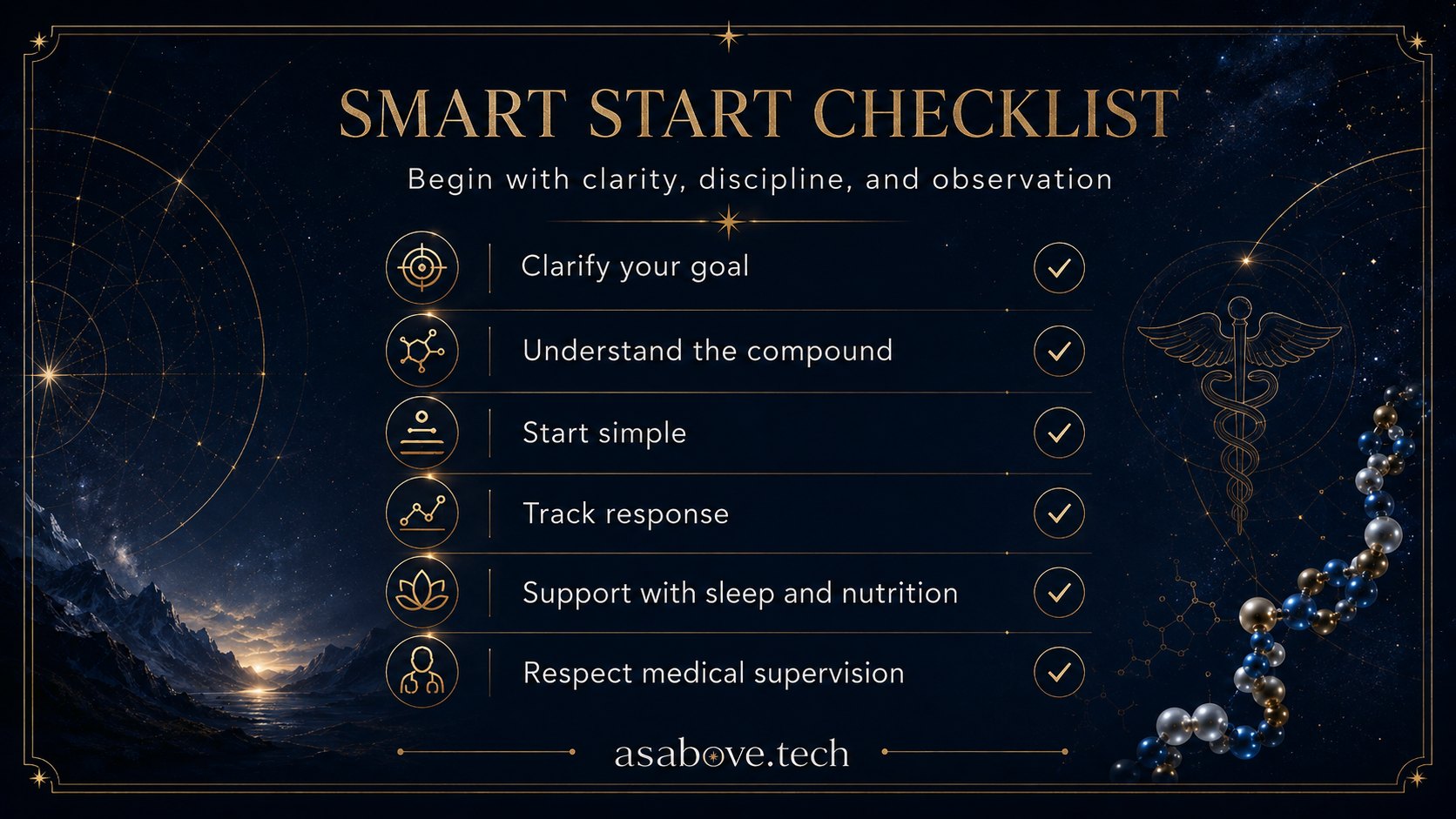
This article is education, not medical advice, and nothing in it is a prescription. Most peptides discussed here are not FDA-approved drugs. Many are sold as research chemicals, several sit inside an unresolved federal compounding review, and a few are banned in tested sport. Doses mentioned are reported real-world examples from public sources, included so you can evaluate claims critically, not so you can copy them. Peptides interact with medications, hormones, and existing conditions. Work with a physician who will actually order labs and read them. If you have or have had cancer, are pregnant or nursing, or manage a chronic illness, the correct beginner protocol is a conversation with your doctor and nothing else.
Who This Guide Is For
You are curious. You have heard the words BPC-157, retatrutide, MOTS-c, or GLOW enough times that they have stopped sounding exotic. You suspect there is something real underneath the hype, and you also suspect that most of the people selling it to you are not qualified to advise you. Both suspicions are correct.
This guide assumes zero background. It builds the biology from scratch, then hands you a decision sequence you can actually execute, then tells you the specific ways beginners get hurt. It is deliberately conservative, because the failure modes of moving slowly are boredom and patience, while the failure modes of moving fast are infection, hormonal disruption, a contaminated vial, and a few thousand dollars spent proving nothing.
🎯 The One Sentence Version
Peptides are small signals with large downstream effects, which means they amplify a system that is already working and do almost nothing for a system that is broken at the foundation. Fix sleep, protein, training, and stress first. Then measure. Then, maybe, signal.
What a Peptide Actually Is
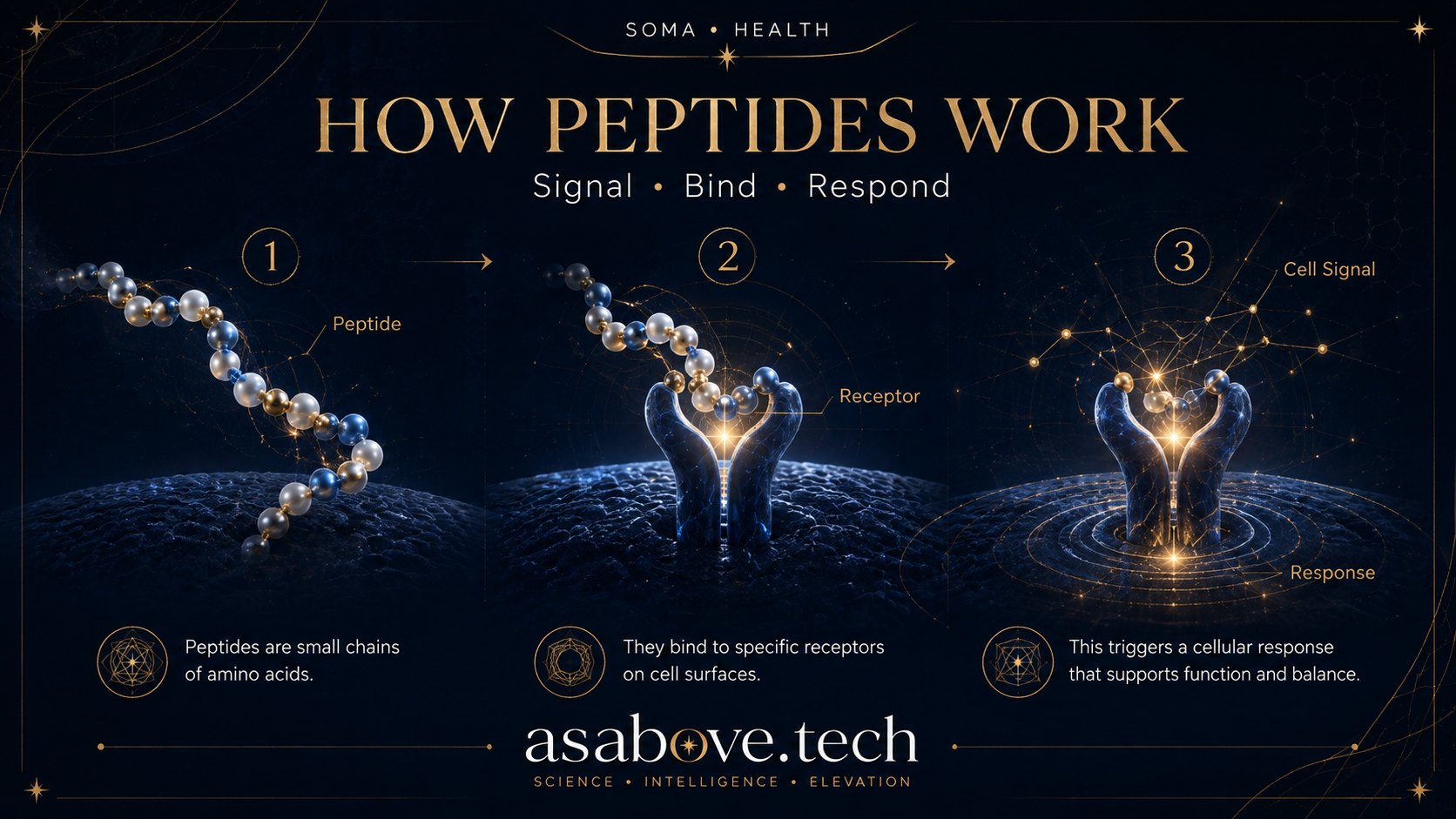
Strip away the marketing and a peptide is simply a short chain of amino acids. Amino acids are the letters. Chain a few together and you have a peptide. Chain a lot together and fold it into a complex shape and you have a protein. The line between the two is arbitrary and usually drawn somewhere around fifty amino acids, but the functional distinction matters more than the count.
Proteins mostly do things. They form structures, catalyze reactions, carry oxygen. Peptides mostly say things. They are the messaging layer of the body. Insulin is a peptide. So is glucagon, so is oxytocin, so is growth hormone releasing hormone. Your body already runs on peptide signaling every second of your life. Nothing about the category is exotic.
What makes therapeutic peptides interesting is specificity. A peptide binds a receptor the way a key fits a lock. Because the shape is precise, the message is precise, and a very small quantity can produce a large coordinated response. A milligram of the right peptide can shift appetite, glucose handling, tissue repair signaling, or mitochondrial behavior for days. That is the appeal. It is also the risk, because a precise message sent into a body you have not measured is still a message you cannot interpret.
🔬 Peptides At a Glance
That last point explains the needles. If you swallow a peptide, your digestive system treats it as dietary protein and breaks it into constituent amino acids. It becomes nutrition instead of a message. A handful of peptide drugs have been engineered around this with absorption enhancers and protease resistance, but the general rule holds: if a vendor is selling you an oral BPC-157 capsule and promising systemic effects, you are being sold optimism.
Why Your Friend's Stack Is the Worst Possible Starting Point
The single most common beginner error is copying. Someone you trust reports that a combination transformed their recovery, so you run the same combination. It fails, or worse, it produces a side effect you were not watching for, and you conclude either that peptides are fake or that you need a higher dose.
The reason copying fails is that the same signal lands in a different system. Consider two men, same age, same stack. One has a total testosterone of 310 ng/dL, a ferritin of 22, six hours of fragmented sleep, and 26 percent body fat. The other is on physician-supervised hormone replacement, sleeps eight hours, eats 180 grams of protein, and carries 14 percent body fat. A repair peptide layered onto the second man accelerates something already in motion. Layered onto the first, it is a whisper into a room full of alarms.
Peptides do not create a physiology. They bias one that already exists. If you do not know what yours currently is, you are not running a protocol. You are running a guess with a needle attached.
This is the principle behind everything that follows. Individualization is not a disclaimer added at the end of the sales pitch. It is the entire mechanism by which the category either works or does not.
The Eight Step Sequence
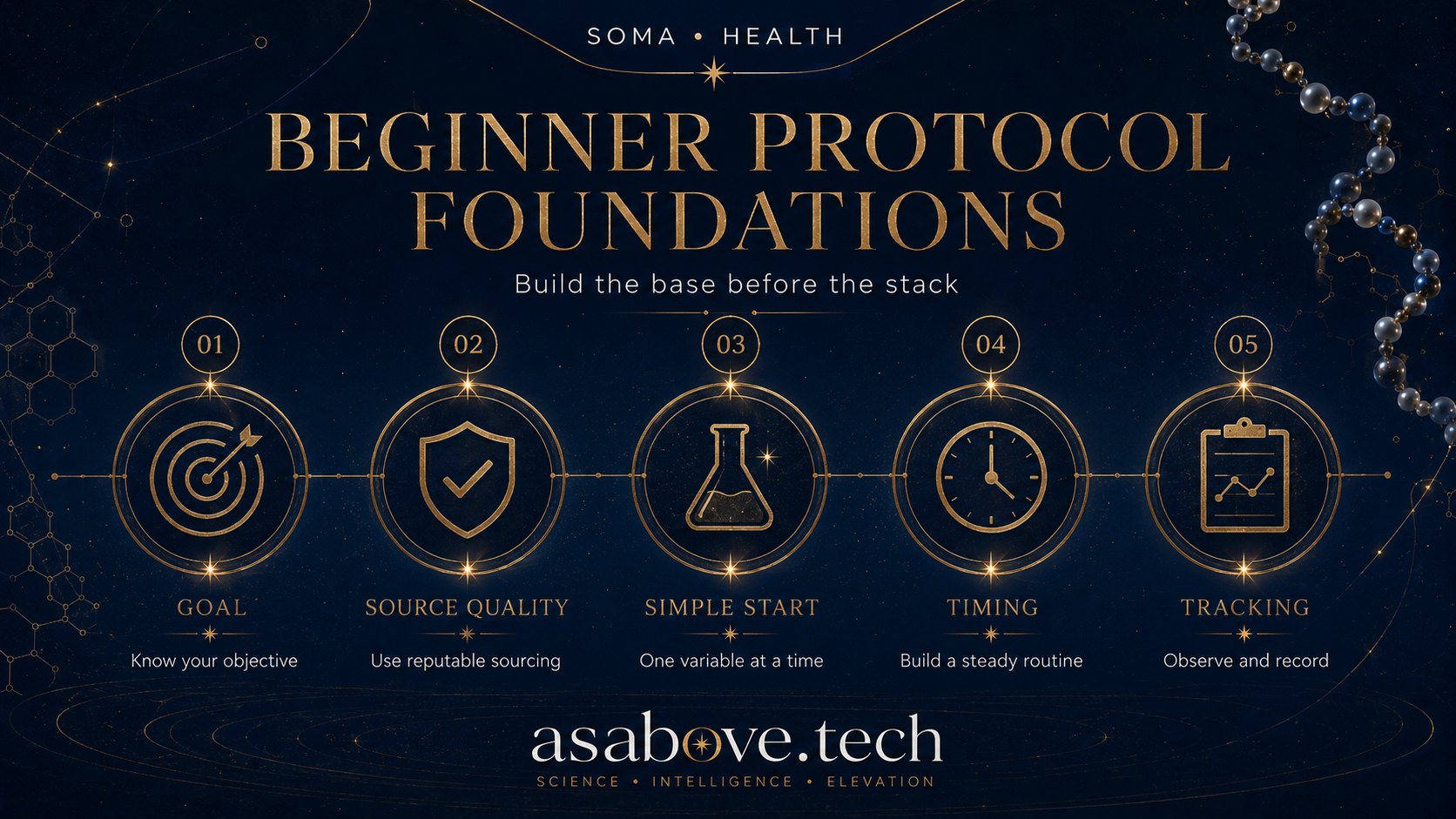
What follows is the backbone. It comes from a framework circulated by Alex Aaron (@alexaaronlab), a pre-med founder who sells and affiliates peptides and is unusually honest about that conflict, and it is worth adopting precisely because it makes buying the last step instead of the first. Each step below is expanded with what a beginner should actually do.
🧭 The Sequence, In Order
- Define the precise physiological target. Not "feel better." A named process.
- Understand the pathway and receptor biology. What receives the signal and what happens downstream.
- Read the primary literature. PubMed, not a thread.
- Establish baseline biomarkers. So any change can be attributed.
- Lock in the high-leverage variables. Training, nutrition, sleep, stress.
- Source with rigorous testing and trust. COAs or nothing.
- Start conservatively and titrate on objective response. Low, slow, monitored.
- Reassess continuously. Biology adapts, so protocols must evolve.
Step 1 · Define the Precise Physiological Target
"More energy" is not a target. "Better recovery" is not a target. These are sensations, and sensations respond to placebo, weather, and whether your quarter went well. A target is a named process you could in principle measure.
Compare the two columns of thinking. Vague: I want to lose fat. Precise: I want to reduce appetite drive and improve insulin sensitivity, measured by fasting insulin, HOMA-IR, and waist circumference, while preserving lean mass measured by DEXA. Vague: my shoulder hurts. Precise: I want to accelerate tendon remodeling in a specific structure with a known injury date, measured by pain-free range of motion and load tolerance on a defined movement.
The precision does two things. It selects the compound class for you, and it defines in advance what evidence would falsify your own protocol. If you cannot state what result would make you stop, you have not designed an experiment. You have bought a lottery ticket with a story attached.
✍️ Write It Down Before You Read Further
One sentence. The process you want to change, the direction you want it to move, the two or three measurements that would prove it, and the date you will check. If you cannot fill in the measurements, that gap is your actual next task, and it is step four.
Step 2 · Understand the Pathway and Receptor Biology
You do not need a biochemistry degree. You need to be able to answer four questions about any compound before it enters your body: what does it bind, what does that receptor normally do, what is the downstream cascade, and what else does that cascade touch.
That fourth question is the one beginners skip and the one that predicts side effects. Biology has almost no isolated switches. A receptor that governs appetite also appears in the gut and influences motility, which is why nausea is the dominant side effect of the incretin class. A peptide that stimulates growth hormone release also affects glucose handling and fluid retention, because growth hormone does. A pigment pathway that produces tanning also sits near pathways governing nausea, flushing, and erectile function, which is why melanotan compounds produce all four.
When you can name the cascade, side effects stop being surprises and become predictions. That transition, from surprised to predicting, is the single best marker that you have learned enough to proceed.
Binding
The peptide docks with a receptor or, in some cases, acts intracellularly on a metabolic sensor rather than a surface receptor.
Transduction
Binding changes receptor shape, which activates second messengers inside the cell. This is where a tiny external quantity becomes a large internal effect.
Transcription
Second messengers reach the nucleus and change which genes are being read. This is why effects often lag doses by days and persist after the compound clears.
Adaptation
The system responds to persistent signaling by adjusting receptor density and sensitivity. This is why nothing works forever at a fixed dose, and why cycling exists.
Step four of that cascade deserves emphasis. Receptor downregulation is the reason honest users report that a compound was extraordinary for eight weeks and ordinary by month five. It is not always tolerance in the addictive sense. It is a system restoring its own set point against a persistent push. Any protocol designed without an exit is a protocol designed to disappoint you on a schedule.
Step 3 · Read the Primary Literature
This is where most of the value is, and it costs nothing but attention. Search PubMed for the compound name. Read abstracts. You are not trying to become a researcher. You are trying to answer three questions that separate real evidence from marketing.
First: was it in humans? An enormous share of peptide enthusiasm rests on rodent work. Rodent data is not worthless, it is where every drug begins, but the translation rate from promising rodent result to confirmed human benefit is brutally low. BPC-157 is the clearest example in this space. The animal literature on tendon, ligament, and gut healing is genuinely striking and genuinely extensive. The controlled human literature is thin. Notably, even prominent advocates have publicly walked back overstated BPC-157 claims while continuing to use it personally. That is the honest position: promising, plausible, mechanistically interesting, and not proven in humans.
Second: what was the dose and route? A rodent study using intraperitoneal delivery at a body-weight-scaled dose tells you very little about a subcutaneous injection in a 90 kg adult. Allometric scaling between species is not a simple multiplication, and vendors routinely present it as one.
Third: what was measured, and for how long? A marker moving in the right direction over four weeks is a hypothesis. An outcome that matters, sustained over a year, is evidence. Most of this field lives in the first category and is sold as the second.
✅ A Practical Evidence Ladder
- Tier 1 · Approved drug with phase 3 human trials. Semaglutide, tirzepatide, prescribed testosterone. Known efficacy, known adverse event rates, real oversight.
- Tier 2 · Human trials underway, not yet approved for your use. Retatrutide is here. Substantial human trial data exists, the compound is not an approved product, and what people buy online is not what was studied.
- Tier 3 · Limited human data, strong mechanism. MOTS-c, thymosin alpha-1 in certain contexts, KPV. Reasonable to be interested, unreasonable to be certain.
- Tier 4 · Animal data only. BPC-157 for most claimed uses, many repair blends. Real mechanism, unproven translation, unknown long-term human safety.
- Tier 5 · Testimonial only. If the evidence is a before-and-after photo and a discount code, it is not evidence.
Beginners should not start below tier 3, and should be honest that tier 3 means experimenting on yourself with incomplete information.
Step 4 · Establish Baseline Biomarkers
This is the step that converts a purchase into an experiment, and it is the step almost nobody does. Without a baseline you cannot attribute anything. You will feel better in week three and never know whether it was the peptide, the two extra hours of sleep you started getting, the deload week, or the simple fact that spending money on your health makes you behave better for a month.
We have a complete guide to this on the site, and if you read only one linked article before touching a vial, make it this one: The Blood Work Protocol. It covers tiered panels, how to prepare for a draw so results are comparable across time, and specifically how to test whether a supplement is actually doing anything. That last methodology applies directly here.
The critical concept from that guide, worth repeating because it governs how you will read your own results: a lab reference range is not a health target. It is a statistical description of a population, typically the central 95 percent of people who happened to get tested. Half of that population is metabolically unwell. Being inside the range means being unremarkable, not being optimal, and it is the reason so many people are told their labs are normal while feeling terrible.
🩸 A Reasonable Beginner Baseline Panel
Metabolic core: fasting glucose, fasting insulin, HbA1c, and a calculated HOMA-IR. Fasting insulin is the one most standard physicals omit and the one that moves earliest.
Lipids done properly: a full panel plus ApoB and Lipoprotein(a). ApoB counts atherogenic particles rather than estimating cholesterol content. Lp(a) is largely genetic, so you measure it once in your life.
Organ function: comprehensive metabolic panel for kidney and liver markers, plus a complete blood count. These are your safety rails, not performance metrics.
Inflammation: high-sensitivity CRP. If you are chasing a repair or inflammation target, this is part of your outcome measure, not background information.
Hormones, if relevant to your target: total and free testosterone, SHBG, estradiol by a sensitive assay, LH, FSH, and a full thyroid panel including free T3, free T4, and TSH.
Growth axis, if considering any GH-related compound: IGF-1. This is the practical readout of that entire class and the number you will track.
Deficiency screen: ferritin, vitamin D, B12, and magnesium. Correcting a deficiency here will outperform most peptides you could buy, at roughly one percent of the cost.
Draw fasted, at the same time of day, hydrated, and not within 48 hours of a hard training session or a night of poor sleep. Consistency of conditions is what makes the second draw comparable to the first. Then repeat the relevant subset at eight to twelve weeks. Two data points under identical conditions are worth more than ten collected haphazardly.
Add the non-blood measurements that are cheap and honest: body weight taken the same way each morning, waist circumference at the navel, a DEXA scan if you can access one, resting heart rate and heart rate variability from a wearable, and a training log with actual loads. Subjective notes matter too, but write them daily rather than reconstructing them at the end of a cycle, because memory reliably rewrites itself in favor of whatever you paid for.
Step 5 · Lock In the High-Leverage Variables
Here is the uncomfortable arithmetic. If you sleep six hours, eat 80 grams of protein, train inconsistently, and live in sustained stress, the total available improvement from fixing those four things exceeds anything the peptide market can offer you. Not marginally. By an order of magnitude. Every honest voice in this space says the same thing, including the ones selling vials.
Peptides are described accurately as small signals with big downstream effects. But the downstream effect requires a downstream. Repair signaling with insufficient protein is a request the body cannot fulfill. Mitochondrial signaling in someone who never approaches an aerobic stimulus is a message with no receiver. Growth hormone pulses in someone sleeping five hours are landing in a system whose largest natural GH release is already being destroyed nightly.
🚧 The Foundation Gate
Do not proceed past this step until you have held all four of these for at least eight consecutive weeks: seven to nine hours of sleep with a consistent wake time, protein at roughly 1.6 to 2.2 grams per kilogram of body weight daily, resistance training three or more sessions weekly with progressive load plus meaningful zone 2 aerobic work, and a real stress practice rather than an intention to have one. If you cannot hold the foundation for eight weeks, you will not hold a peptide protocol either, and the protocol is harder.
There is also a strategic argument for the delay. Eight weeks of clean fundamentals moves your biomarkers. That movement is information: it tells you what your body does when it is properly supported, and it resets your baseline to a state worth building on. If you add a compound before that, you will spend the entire cycle unable to separate the compound's effect from the effect of finally sleeping.
Several existing guides on this site cover the foundation layer in depth. Hormesis: Strategic Stress as Medicine explains why controlled stress is the actual mechanism behind most adaptation, which reframes what you are trying to amplify. Fasting: The Metabolic Reset covers protocols that improve insulin sensitivity endogenously, often addressing the exact target people reach for metabolic peptides to fix. The Cold Exposure Protocol and Sleep Architecture and Cognitive Performance handle recovery and the sleep variable respectively.
🧪 The Hormonal Prerequisite
If your target involves body composition, recovery, drive, or energy, your hormonal baseline is not background context. It is likely the primary variable. Men chasing recovery peptides while running a total testosterone in the low 300s are optimizing the wrong layer. Start with Hormone Optimization: The Complete Guide and, for men specifically, Testosterone: The Foundation of Male Vitality. Both cover testing, interpretation, natural optimization, and when physician-supervised replacement becomes the honest answer. Most credible peptide users are layering onto a corrected hormonal base, and they are rarely explicit that this is the load-bearing part of their result.
Step 6 · Source With Rigorous Testing and Trust
Everything above is intellectual. This step is where you can be physically harmed, and it is the step where the incentive structure is worst, because nearly everyone recommending a vendor is being paid for the recommendation.
Peptides sold as research chemicals are not manufactured under pharmaceutical oversight. There is no regulator confirming that the vial contains what the label says, in the quantity stated, without contamination. Independent testing has repeatedly found underdosed product, wrong compounds, and unacceptable impurities across this market. The failure modes range from wasting money on saline to injecting bacterial endotoxin.
🔍 The Certificate of Analysis Checklist
Demand a COA that is batch-specific and matches the lot number on your vial. A generic PDF from two years ago is a marketing asset, not a test result. It should show:
- Identity by mass spectrometry. Confirms the molecule is the one named. This is the test that catches wrong-compound errors.
- Purity by HPLC. Look for 98 percent or higher, and read what the remaining percentage consists of. Truncated synthesis fragments are common and are not inert.
- Endotoxin testing. Bacterial cell wall fragments survive sterilization and cause fever and systemic inflammatory response when injected. This test is frequently missing and it is the one that can put you in an emergency room.
- Heavy metals and residual solvents. Synthesis byproducts. Less dramatic, more cumulative.
- Sterility. Especially relevant for anything not lyophilized under proper conditions.
- Third-party, US-based, and independently verifiable. Testing performed by the seller on the seller's product is a statement of intent, not evidence. Call the lab if the report looks templated.
⚠️ On Affiliate Codes
Almost every public peptide educator earns a commission on the vendor they recommend. This does not automatically make them wrong, and some of them do genuinely better diligence than the average buyer ever will. It does mean the recommendation is not disinterested. When someone shows you a COA and a discount code in the same post, evaluate the COA on its own merits and treat the code as advertising. Ask specifically what they would say if the lab result had come back at 91 percent purity. If they have never rejected a batch, they are not testing, they are collecting paperwork.
Two adjacent details that beginners overlook. First, bacteriostatic water quality matters. It is not sterile water and it is not saline. It contains 0.9 percent benzyl alcohol as a preservative, which is what allows a reconstituted vial to be used repeatedly over weeks. Buy it from a pharmaceutical supplier rather than as an unbranded accessory bundled with your peptide order. Second, the legal and regulatory situation is genuinely unsettled. In July 2026 the FDA's Pharmacy Compounding Advisory Committee reviewed seven peptides including BPC-157, KPV, a thymosin beta-4 fragment, MOTS-c, DSIP, Semax, and Epitalon for the 503A Bulks List. Our full coverage is at FDA Reviews Seven Peptides for Compounding. Note carefully what that proceeding was and was not: an advisory committee discussing eligibility for compounding is not approval, not proof of efficacy, and not a final change in legal access. Anyone citing it as validation is misreading the record.
Step 7 · Start Conservatively and Titrate on Objective Response
The instinct of a beginner is to start at the dose that produced the result they read about. This is exactly backwards. You start below the expected effective dose deliberately, because the first thing you need to learn is not whether the compound works. It is whether you tolerate it.
Run one variable at a time. This is non-negotiable for a first cycle and it is where enthusiasm does the most damage. If you introduce three compounds simultaneously and feel better, you have learned nothing about which one to keep, and if you develop a reaction you cannot tell what caused it. One compound, minimum four weeks, then evaluate. It feels slow. It is the only version of this that generates knowledge.
💉 Practical Administration for a First-Timer
Reconstitution: the vial contains lyophilized powder under vacuum. Bacteriostatic water is injected slowly down the inner wall of the vial, never sprayed directly onto the powder, because peptides are fragile and shear force degrades them. Swirl gently. Never shake. Wait for full dissolution rather than forcing it.
Math before needles: know your concentration and your volume before you draw. A 5 mg vial reconstituted with 2 mL yields 2.5 mg per mL, meaning a 0.5 mg dose is 0.2 mL, which is 20 units on a standard 100-unit insulin syringe. Write this on the vial. Dosing errors in this category are almost always arithmetic errors, not judgment errors.
Storage: lyophilized powder is stable refrigerated, and often for longer frozen. Once reconstituted, refrigerate and respect a limited window, typically a few weeks, shorter for less stable compounds. Light and heat degrade product. A vial that has been at room temperature in a car is a vial you discard.
Route: most are subcutaneous, into abdominal fat or the flank, with a short insulin needle at a 45 to 90 degree angle. Rotate sites systematically. Some compounds cause local histamine reactions, welts, or irritation subcutaneously, and users with low body fat sometimes switch to intramuscular delivery in the lateral deltoid with a short 31-gauge needle to avoid this. Do not improvise routes for a compound where route materially changes pharmacokinetics.
Sterile technique: alcohol-swab the vial stopper every single time, swab the injection site, new needle for every injection with no exceptions, and dispose in a proper sharps container. Skin infection and abscess are the most common physical harms in this entire category, and they are entirely procedural.
On titration itself, the rule is that you increase based on objective response, not impatience. Hold each dose long enough for the compound's pharmacokinetics to reach steady state, which for a weekly-dosed peptide can mean four to five weeks, not one. Increase only when the measurements you defined in step one are flat and side effects are absent. If side effects appear, the first move is dose reduction or route change, not discontinuation, and not powering through.
One category-specific warning that deserves its own line. With the incretin and multi-agonist metabolic compounds, aggressive dosing is where beginners get genuinely hurt. Severe nausea, vomiting, dehydration, and in extreme cases pancreatitis and gallbladder complications follow rapid escalation. The clinical protocols for approved drugs in this class escalate over months for a reason, and people running unapproved analogs frequently compress that schedule into weeks. There is also the muscle loss problem: rapid weight loss without adequate protein and resistance training strips lean mass alongside fat, which degrades the metabolic rate you were trying to fix. Anyone using a metabolic peptide should be training hard and eating high protein throughout, and should be tracking body composition rather than scale weight.
Step 8 · Reassess Continuously
Biology adapts. This is the closing principle and the one that separates a practice from a purchase. Receptors downregulate, set points shift, your goals change, your training changes, your age changes. A protocol that was correct in March is not automatically correct in September.
Build the review into the calendar rather than into your intentions. At eight to twelve weeks, redraw the relevant subset of labs under the same conditions as your baseline and compare. Then ask four questions honestly. Did the target measurement move in the intended direction, by an amount that exceeds normal variation? Did any safety marker move in the wrong direction? Are side effects acceptable relative to benefit? And would I make this same purchase again knowing what I now know?
A negative answer is not a failure. It is the return on doing this properly, and it is worth more than the positive answer, because a beginner who can correctly identify a non-responder has learned something the copy-the-stack crowd never will. Most compounds are situational and few belong in a year-round protocol. Stopping something that did not work is the most underrated skill in this field.
The goal is not to be on peptides. The goal is a specific physiological outcome, and peptides are one instrument among several. Confusing the instrument for the objective is how people end up spending four figures a month to feel exactly the same.

The Categories, Honestly Rated
What follows is a map of the landscape, organized the way practitioners actually organize it. This is not a shopping list and no doses are recommended here. Read it to understand what exists, what the evidence tier is, and where the specific risks live.
Metabolic and Body Recomposition
This is the category with the strongest human evidence by an enormous margin, because it overlaps with approved pharmaceuticals. The incretin family, GLP-1 receptor agonists and the dual and triple agonists that followed, has been through large randomized trials with hard outcomes. Semaglutide and tirzepatide are approved drugs with known efficacy and known adverse event profiles.
Retatrutide, a triple agonist acting at GLP-1, GIP, and glucagon receptors, is the compound generating the most attention in enthusiast circles. Human trial data is substantial and the weight loss results reported in trials are large. It is also not an approved product, which means what people obtain online is not the trial material, is not manufactured to that standard, and carries none of that oversight. The glucagon component is what distinguishes it mechanistically, contributing to energy expenditure rather than appetite suppression alone. Reported real-world use starts very low, often in the range of half a milligram to one milligram weekly, and titrates slowly, and the people using it responsibly are emphatic about not jumping to high initial doses.
The mistake to avoid in this category is treating it as a substitute for the metabolic foundation rather than a lever on top of it. If your insulin resistance is driven by sleep debt and sedentary behavior, a pharmacological appetite intervention treats the symptom while the cause compounds. Fasting: The Metabolic Reset covers the endogenous version of the same target and is the correct first attempt for most beginners.
Mitochondrial and Cellular Energy
MOTS-c is the notable entry, and it is genuinely interesting because it is not a foreign molecule. It is a 16-amino-acid peptide encoded in your own mitochondrial DNA, discovered in 2015, that functions as a mitochondrial-to-nuclear signal and acts substantially through AMPK, the same energy sensor that exercise and caloric restriction activate. Muscle MOTS-c expression rises sharply with exercise, which is why it is described as an exercise mimetic.
We have a full deep dive at MOTS-c: The Mitochondrial Exercise Mimetic Peptide covering discovery, mechanism, and the evidence in detail. The honest summary for a beginner: mechanistically elegant, human data limited, and worth understanding that "exercise mimetic" describes a molecular pathway, not a replacement for training. Practically, subcutaneous administration produces local histamine reactions and welts in some users, particularly at low body fat, and intramuscular delivery is a common workaround.
Adjacent to this sits the NAD+ conversation, which is popular, expensive, and where subjective reports diverge most sharply from expectations. NAD+ and Cellular Longevity covers the decline curve, the precursor debate between NMN and NR, and the sirtuin pathway. Worth reading specifically because the gap between the marketing and the human evidence in that category is instructive, and several experienced users rate it well below its hype.
Repair, Recovery, and Inflammation
This is the category with the most enthusiasm and the weakest human evidence, and the two facts are related. BPC-157, a synthetic fragment derived from a gastric protein, has an extensive and genuinely impressive animal literature covering tendon, ligament, muscle, and gut healing, with plausible mechanisms involving angiogenesis and growth factor signaling. Controlled human trials are essentially absent. TB-500, a fragment related to thymosin beta-4, occupies similar territory with similar limitations. The two are frequently combined, sometimes with GHK-Cu in blends marketed under names like GLOW. KPV, a tripeptide fragment of alpha-MSH, targets inflammatory signaling and appears in gut-focused protocols.
Users report high satisfaction with this category for injury recovery and gut symptoms. Take that seriously as a signal and simultaneously recognize what it is: uncontrolled, unblinded self-report in a population that expects improvement, for conditions that frequently improve on their own timeline. Injuries heal. The counterfactual is unknowable in n of 1.
The specific unresolved risk in this category is the angiogenesis question. Compounds that promote new blood vessel formation to accelerate tissue repair are doing something a tumor also benefits from. There is no human data establishing that BPC-157 promotes cancer, and there is also no human data establishing that it does not, because the long-term studies do not exist. Anyone with a personal or strong family history of cancer should treat this category as off the table pending real evidence, and everyone else should hold the uncertainty consciously rather than assuming absence of evidence is evidence of safety.
Growth Hormone Secretagogues
CJC-1295, ipamorelin, sermorelin, tesamorelin, and related compounds stimulate the pituitary to release growth hormone in pulses rather than supplying exogenous GH directly. The theoretical advantage is preserved feedback control, which reduces the risk profile relative to synthetic GH.
This category is worth including specifically because it is the clearest example of hype exceeding delivery. It is heavily marketed for recovery, sleep quality, body composition, and anti-aging. Experienced users frequently rate it well below expectations, with mild sleep improvement being the most consistently reported real effect. IGF-1 is your objective readout, and it is the number to track rather than how you feel. Known effects include water retention, carpal tunnel symptoms, and impaired glucose handling at higher exposures, which is a direct consequence of what growth hormone does metabolically.
The relevant context is that your largest natural GH pulse occurs during deep sleep. Someone sleeping five fragmented hours and buying a secretagogue is paying to partially replace something they are actively destroying for free. Fix the sleep. Then, if IGF-1 is genuinely low and a physician agrees it is clinically relevant, discuss the pharmacology.
Cosmetic, Immune, and Neurological
GHK-Cu, a copper-binding tripeptide, is used both subcutaneously and topically for skin quality and collagen signaling, and the topical dermatology literature is the more credible half. Melanotan-2 stimulates melanocortin receptors to produce tanning, and its side effect profile is exactly what receptor promiscuity predicts: nausea, flushing, spontaneous erections, appetite suppression, and darkening of existing moles. That last one matters, because it complicates melanoma surveillance in a population using a compound that alters pigmentation. Dermatologist monitoring is not optional if you go near this one.
Thymosin alpha-1 has legitimate immune-modulating credentials and approved use in some countries for specific indications. Selank and Semax are Russian-developed nootropic and anxiolytic peptides with a research base that is real but largely published outside the Western literature, which makes independent evaluation harder rather than impossible. Epitalon and DSIP round out the longevity and sleep corners with thin data.
🏅 If You Compete in Tested Sport
Most compounds in this article, including growth hormone secretagogues, TB-500, and the melanocortin agonists, are prohibited by WADA and equivalent bodies. Detection windows are longer than users assume and testing methods improve retroactively against stored samples. If you compete under any anti-doping code, check the current prohibited list against every compound before considering it, and understand that strict liability means intent is irrelevant to sanction.
The Failure Modes, Named
Every beginner mistake in this category falls into one of these. Read them as a pre-mortem.
❌ Ten Ways This Goes Wrong
- Copying a stack. Different baseline, different result, no way to interpret either.
- Skipping the baseline draw. Guarantees you cannot attribute anything to anything.
- Stacking multiple new compounds at once. Produces a feeling and zero knowledge.
- Starting at the dose from the anecdote. Skips the tolerance question entirely.
- Buying on price. The cheap vial is cheap because something was skipped, and it was probably the endotoxin test.
- Accepting a generic COA. Batch-specific or it is decoration.
- Sloppy sterile technique. The most common actual physical harm in this space, and fully preventable.
- Extrapolating rodent data to yourself. Especially in the repair category, where the temptation is strongest.
- Running compounds year-round. Ignores receptor adaptation and guarantees diminishing returns.
- Using peptides to compensate for a broken foundation. The most expensive possible way to not fix your sleep.
Your First Ninety Days
If you have read this far and still want to proceed, here is the schedule. Note that a compound does not appear until week nine.
📅 The Beginner Timeline
Weeks 1 to 2 · Define and measure. Write your one-sentence target with named measurements. Book a physician appointment and a baseline panel. Start the daily log: weight, sleep hours, training, subjective energy. Read the mechanism of the compound class you are considering and be able to explain the cascade out loud.
Weeks 3 to 8 · Foundation only. No compounds. Sleep seven to nine hours with a fixed wake time. Protein at 1.6 to 2.2 g/kg. Three or more resistance sessions weekly plus zone 2 work. A daily stress practice. Correct any deficiency your labs revealed, because vitamin D, iron, and thyroid corrections will outperform anything you could buy.
Week 8 · The honest checkpoint. Redraw. Compare to baseline. Reassess whether you still need a compound, because a meaningful minority of people discover at this point that their original complaint has resolved. If it has, you have saved yourself considerable money and risk, and that is a successful outcome, not an anticlimax.
Weeks 9 to 12 · One compound, low dose. If proceeding: one compound only, at the conservative end, from a source with a batch-specific COA you have actually read. Continue every foundation habit unchanged. Log daily. Change nothing else in your life during this window, because every additional variable destroys your ability to interpret the result.
Week 12 · Evaluate. Redraw the relevant subset under identical conditions. Did the target move beyond normal variation? Did safety markers hold? Are side effects acceptable? Would you buy this again? Then decide: continue, adjust dose, or stop. All three are legitimate answers and stopping is the most underused.
Who to Learn From
The signal-to-noise problem in this space is severe, and the filter is simpler than it looks. Credible sources cite primary literature and name the limitations of what they cite. They distinguish animal data from human data without being asked. They disclose financial relationships. They report compounds that did not work for them. They emphasize individualization and monitoring rather than protocols. They update publicly when evidence changes, including walking back their own prior claims.
Non-credible sources lead with transformation photos, present rodent studies as established fact, sell certainty, describe a fixed stack as universally applicable, and never mention a compound they abandoned. The presence of a discount code is not disqualifying, but the absence of a single documented failure is.
The clinicians worth following in this space, including physicians like Alex Tatem in urology and men's health and Jesse Morse in sports medicine, share a common approach: mechanism first, then evidence, then personalization, then monitoring, under supervision. That order is the same as the eight-step sequence above, which is not a coincidence. It is what competence looks like in a field where the evidence base is incomplete.
📚 Read These Before You Buy Anything
- The Blood Work Protocol The measurement layer. Baseline panels, draw conditions, and how to test whether an intervention is actually doing anything. Step four of the sequence, in full.
- Hormone Optimization: The Complete Guide Most peptide results in body composition and recovery are layered on a corrected hormonal base. This is that base.
- Testosterone: The Foundation of Male Vitality For men, the single highest-leverage variable, and usually the real explanation behind a transformation attributed to a stack.
- MOTS-c: The Mitochondrial Exercise Mimetic Peptide A full worked example of what step two and step three look like when done properly on a single compound.
- NAD+ and Cellular Longevity The adjacent cellular energy category, and a useful case study in the gap between marketing and human evidence.
- Hormesis: Strategic Stress as Medicine Why controlled stress drives adaptation. Understand this and you understand what a peptide is amplifying.
- Fasting: The Metabolic Reset The endogenous route to the same insulin sensitivity target people buy metabolic peptides to reach.
- Retatrutide 2026: Phase 3 Results, FDA Status and Timeline The strongest late-stage metabolic-peptide case study, with current trial results and the FDA's warning about unapproved retatrutide products.
- FDA Reviews Seven Peptides for Compounding The current regulatory reality, and why an advisory committee agenda is not an approval.
The Closing Argument
Peptides are real. The signaling is real, the mechanisms are real, and in the metabolic category the human outcomes are large and well documented. The category is not a scam.
But the way most people enter it is a scam played on themselves. They buy first and think later, copy a protocol built for a different body, measure nothing, attribute everything, and then either quit disillusioned or escalate into genuine risk. The compound was never the problem. The sequence was.
Run the eight steps in order. Define the target. Learn the pathway. Read the literature. Get the labs. Fix the foundation and hold it for eight weeks. Verify the source with a batch-specific COA. Start low, one variable, and titrate on data. Reassess forever.
Do that and one of two things happens. You find a compound that measurably moves a target you defined in advance, and you will know it is real because you can prove it. Or you discover the foundation was the whole answer, you never needed the vial, and you saved yourself the money and the risk. Both outcomes are wins. Only the guessing loses.
⚕️ Final Medical Notice
This article synthesizes publicly available information including posts by content creators who have commercial relationships with peptide vendors and who explicitly state they are not providing medical advice. Neither are we. Most compounds discussed are not approved for the uses described, several are under active regulatory review, long-term human safety data is absent for most of them, and quality varies enormously between sources. Peptides can interact with medications, existing conditions, and hormonal therapies. Do not begin any protocol without a qualified physician who will order appropriate labs, screen for contraindications, and follow up. If you have or have had cancer, are pregnant or nursing, or manage a chronic condition, do not use these compounds outside direct medical supervision.