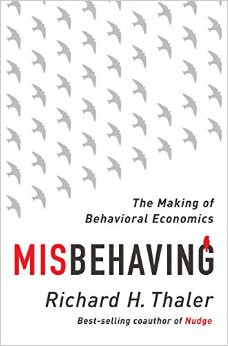
The Essential Question
What happens when a system built for perfectly rational people meets an actual person?
Richard Thaler spent a career worrying this seam. Traditional economic models often begin with an elegant creature who knows what matters, processes available information without strain, values a dollar consistently, discounts the future coherently, and chooses whatever best serves a stable set of preferences. Thaler calls that creature an Econ.
Humans are the people we know. They procrastinate, anchor, overreact to losses, treat identical dollars differently, care about fairness, and eat too many cashews while waiting for dinner. They are influenced by defaults, presentation, timing, ownership, memory, effort, social comparison, and the presence of temptation. These details look small until institutions, markets, retirement systems, and households are built on the assumption that they disappear.
Misbehaving is the story of how those details forced their way into economics. Its real contribution is larger than a catalog of biases. Thaler changes the standard for what counts as a serious model. Elegance is useful. Prediction still has to survive contact with the people being predicted.
The Oikos reading begins here: every financial system contains a theory of the person. A budget assumes something about memory and restraint. A retirement plan assumes something about future attention. A brokerage interface assumes something about temptation. A market model assumes something about fear, imitation, and limits to arbitrage. The theory may be explicit or buried in the design. It is there either way.
Economics gets more practical when the person inside the model is allowed to be human.
Econs, Humans, and the Cost of a Clean Model
An Econ makes mistakes only because information is incomplete or calculation is costly. Give the Econ the right facts and enough computing power, and the choice improves. A Human can understand the facts and still choose against a stated intention. The problem may be attention, habit, identity, framing, fatigue, temptation, or the pain of admitting a loss.
This distinction matters because a model can be internally coherent while failing exactly where life becomes expensive. A retirement system that requires every worker to opt in, select an allocation, set an adequate contribution, rebalance, and resist every market panic may preserve formal freedom. It also asks for a chain of good decisions from people who are busy living.
The old defense says that irrational behavior should wash out in aggregate or be disciplined by markets. Sometimes it does. Sometimes institutions amplify it. A default adopted by millions does not wash out. A housing bubble built from social imitation does not vanish because a rational trader noticed it. A bad incentive can recruit intelligence into defending the wrong behavior.
Thaler's phrase for the details excluded by theory is supposedly irrelevant factors. The wording is perfect because it exposes a bad habit of mind. Once a variable has been declared irrelevant by the model, evidence of its influence is treated as noise. The map begins grading the territory.
The Human decision loop
Situation
A choice appears inside a real environment with defaults, deadlines, social signals, effort, and an existing state of affairs.
Frame
The person interprets the choice as a gain, loss, expense, windfall, obligation, opportunity, or threat. The frame changes what the same numbers mean.
Account
The choice is assigned to a mental category with its own informal rules. Vacation money and emergency money may be equal on paper and completely different in use.
Conflict
The future plan meets present appetite. Ownership, pride, fear, and social comparison enter before calculation has the final word.
Action
The person chooses, delays, accepts the default, or avoids the decision. The result then becomes part of the next frame.
This loop is why financial behavior cannot be repaired with information alone. Information enters a living system. The system translates it before acting.
The Endowment Effect: Ownership Changes the Price
The endowment effect names a common asymmetry: people often demand more to give up something they possess than they would have paid to acquire it. Ownership alters valuation. The object did not improve. The reference point changed.
Once an item becomes mine, surrendering it is coded as a loss. Losses usually carry more psychological weight than equivalent gains. The current state gains gravity, and the asking price begins to include the pain of separation. This helps explain why people keep unused property, resist selling inherited assets, overvalue a business they built, or hold a losing position long after the original thesis has failed.
The effect goes beyond physical goods. People become endowed with plans, job titles, opinions, routines, and identities. Time and effort intensify attachment. A founder may assess an old product as an owner while the customer assesses it as a buyer. The difference between those viewpoints is where dead capital hides.
Markets add another layer. A quoted price can make the position feel objective while ownership is quietly changing the required evidence. The person who demanded a clear thesis before buying may accept a vague hope after the purchase. The standard of proof moved because the reference point moved.
A clean test is to remove ownership from the question: If I held cash today, would I buy this asset, keep this inventory, renew this contract, or build this product at the current price? The answer does not automatically require a sale. Taxes, transaction costs, relationships, and strategic fit still matter. It does reveal when possession is impersonating judgment.
The endowment effect should not be treated as a universal law. Experimental procedures, experience, market context, and the nature of the good can change the result. Later work has challenged whether some willingness-to-pay gaps reflect stable preferences or confusion about the experimental mechanism. The durable lesson is narrower and stronger: ownership can contaminate valuation, so owner and buyer perspectives should be compared deliberately.
Mental Accounting: Useful Fiction, Expensive Mistake
Standard theory treats money as fungible. A dollar is a dollar regardless of where it came from or what label sits on the account. Humans maintain internal ledgers. Salary, bonus, tax refund, house money, emergency savings, business cash, and inheritance can each carry different rules.
Mental accounting is neither simple stupidity nor a defect waiting to be erased. It is a control system. Categories reduce cognitive load, protect commitments, and make restraint possible. A household that separates operating cash from taxes and reserves may behave better than one that keeps a single perfectly fungible pool. The fiction serves governance.
The cost appears when labels hide the total position. Someone may carry expensive debt while preserving low-yield savings because the savings account is sacred. A trader may take greater risk with recent gains because the profit feels like the market's money. A business may defend a department's budget while ignoring the return on the whole enterprise. The categories begin protecting themselves.
Good accounting asks two questions at once. What behavior does this category make easier? What economic reality does it conceal? The first protects the Human. The second protects the balance sheet.
Categories as guardrails
Separate reserves, tax accounts, and automatic contributions can protect important capital from ordinary temptation. The label creates friction on purpose.
Categories as camouflage
Windfalls can invite careless spending, sunk costs can defend bad projects, and house money can excuse risk that would feel reckless if labeled savings.
There is a Hermetic correspondence here. The outer ledger and inner ledger mirror each other, but never perfectly. A clean financial statement can coexist with a chaotic meaning system. A disciplined household aligns both.
Self-Control Is an Architecture Problem
Thaler's work with Hersh Shefrin models the person as an organization with internal conflict. A forward-looking planner wants health, savings, patience, and consistency. A present-focused doer wants the pleasure, relief, status, or escape available now. Both belong to the same person. Both are real.
This is more useful than moral language. Calling the doer weak does not change the environment that keeps summoning it. Calling the planner wise does not supply the energy required to win every negotiation. Willpower has a cost. Decision after decision drains it, and temptation grows more persuasive when the person is tired, afraid, rushed, or celebrating.
The cashew bowl captures the mechanism. Removing an available option can make people better off when they know that availability itself creates a self-control cost. More choice carries value. It can also carry exposure.
Precommitment changes the battlefield. Automatic saving, cooling-off periods, written loss limits, separate reserves, shopping lists, device restrictions, and calendar blocks all let the planner act before the doer arrives. These tools work because they reduce the number of heroic moments required.
The financial application is direct. A rule made while calm should govern the moment that makes calm impossible. Position limits come before the trade. Contribution increases can be attached to future raises. Large purchases can wait through a fixed review period. A reserve can live somewhere inconvenient to raid.
Systems beat repeated self-negotiation. Still, architecture can become avoidance. A rule deserves revision when conditions change, and a Human can learn. The goal is a structure that supports agency, not a cage built by yesterday's planner.
Willpower is a costly employee. Design the household so it is not working every shift.
Supposedly Irrelevant Factors Run the Room
Defaults, sequence, visibility, wording, friction, and social norms should be irrelevant when preferences are stable and calculation is complete. In the world we inhabit, these factors often decide whether a form gets completed, money gets saved, medicine gets taken, or a loss gets realized.
A default is especially powerful because inaction becomes a choice. People remain with defaults for many reasons: attention is scarce, changing the setting requires effort, the default signals a recommendation, and staying put avoids responsibility for a bad outcome. One design decision can shape millions of individual results without changing the available options.
Friction works the same way. One extra form, login, phone call, waiting period, or confusing menu can suppress an action even when the stated preference remains. Businesses understand this perfectly when they make buying easy and cancellation difficult. Behavioral design did not begin with public policy. Commerce has practiced it for generations.
Presentation changes perception too. A fee described monthly feels different from the same amount shown annually. A retirement contribution expressed as a percentage can feel different from its dollar cost. A sale price creates a reference point before value is considered. Nothing about the underlying economic quantity changed. The Human did.
The lesson is uncomfortable because choice architecture is unavoidable. There is no neutral screen, enrollment form, cafeteria line, benefits portal, or store shelf. Something must appear first. Some option must require less effort. Some information must be emphasized. The honest question is who designed that structure, whose interest it serves, and whether the influence remains visible and reversible.
Nudges: Power Without the Alibi
A nudge alters the choice environment while preserving options and avoiding large changes to economic incentives. Automatic enrollment, a better default, a reminder, clear feedback, and simplified disclosure are familiar examples. The appeal is obvious. Small design changes can improve behavior without mandates.
The strongest nudges often work with existing intentions. Many people say they want to save more, take medication, complete a form, or choose a healthier option. Attention and inertia intervene. Good architecture closes the gap between intention and action.
The Save More Tomorrow program is the cleanest wealth example. Workers can commit part of future pay increases to retirement saving. The design respects present loss aversion because take-home pay does not need to fall immediately, and it uses inertia to keep future increases operating. A behavioral weakness is redirected into a durable advantage.
That success can make nudge language too attractive. Institutions may use it as a substitute for harder work. A reminder cannot repair inadequate wages. A default cannot make an unaffordable product affordable. Better disclosure cannot cure an incentive structure built on confusion. Small causes sometimes deserve small interventions. Structural causes do not.
Nudges also carry politics. The architect chooses a direction, even when opting out remains easy. That choice should be disclosed. The objective should be defensible. The opt-out should be real. Effects should be measured across groups and over time. A nudge that helps the average while quietly burdening a vulnerable group is not clever policy.
Recent evidence has also made the field more sober. Effects vary by context, intervention, population, and measurement. Defaults tend to outperform many lighter prompts, while some nudges fail or backfire. Long-term effects and spillovers remain less certain than the cleanest success stories suggest. Choice architecture is a tool, not a natural law.
Markets Are Human Systems Too
Behavioral economics becomes financially serious when it enters markets. Human error alone does not guarantee a profitable opportunity. Mispricing can persist, but exploiting it requires capital, timing, liquidity, institutional permission, and the ability to survive looking wrong.
This is where the simple story about rational arbitrage breaks. A fund manager may recognize a bubble and still be unable to short it safely. Investors can withdraw before the thesis resolves. Borrowed assets can become costly or unavailable. A correct long-term view can meet a fatal short-term path.
Price and value can separate without handing anyone an easy trade. That distinction matters. Behavioral finance explains why distortion can arise. Market structure explains why the correction may be slow, violent, or inaccessible.
Supposedly irrelevant factors become especially loud under pressure. The purchase price anchors judgment. A recent win feels like house money. A loss creates an urge to break even. Social proof makes crowded risk feel safer. A quarterly reporting window turns long-term conviction into career risk.
Market discipline therefore needs architecture too. Written theses, invalidation points, position limits, review intervals, and rules around adding to losses are choice design for the operator. They put the wiser self in the room before price starts speaking directly to identity.
Fairness, Trust, and the Missing Social Animal
Thaler's Humans care about more than consumption. They punish unfair offers, reward reciprocity, and judge a transaction partly by the story around it. A business can maximize a single exchange and damage the field that makes future exchange possible.
This expands Oikos beyond private optimization. The household sits inside relationships. Customers remember opportunism. Employees compare treatment. Communities distinguish a necessary price increase from exploitation during scarcity. Trust is economic capital even when the model struggles to price it.
Fairness does not mean every reaction is correct or every price should remain fixed. It means perceived legitimacy affects behavior. A policy that ignores that fact may be efficient on paper and unstable in practice. The reaction becomes part of the economics.
The deeper principle is correspondence. Inner motives become outer rules. Outer rules train inner motives. A system that repeatedly rewards concealment produces better concealment. A system that makes honest action easier produces more of it. Character matters, and architecture determines how often character must fight uphill.
What Marc Actually Uses
The practical application is a Human audit. Before changing a financial process, look for the supposedly irrelevant factors already shaping it.
Name the default
Identify what happens when nobody acts. Defaults govern busy systems, so choose them as deliberately as the visible options.
Separate buyer from owner
Value current holdings twice: once from inside possession and once as if the same capital were uncommitted today.
Audit the accounts
List the mental labels attached to money. Keep the labels that protect behavior and expose the ones hiding total cost or risk.
Move rules upstream
Set contribution rates, position limits, review periods, and cancellation standards before appetite or fear gets a vote.
Price the friction
Count the clicks, forms, decisions, delays, and explanations required for the preferred action. Friction is part of the incentive.
Test the architect
Ask who benefits from the frame, whether the influence is visible, and whether a person can reverse the choice without punishment.
The Book's Real Mechanism
Misbehaving looks like an intellectual history full of anomalies, arguments, experiments, and academic resistance. Underneath it is a method of inquiry: notice where the model and lived behavior disagree, treat the disagreement as evidence, then build the smallest better account of the person.
The method begins with observation. People do something that theory says should not matter. Instead of correcting the people, ask what the behavior reveals. Perhaps ownership changes the reference point. Perhaps a mental account provides self-control. Perhaps fairness belongs inside preference. Perhaps the available options impose a psychological cost.
Then comes disciplined modesty. Behavioral economics should improve models, not replace one fictional creature with a list of universal biases. Context matters. Incentives still matter. Learning matters. Markets sometimes correct error. Humans can reason. The field is strongest when psychology enters economics as evidence, not decoration.
The operational mechanism is simple: design for the person who will actually use the system on a tired Tuesday, not the person who explains it perfectly on a calm Sunday.
Where the Book Is Weak or Dated
The book was published in 2015 and tells the rise of behavioral economics largely through Thaler's own career. That makes the history vivid. It also narrows the lens. Intellectual movements are messier and more collective than a first-person account can show. Collaborators appear, but the narrative naturally gives its author the cleanest through-line.
The anomaly format can encourage a cabinet-of-biases reading. Readers collect names for mistakes and begin diagnosing everyone around them. That turns behavioral economics into a superiority game. The observer is Human too. Knowing the label for a bias does not grant immunity from it.
Some famous effects are more sensitive to context and experimental design than popular retellings suggest. The endowment effect remains important, yet work on elicitation procedures and subject understanding has challenged broad claims based on simple willingness-to-pay gaps. The right response is better boundary conditions, not denial or blind repetition.
The self-control account is useful but schematic. Planner and doer describe conflict. They do not capture the full interaction among habit, emotion, physiology, social setting, trauma, attention, and identity. The model earns its keep by clarifying precommitment, not by exhausting the person.
Nudges have aged into a more contested policy field. Effect sizes vary. Publication bias, weak measurement, short follow-up, and context dependence complicate broad promises. Digital platforms also turned choice architecture into an industrial system of targeting, testing, and continuous optimization. A public retirement default and a commercial interface engineered to prolong compulsion belong to the same family of tools but serve very different ends.
The largest weakness is political economy. Behavioral explanations can individualize problems created by power, scarcity, pricing, labor conditions, and institutional incentives. A better form helps. It does not replace income, access, competition, enforcement, or honest product design. Human behavior belongs inside economics, and so do the structures constraining the Human.
These limits strengthen the useful core. The book opened economics to evidence it had trained itself to ignore. The next step is applying the same skepticism to behavioral economics itself.
The Oikos Lineage
This is the second study in a nine-book wealth sequence. It follows the personal behavior of The Psychology of Money by showing how those tendencies entered economic theory, then prepares the ground for practitioners who have to manage them under market pressure.
- Behavioral foundation: Morgan Housel makes financial conduct personal, while Richard Thaler shows why the supposedly irrational pattern is systematic enough to model.
- Market practitioners: Jack Schwager's interview volumes reveal how rules, fit, and risk limits become choice architecture for traders.
- Household floor: George Clason turns precommitment into plain arithmetic by keeping part of what is earned before appetite allocates it.
- Decision range: Charlie Munger supplies multiple models for catching the frame that any single discipline would miss.
- Feedback: George Soros extends behavioral distortion into reflexivity, where belief changes action and action changes the world being valued.
Thaler's place in the sequence is architectural. He explains why good intentions need structure and why structure is never neutral. Oikos is the household as both economy and field of responsibility. The design of that field is part of stewardship.
Read Alongside
The Psychology of Money
Housel shows how history, envy, uncertainty, and temperament enter financial decisions. Thaler explains why these departures from textbook rationality are patterned rather than random. Read together, they turn self-knowledge into system design: room for error, helpful defaults, and fewer moments that demand perfect behavior.
Market Wizards
Schwager's traders build private architectures around loss limits, position size, patience, and method. Thaler supplies the behavioral reason those rules are necessary. The market interviews show what planner-doer conflict looks like when feedback arrives in dollars.
Hedge Fund Market Wizards
At institutional scale, behavioral control becomes organizational design. Mandates, investor terms, drawdown rules, team structure, and review processes determine whether a sound idea survives the Humans carrying it.
Oikos
The pillar extends the book's argument into markets and stewardship. Capital, incentives, household reserves, and risk systems work only when they account for the operator inside them.
The Bottom Line
Misbehaving earns its place because it refuses to treat actual behavior as an inconvenience. People care about ownership, fairness, labels, defaults, effort, and now versus later. Those forces shape prices, savings, businesses, policies, and households whether the spreadsheet acknowledges them or not.
The book's lasting instruction is to look at the factor everyone says should be irrelevant. That is often where the real system is hiding.
Model the Human. Expose the frame. Put wise choices closer. Make manipulation visible. Build fewer moments that require heroism.
Sources and Further Reading
This is an original interpretation, not a chapter summary. It contains no purported quotations from the book and no page-number claims. The source spine is Richard H. Thaler's Misbehaving: The Making of Behavioral Economics (2015), his Nobel Prize lecture, the Royal Swedish Academy's scientific background on his contributions, Kahneman, Knetsch, and Thaler's work on the endowment effect, Shefrin and Thaler's planner-doer model of self-control, and Plott and Zeiler's challenge concerning experimental procedures and valuation gaps.