1. Before the temple: what do we mean by psychedelic?
“Psychedelic” is a modern term, not an Egyptian classification. It is useful as an invitation to the subject, but misleading if allowed to decide the answer in advance.
In contemporary pharmacology, classic psychedelics include substances such as psilocybin, LSD and DMT, with serotonin 5-HT2A receptor activity central to their characteristic effects. That is a narrower category than everything that changes consciousness. Alcohol intoxication, sedation, anticholinergic delirium, dreaming and a visionary religious experience are not interchangeable mechanisms. Nichols, Psychedelics
Three questions therefore have to remain separate.
Was a substance present? This is a question for identified remains, residues, textual descriptions and their contexts.
Was it used to alter experience? A plant could be food, fragrance, medicine, pigment, ornament or intoxicant. Presence alone does not settle intention.
What did the experience mean? Even where intoxication is established, chemistry cannot by itself tell us whether someone understood it as pleasure, danger, healing, divine contact or social obligation.
The word entheogen does not solve this problem. It highlights a proposed religious use; it is not a chemical test or a guarantee that a particular ancient rite involved a psychoactive substance.
Our evidence labels are deliberately plain:
| Evidence register | What it can establish | What it cannot establish by itself |
|---|---|---|
| An excavated object or analytical result | Material presence, within the limits of identification and context | Intention, experienced effect, prevalence across Egypt |
| An ancient text or image | A representation, prescription, belief or reported practice | That every depicted event occurred, or every prescription worked |
| A historical reconstruction | A reasoned connection among different kinds of evidence | A directly observed ancient event |
| Modern pharmacology | What a tested substance can do under specified conditions | What an ancient person consumed or experienced |
| Philosophical comparison | A useful way to think with the material | Historical transmission, hidden chemistry or metaphysical proof |
This is not a ladder on which chemistry always outranks a text. A chemical measurement answers one kind of question. A hymn answers another. A serious history needs both without forcing them to say the same thing.
2. Egypt was not one moment
The familiar collage places pyramids, Tutankhamun, Cleopatra, the Corpus Hermeticum and modern lotus products in the same timeless room. Historically, they are very far apart.
For orientation, the Old Kingdom belongs broadly to the third millennium BCE; the New Kingdom to approximately 1550–1070 BCE; the Ptolemaic dynasty to the centuries after Alexander and before Roman annexation in 30 BCE. Roman and late antique Egypt produced further religious and literary developments. Chronological boundaries vary somewhat among scholarly conventions. UCL, Egyptian chronology
The distance matters. A late vessel cannot establish what a pyramid builder drank. A Roman-period magical handbook cannot automatically explain a New Kingdom banquet. A modern interpretation of a temple plan cannot serve as an ancient inscription.
Continuity is a possibility to investigate, not a bridge that appears whenever we need one.
Throughout this essay, “Egyptian” refers to a changing civilization with regional traditions, political upheavals, different social positions and sustained contact with neighboring peoples. It does not mean a single priesthood preserving an unchanged secret for three thousand years.
3. The cup that changed the conversation
In 2024, Davide Tanasi and colleagues published a multimethod analysis of residues from a Bes-shaped vessel in the Tampa Museum of Art. They reported evidence consistent with Syrian rue, blue water lily, a plant in the Cleome group, a fermented fruit-based liquid and other ingredients. Chemical, genetic and protein analyses contributed different pieces of the reconstruction. Human-fluid interpretations were also proposed.
The provenance is essential: the mug was purchased from a Cairo dealer in 1960 and entered the museum in 1984. The reported Fayum findspot and second-century BCE dating lacked supporting documentation; the paper also discusses broader stylistic comparanda. It was not recovered by these researchers from a sealed, excavated ritual room. The authors themselves call for testing additional vessels. Tanasi et al., 2024
This is a consequential finding. It is not a census of Egyptian religious practice.
Consider the distance between these statements:
- An analysis identifies substances associated with psychoactive plants.
- Those substances belonged to a deliberately psychoactive preparation.
- That preparation was used in a particular ceremony.
- The ceremony was common across a civilization.
- That ceremony explains the civilization's mythology.
Each step requires more evidence. Confidence cannot simply travel with the excitement of the story.
Several methods applied to one object can strengthen a material identification. They do not create several independent archaeological contexts. Nor does a list of constituents recover a serving size, physiological effect, sequence of use or participant's testimony.
The human-fluid claim deserves the same discipline. A proposed biological source, intentional addition and ritual meaning are separate inferences. Sensational ingredients should not receive a lighter burden of proof than ordinary ones.
We also need to distinguish continued discussion from replication. An August 2026 methodological paper by Enrico Greco, Davide Tanasi and Elia Marin revisits the Bes case within an argument about molecular archaeology. Two authors overlap with the original study. Its discussion should not be counted as an independent second discovery. Greco, Tanasi and Marin, 2026
The right response is neither to minimize the cup nor to make it carry an entire civilization. It opens a specific line of inquiry. That is enough to make it important.
4. The strongest starting point is beer, not DMT
Alcohol can seem disappointingly ordinary to a reader seeking a lost psychedelic sacrament. That disappointment belongs to us, not to the evidence.
Ancient brewing is materially attested. Delwen Samuel's microscopy study examined Egyptian bread and beer remains and revised assumptions about their production. This is evidence of a developed craft, not an inference from a vaguely cup-shaped symbol. Samuel, 1996
The religious significance is equally striking. In the Myth of the Heavenly Cow, humanity rebels against Ra, whose destructive Eye is dispatched as Hathor. The slaughter is interrupted when beer colored red is spread before the goddess. Taking it for blood, she drinks and becomes intoxicated; the surviving humans are spared. Nadine Guilhou's account identifies the coloring as red ochre. The surviving composition is attested in New Kingdom royal funerary contexts, including Tutankhamun's shrine. Guilhou, Myth of the Heavenly Cow
Read that story first as a story. Do not secretly add another ingredient and then call the addition a discovery.
Its psychological force needs no such assistance. Violence does not end through a greater act of violence. A destructive momentum is interrupted by a transformation of state. Something dangerous becomes something appeased. The world survives because the next action is different from the last.
That is our reading of the narrative, not a claim that its ancient authors were writing modern trauma theory. But it helps explain why the subject deserves more than a paragraph about ancient partying.
From divine narrative to human occasion
Egyptologist Betsy Bryan's work at the Mut precinct at Karnak connects material and inscriptional evidence with drunkenness festivals. Her published lecture discusses a hall associated with Hatshepsut and Thutmose III, later festival texts, music, drinking and encounters with the divine and the dead. She also notes scenes of refusal and changes in festival emphasis over time. The evidence should not be flattened into one uniform rite, and her reconstruction of altered states is not a chemical analysis of every drink. Bryan, ARCE lecture transcript, 2020
Here is the crucial cultural difference: an exceptional state can be placed inside a calendar, a story and a community. It does not have to be understood as a private escape from those things.
That does not make excess harmless. Religious authorization is not a medical safety standard. Nor does a festival erase distinctions between a guest, a servant, a musician and the authority overseeing the occasion. A complete account asks who participated, who worked, who could refuse, and who interpreted the event afterward.
Herodotus, writing as a Greek observer in the fifth century BCE, describes the journey to the festival at Bubastis with music, singing, provocative behavior and extensive wine drinking. His enormous attendance figure is a reported claim, not a reliable head count. His account supports the importance of collective celebration, not a particular hidden drug formula. Herodotus, Histories 2.60
Alcohol belongs at the center of the inquiry precisely because it does not need to be exotic to be religiously powerful.
5. The blue flower: botany, beauty and disputed chemistry
The blue water lily is the image around which much of modern “psychedelic Egypt” revolves. Its beauty makes the interpretation feel almost self-evident. The problem is that beauty is not a pharmacological assay.
First, identify the plant
The Egyptian blue water lily is often called Nymphaea caerulea; Kew's Plants of the World Online accepts the name Nymphaea nouchali var. caerulea. It belongs to the water-lily family, Nymphaeaceae. It should not be casually equated with Nelumbo, the lotus genus familiar from other Asian traditions. Kew, botanical record
A familiar common name can conceal a consequential substitution. If a modern chemical claim comes from another species, another plant part or an unverified commercial product, it cannot silently become a finding about an Egyptian flower.
Then, let the symbol be a symbol
The Met's record for a Nefertum amulet, dated approximately 1080–332 BCE, explains the god's association with the lotus and the newborn sun. His floral headdress belongs to an imagery of youthful emergence and regeneration. The Met, Nefertum amulet
The image holds an extraordinary compression of experience: emergence, beauty, light, renewal. It gives visible form to a possibility a person cannot hold directly in the hand.
We do not have to choose between “only decoration” and “secret drug diagram.” Those alternatives impoverish the object. A flower can be materially present, sensually pleasurable and religiously meaningful without every function being reducible to its alkaloids.
The reduction works in both directions. Dismissing the image as mere ornament misses its religious importance. Declaring that its religious importance proves intoxication mistakes the question for the answer.
What modern analysis does and does not establish
A 2023 study by Noura Dosoky and colleagues examined six authenticated, industrially produced blue-lotus extracts and eleven commercial products. Apomorphine and nuciferine were virtually absent from the authentic extracts. The work concerned particular extract types, including fragrance materials; it was not a trial of an ancient drink and does not establish that every part or preparation of the plant is pharmacologically inactive. Nor should its discussion of diluted topical use be converted into a claim of ingestion safety. Dosoky et al., 2023
This does, however, make confident commercial stories harder to repeat. “Ancient Egyptians used it” and “this product contains the compound named on the website” are two different propositions, neither guaranteed by the other.
There is another important complication. Experimental work on nuciferine found a complex receptor profile, including 5-HT2A antagonism, rather than the straightforward classic-psychedelic profile readers may imagine. Those experiments were not tests of Egyptian ritual preparations or demonstrations of human clinical benefit. Farrell et al., 2016
Earlier scholarship did explore stronger psychoactive interpretations. William Emboden's 1989 article proposed connections among water lilies, mandrake and trance. Its value here is as an influential hypothesis to examine, not as a substitute for secure contextual and chemical evidence. Emboden, 1989
The responsible position is not that the flower could never have affected anyone. It is that a sacred botanical identity, a modern extract and a specific ancient subjective effect are not the same object of knowledge.
6. Syrian rue and the temptation of an Egyptian ayahuasca
The presence of harmala-related evidence is exciting because the pharmacology is real. Harmine and harmaline can inhibit human monoamine oxidase A; laboratory work has characterized that activity in Peganum harmala. Serious poisonings have also been reported. Herraiz et al., 2010, Yuruktumen et al., 2008
But one shared chemical relationship does not establish a shared ceremony, a shared recipe or a shared religious history.
Calling a proposed Egyptian preparation “ayahuasca” can make a headline vivid while making its history worse. It imports a name and complex traditions from another part of the world, then risks treating analogy as evidence of identity. Neither Egypt nor Amazonian traditions benefit from becoming interchangeable props in a universal drug story.
Likewise, the detection or proposal of a medicinal plant does not establish a visionary role. The Cleome identification in the Bes report belongs in the botanical reconstruction, not in a confidently labeled list of Egyptian classic psychedelics.
The distinction is also a matter of safety. This essay is not a reconstruction manual. Ancient attribution does not make a plant safe, and laboratory evidence of enzyme inhibition is not an invitation to combine substances. No historical thesis requires a reader to test it on their own body.
7. Mandrake: desire, danger and a painted fruit
One of the most revealing objects is not an original wall painting but a carefully documented facsimile. Nina de Garis Davies's Women at a Banquet, made in 1922 after a scene in the tomb of Nebseny, records an original dated approximately 1396–1386 BCE. A woman offers a yellow mandrake fruit to another guest. Water lilies also appear. The Met relates the fruit to love and sexuality. The Met, object 30.4.92
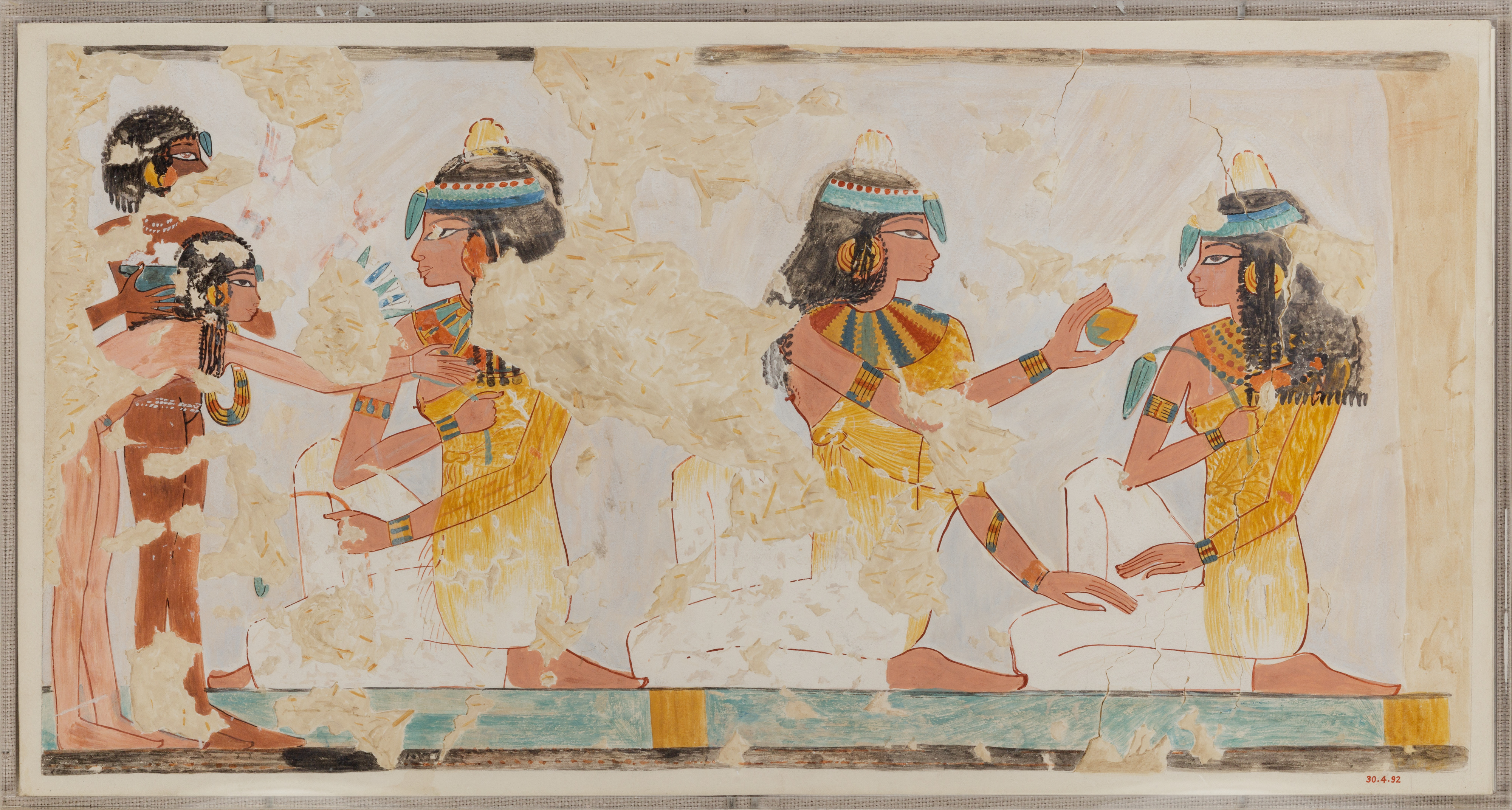
The scene invites a richer vocabulary than “they were getting high.” Offering, intimacy, fragrance, status and regeneration may all be relevant to its interpretation. A painting can organize several meanings simultaneously.
Mandrake also demonstrates why pharmacological categories matter. Mandragora contains anticholinergic tropane compounds. It must not be treated as simply another version of psilocybin. Even its common name is hazardous: the unrelated American plant Podophyllum has also been called mandrake, a confusion documented in clinical literature. NCBI, Mandragora, Frasca et al., 1997
The image establishes a depicted fruit and a cultural setting. It does not establish how much was consumed, whether it was consumed at all in that depicted exchange, or which effect followed. A fragrant fruit in a hand is not automatically a pharmacologically active dose in a stomach.
That may sound obvious. Many elaborate theories quietly depend on forgetting it.
8. Opium: a plausible regional history is not a confirmed Egyptian rite
Opium deserves a place in the investigation, but the quality of each case matters more than the familiarity of the claim.
A 1994 examination of materials from the tomb of Kha, the royal architect, used multiple methods and did not confirm the earlier opium identification. The reported analyses found neither morphine nor tropane alkaloids. That corrects a particular claim; it does not prove that nobody in ancient Egypt ever encountered opium. Bisset et al., 1994
By contrast, a study published in 2022 reported opioid alkaloids and degradation products in Late Bronze Age vessels from burials at Tel Yehud. It is an important material result for the Levant. Tel Yehud is not Egypt, however, and a regional trade connection cannot replace evidence of an Egyptian use or ceremony. Linares et al., 2022
This is what a comprehensive account must be willing to do: include positive findings, negative findings and geographic boundaries on the same page.
The resulting history is less smooth than a legend. It is also more informative. It tells us where to look next rather than pretending the investigation has ended.
9. Cannabis: the problem hidden inside a translated plant name
Cannabis claims often turn on the identification of the Egyptian word usually transliterated shemshemet. A proposed translation can pass from one publication to another until a reader encounters it as if it were a labeled specimen from an excavation.
That identification is contested. In a 2015 ARCE conference abstract, W. Benson Harer directly challenged its evidentiary basis and criticized the way an identification attributed to Warren Dawson had acquired authority through repetition. A conference abstract is not a comprehensive final resolution of the debate, but it is sufficient reason not to describe the identification as uncontested. Harer, ARCE abstract, printed page 45
Even if a particular occurrence could securely be translated as cannabis, further questions would remain: fiber or medicine? Which part? What preparation? What intended action? What evidence of intoxication?
The relevant distinction is not pro-cannabis versus anti-cannabis. It is a plant-name identification versus a history of use. Someone interested in the plant should want the strongest version of that history, including its unresolved portions.
We should be equally cautious about identifying an emblem as a cannabis leaf simply because it looks familiar. Similarity can generate a research question. It cannot complete the research.
10. Mushrooms, acacia and the single-key theory
The most sweeping proposals offer a master key: Egyptian crowns were mushrooms; a god was a mushroom; a recurring image encoded the same sacrament everywhere.
These arguments are not confined to casual internet speculation. Stephen Berlant's 2005 paper explicitly theorized that Egyptian crowns and aspects of Osirian religion encoded psychoactive mushrooms. Its argument rests on readings of images and texts, not on the reported recovery of psilocybin residues from an Egyptian initiation vessel. Publication in a journal does not change the category of evidence. Berlant, 2005
There is a basic interpretive danger here. If a crown resembles a mushroom, a pillar resembles a stalk, and rebirth resembles a psychedelic experience, the similarities can begin to support one another without any independent anchor. The theory appears to accumulate confirmations when it may be repeating its starting assumption.
That does not mean every unusual interpretation is wrong. It means a useful hypothesis should specify what could distinguish it from competing interpretations. What find would support it? What inscription would contradict it? What observation would cause its advocate to revise the claim?
The DMT-acacia argument has a related weakness. A botanical possibility is not proof of an ancient preparation. A preparation is not proof of a particular ceremony. The presence of one constituent somewhere in a region is not evidence that ancient people combined the necessary materials, in an effective form, for the purpose we imagine.
The sources reviewed for this article do not establish an Egyptian DMT initiation system or a civilization-wide psilocybin cult. That is a statement about the evidentiary threshold reached here, not a claim that future discoveries are impossible.
The same restraint applies to modern claims about the Eye of Horus, brain anatomy and the pineal gland. An evocative visual comparison cannot establish ancient neurochemistry. We can study an image's contemporary spiritual resonance without converting that resonance into a pharaonic laboratory report.
11. Mummies, cocaine and the history after burial
An ancient object has more than an ancient history. It may also have been excavated, unwrapped, transported, conserved, handled, displayed and sampled.
Paul Buckland and Eva Panagiotakopulu's 2001 article examined tobacco associated with the mummy of Ramesses II and proposed nineteenth-century conservation treatment as an alternative explanation. They also questioned claims involving cannabis and cocaine. The lesson is not that every inconvenient result is contamination. It is that an object's post-excavation life must be investigated before a startling chemical identification becomes a new history of world contact. Buckland and Panagiotakopulu, 2001
An analytical instrument measures a sample in the present. Archaeology has to establish which past produced that sample.
That distinction is indispensable wherever spectacular claims depend on small traces.
12. Reading the art without turning it into a toxicology report
Egyptian images are central to this subject, but the question we ask of them determines what we are capable of seeing.
If we begin with “where is the drug?”, a flower becomes a clue, a crown becomes a clue, a cup becomes a clue. Soon the whole image has disappeared into our investigation. The people, their gestures, the relationship between a tomb and its visitors, and the desired continuity of life have become background noise.
A better reading makes room for the whole scene.
The banquet: abundance made durable
The British Museum's banquet fragment from Nebamun's tomb brings guests, musicians and dancers into one composition. It belongs to an eighteenth-dynasty funerary setting, not a modern documentary photograph. British Museum, EA37984
What happens if we read such an image as a presentation of desirable life rather than a police inventory of consumed substances?
Food, flowers, company and performance become ways of giving fullness a visible form. The image can preserve an ideal of social vitality in a place associated with death. Its power lies partly in that tension: the living world does not surrender its beauty merely because the painting belongs to a tomb.
This is an interpretive reading, not a claim that every banquet had the same function. But it keeps the art from shrinking to one modern question.
The head cone: when archaeology changes the image
Objects depicted on Egyptian heads were once debated partly because physical examples were elusive. Anna Stevens and colleagues reported actual wax head cones from burials at Amarna in 2019. Their analysis identified biological wax, likely beeswax. The finds establish that such objects could be real; they do not establish that all depicted cones contained intoxicants or that their precise use is settled. Stevens et al., 2019
This is a satisfying model of discovery. An uncertainty becomes narrower. Not every uncertainty disappears with it.
Osiris: regeneration enacted in matter
The Met's falcon-headed coffin and grain mummy, dated to the Late Period or Ptolemaic era, is a particularly useful corrective to the search for a single hidden molecule. Such objects contained grain and sand, and the germination of the grain expressed renewed life through Osiris. They belong to annual ritual activity, not simply to a decorative theme. The Met, object 58.106.1a–d
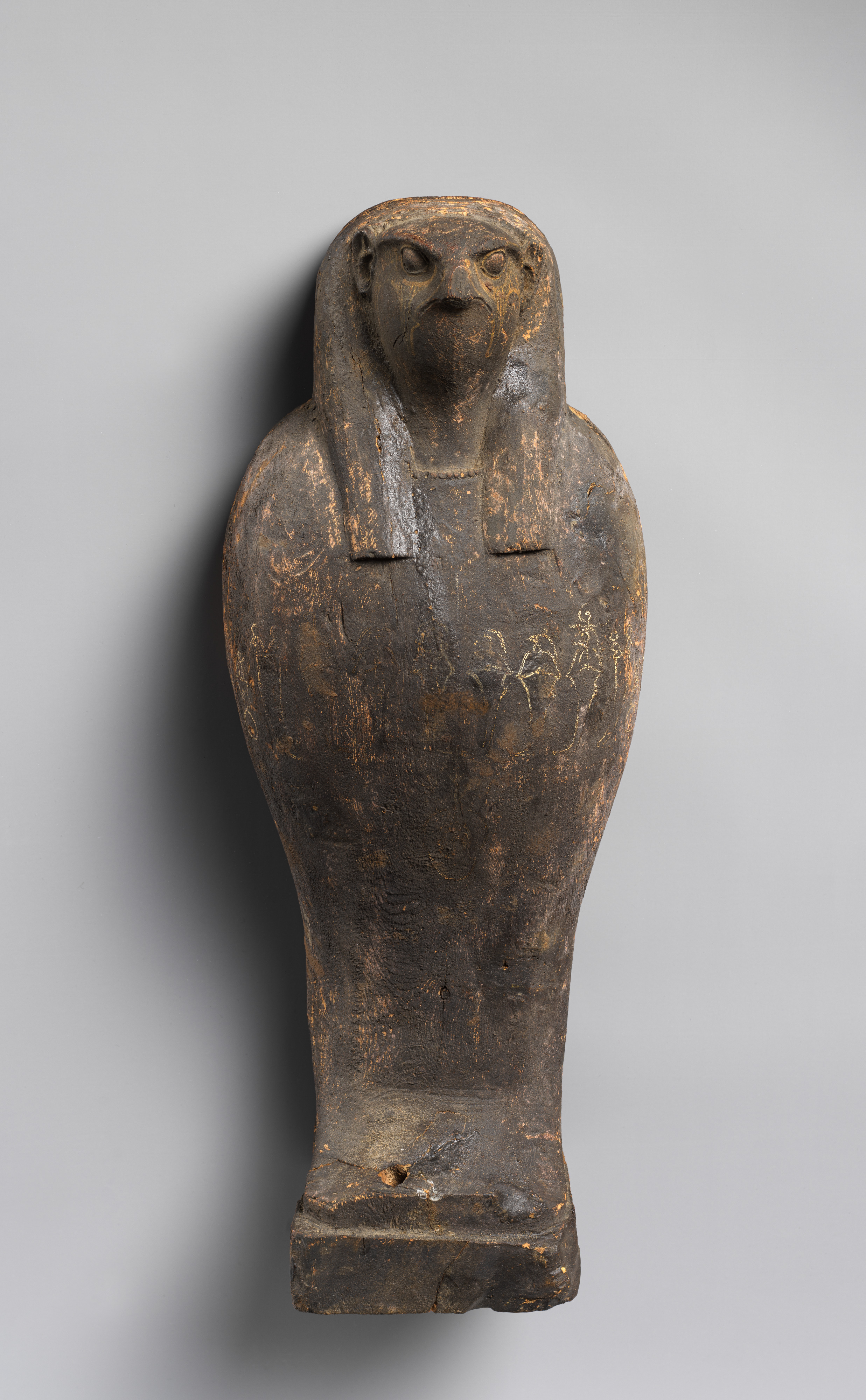
Here, transformation is not merely described. It is given something to do. A material process becomes an occasion for religious understanding.
This is a deeper sense in which a culture can work with nature. The natural object is neither inert raw material nor a chemical explanation that cancels meaning. It participates in the making of meaning.
To call every Osirian renewal an encoded mushroom experience would obscure this plainly attested relationship with growth. To dismiss it as childish agricultural metaphor would miss the seriousness of asking how life returns.
The healing stela: a word becomes something taken into the body
The Met's Magical Stela with Horus the Child, dated 360–343 BCE, offers another model. Its record describes a practice in which water poured over protective words and images could be drunk. The mythic precedent was the healing of Horus. Bes appears above the central scene as a protective presence. The Met, object 50.85
The relevant point is the ritual logic, not a claim that the water cured poisoning. Meaning was imagined as transmissible through contact with matter and then through the body.
A history focused exclusively on psychoactive ingredients would have difficulty seeing what is most remarkable here. The ceremony does not need a concealed hallucinogen to reveal a radically different account of what a word, an image and a liquid can be.
13. Dreams: an encounter is not necessarily a dose
Dreams are a neglected middle ground in discussions of ancient altered states. Modern debate often jumps from ordinary waking life directly to a drug-induced vision, as if sleep had not already given every society a recurring problem of experience and interpretation.
The British Museum's Chester Beatty Dream Book, a New Kingdom papyrus, preserves a system for interpreting dream scenarios. Whatever we make of its interpretations, it documents an organized interest in the significance of dreams. It is not, on that account, evidence that those dreams were chemically induced. British Museum, EA10683,3
Later material gives us more explicit procedures directed toward visions. The London-Leiden Demotic magical papyrus includes invocations for revelation, dream visions and inquiries involving a lamp. Its combination of Egyptian writing with Greek and Old Coptic elements belongs to a historically specific, multilingual milieu. British Museum, EA10070,2
The distinction between an instruction and an outcome remains essential. A surviving procedure tells us what someone prescribed or copied. It does not furnish a recording of what happened to everyone who attempted it.
Dream incubation, where sought in a sacred setting, also raises a broader issue. Before sleep, an individual may already have been given a place, a question, a divine addressee and an expectation. After waking, a community or specialist may help decide what the experience means. This is a general interpretive model, not a reconstruction of every Egyptian dream practice.
The dream itself is only part of the event. Preparation and interpretation surround it.
For As Above, that is a valuable distinction. The reality of an experience to the person having it does not make its first interpretation infallible. A dream may matter profoundly without functioning as a literal news bulletin from another world. Conversely, explaining a possible mechanism does not exhaust its importance in a person's life.
History does not require us to settle the metaphysics of dreaming before we can take dreamers seriously.
14. Music, scent and the shaping of attention
A temple approached through a browser tab is silent. An object photographed against a neutral background has no fragrance. The archive makes research possible while removing much of the environment in which its materials once mattered.
That absence should make us careful, not give us permission to invent the missing atmosphere.
Sound was part of the religious action
The sistrum was a rattle associated with major female deities. The Met's silver example, dated 332–30 BCE, combines a Hathor emblem with an inscription referring to the instrument's use for a goddess. It is a religious object designed around sound and movement, not simply an image of sound. The Met, object 58.5a
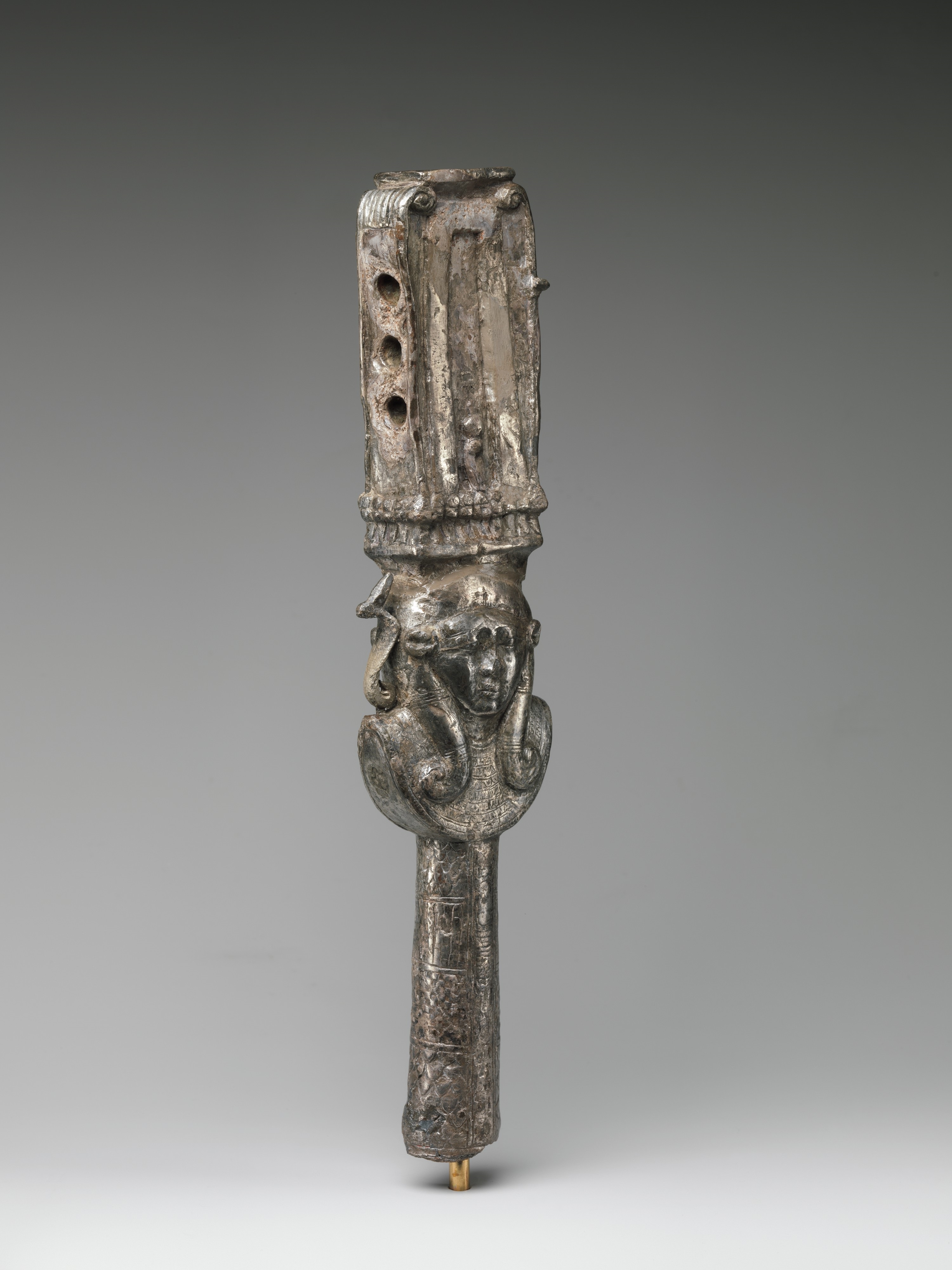
We can responsibly say that music belongs in an account of religious practice. We cannot recover the precise neural state of its listeners from the instrument's survival.
But the presence of sound changes the historical question. Instead of asking only what entered a body, we ask what the body was doing: listening, moving, waiting, responding, participating. The person was not an isolated brain to which a chemical had been added.
Fragrance could carry an account of order
In On Isis and Osiris, Plutarch describes daily incense offerings and a compound called kyphi, or cyphi. He connects its evening use with rest, relief from daily cares and the capacity to dream. He also describes sacred writings accompanying its preparation. This is a Roman-era Greek author's explanation, shaped by his own philosophical and medical assumptions, not a modern validation of the claimed effects. Plutarch, On Isis and Osiris 79–80
What matters for our argument is the joining of sensory experience with an ordered time of day. A fragrance can mark a transition. A repeated action can make that transition recognizable. A text can locate the action inside a world of significance.
No precise claim about brainwaves is necessary. No speculative “frequency technology” has to be added. The ordinary capacities of embodied life are already substantial.
The room is not an inert container
This suggests a useful contemporary framework: substances, sensory conditions, expectations, social relationships and interpretive traditions can all be relevant to an experience. It is our comparative framework, not an Egyptian diagram recovered from a wall.
Calling it an architecture of experience does not mean every temple was designed to induce a clinically defined trance. It means that human experience takes place somewhere, among things and people, under conditions that matter.
The mistake is not in noticing that. The mistake would be turning a reasonable contextual insight into an undocumented ancient technology.
15. Who was allowed to encounter the divine?
A story of sacred substances is also a story about access.
Who owned the ingredients? Who maintained the setting? Who possessed literacy or specialist knowledge? Who could announce that an experience was divine, confused, dangerous or illegitimate? Who carried the consequences when a ceremony failed to heal?
These are research questions, not an accusation that all religion was manipulation. They protect us from the equally simplistic assumption that every religious setting was a place of equal participation.
The household must remain in view alongside the monumental temple. Bes's protective associations, visible on the healing stela discussed above, bring the inquiry toward vulnerability and care rather than only toward spectacular initiation. Protection from danger is a different human need from the desire for an extraordinary experience.
A mother, an ill person, a grieving relative, a musician, a scribe and a ruler do not enter the same ceremony with the same problem. A comprehensive history cannot make them all anonymous “initiates.”
Nor should women be treated as decorative companions in an otherwise male intellectual drama. The banquet image and festival accounts already complicate that assumption. At the same time, a depicted woman, a female deity and a woman's actual social power are different categories. None can stand in automatically for the others.
Care and authority can occupy the same space
The most useful question is not whether the system was benevolent or controlling in the abstract. It is how particular practices brought reassurance, obligation, hope and authority together.
Someone may sincerely seek healing while a religious institution reinforces its position. An experience may be moving and socially regulated at the same time. The possibility of power does not prove fraud; sincerity does not remove power.
This is where the subject connects most clearly with our work on cognitive sovereignty. An account of experience is incomplete if it leaves out the person entitled to interpret it.
The connection should not become an anachronistic allegation of an Egyptian “psyop.” We can use a question developed in one field to illuminate another without claiming the fields were historically identical.
16. Egypt in the imagination of others
Egypt's reputation for exceptional knowledge is itself part of the history. It must be studied as a reputation, not automatically accepted as an inventory of lost capabilities.
In Book 4 of the Odyssey, Helen adds a sorrow-quieting drug to wine. The narrative connects it with Polydamna in Egypt, a land described as possessing both healing and harmful drugs. This is a Greek literary witness to Egypt's imagined pharmacological authority. The passage does not securely identify a modern botanical species or prove that an Egyptian community used the same preparation. Homer, Odyssey 4.219–232
That distinction does not make the passage unimportant. It changes the question from “which modern product was Helen taking?” to “why did Egypt become a place from which such knowledge could plausibly come?”
The latter question opens a history of cultural authority, translation and imagination. It is larger than a botanical guessing game.
Hermetic Egypt is real history, but it is not pyramid-age Egypt
The philosophical Hermetica belong to a later world. The Corpus Hermeticum is generally situated in the early centuries CE, in a milieu where Egyptian religious traditions and Greek philosophical language interacted. Hermes Trismegistus joins the cultural identities of Hermes and Thoth; he should not be treated as a securely documented author from the age of the Great Pyramid. Cambridge, “Renaissance Hermetism”
That chronology makes the texts more historically interesting, not less spiritually useful. They belong to an encounter among traditions, not to a frozen civilization transmitting a perfectly unchanged code.
Our As Above study of the Corpus Hermeticum explores vision, mind and rebirth. Those themes provide a meaningful philosophical conversation with this article. They do not establish a chemical cause for Hermetic revelation.
A description of luminosity is not a toxicology result. A teaching about rebirth is not an ingredient list. Religious literature can describe an experience, teach a discipline, construct an authoritative voice or transform a reader without serving as a disguised pharmacological record.
17. As Above, So Below: correspondence without collapse
Here we move explicitly from historical reconstruction into contemporary interpretation.
What makes Egypt compelling for the As Above project is not the prospect of finding one intoxicant behind everything. It is the possibility of thinking more carefully about relationships among levels of life.
A flower belongs to a biological world. It can also belong to a field of images and stories. A ceremony is a sequence of physical actions. It can also organize a person's relation to grief, hope, continuity or obligation. A building occupies space. It can also direct attention.
We can acknowledge those relationships without asserting that the physical and symbolic descriptions are identical.
Correspondence is a method for asking better questions. It is not permission to erase distinctions.
The lotus does not have to be a molecule wearing a costume. The sacred does not have to disappear when a material mechanism becomes visible. Nor does a moving symbolic relationship give us the right to claim a mechanism we have not demonstrated.
That balance is central to the kind of intelligence this site should cultivate: open enough to encounter something unfamiliar, disciplined enough not to confuse recognition with proof.
A necessary boundary around our own Egyptian writing
As Above's The Temple of Man essay explores Schwaller de Lubicz's anthropocosmic reading of Egyptian architecture. That is a modern interpretive tradition. Claims that a temple plan encodes precise anatomy, pineal activation or ancient neurochemical knowledge require evidence beyond the interpretation itself.
This article does not use that essay as an archaeological source. It places it in conversation with the evidence as a modern philosophy of symbolic perception.
The distinction strengthens the larger project. We do not have to make every writer in our library agree, or turn every evocative proposition into a verified historical fact. A living intellectual tradition needs the ability to qualify its own favorite ideas.
Experience, meaning and explanation
Three sentences can all be true:
- An experience was profound for the person who had it.
- Its meaning remains worth examining.
- The explanation first attached to it may be mistaken.
Our recent DMT evidence essay approaches a contemporary problem with a similar distinction. Intensity is not self-authenticating evidence. Yet careful scrutiny need not make experience trivial.
The same principle helps us read Egypt. “It was only a drug” and “it was therefore divine revelation” are both shortcuts past the difficult work.
The first reduces meaning to cause. The second treats meaning as proof of cause.
Neither does justice to the person, the culture or the evidence.
Thomas, Osiris and the work after the insight
There is also a legitimate philosophical conversation with our Gospel of Thomas essay, our Osiris Protocol and the Twelve Gates of the Great Work.
The link is interpretive: how a person lives after an encounter that changes what seems possible. It is not proof that these traditions share a drug, descend from one secret rite, or teach identical doctrines.
From this contemporary perspective, the test of a revelation is not exhausted by its emotional force. What follows? Greater honesty? More patient attention? A stronger capacity to care? A willingness to recognize error? Or merely a more elaborate explanation for why the person having it must be right?
That is an ethical test we bring to the material. We should own it as ours.
The Great Work, in this register, is not the collection of extraordinary states. It is the difficult passage from insight into conduct.
18. What would actually change the evidence?
The question remains open in important ways. “Not established” should create a research agenda, not a prohibition against discovery.
A stronger case for a particular Egyptian psychoactive rite would combine securely recorded archaeological context with transparent analytical work and historically relevant interpretation. No single technique substitutes for all three.
The most useful future advances would include:
- More contextualized vessels. Comparable findings from independently excavated objects, with location, date and associations recorded.
- Clear authentication. Appropriate sampling controls, treatment histories, reference standards and explicit uncertainty around chemical and taxonomic identifications.
- Independent examination. Laboratories and researchers able to test important findings without merely restating the original interpretation.
- Textual connections. An identifiable substance connected to a practice through language that survives specialist scrutiny.
- A careful bridge to effects. Evidence sufficient to discuss a likely preparation and action, without pretending an ancient experience can be reproduced from a trace.
- Negative results. Publication of what was tested and not detected, including explanations of detection limits and preservation problems.
This is an editorial research standard, not a claim that the studies cited above omitted every one of these safeguards. The Bes paper, for example, reports contamination precautions and extraction controls. The point is to carry uncertainty through to the historical conclusion rather than dropping it once an instrument produces a result.
We should also ask what our sampling habits make invisible. Monumental, collectible and well-preserved objects are easier to encounter in museums than the full range of ordinary practices. That does not permit us to invent what is missing. It tells us why “the record” and “everything that happened” are not synonyms.
19. A considered verdict
What role did psychedelics play in Egyptian mythology, society, art and culture?
The most accurate answer changes depending on what the word is meant to include.
If it means sacred intoxication broadly, the subject is substantial. Alcohol, divine narratives, festival behavior, sensory practices and the interpretation of unusual experiences belong to the history.
If it means particular psychoactive botanicals, the evidence is uneven and deserves case-by-case treatment. The Bes study is significant; plant-name identifications, image interpretations and modern chemistry do not all have the same evidentiary force.
If it means classic psychedelics as the hidden engine of Egyptian civilization, the sources reviewed do not establish that conclusion.
If it means an Egyptian art of transformation, there is a rich subject here, provided we label this as a modern interpretive framework rather than an ancient technical term.
The point is not to distribute everything into “proven” and “debunked” bins. It is to understand what kind of confidence each claim has earned and where a good question still remains.
An article that admits uncertainty can nevertheless reach a strong conclusion: the Egyptian relationship among matter, ritual and meaning was more varied than the modern search for a single psychedelic key allows.
20. The flower does not need the rumor
At the end of the investigation, return to the flower.
Do not ask it to prove everything. Do not make it responsible for a lost global civilization, a universal sacrament, the origin of all religion, or the validity of an experience you had centuries after its painters died.
Look at what survives: an object, an image, a text, a material trace. Give each the dignity of being something particular before turning it into an example of your theory.
Then allow the larger question to return.
What kind of life becomes possible when beauty, attention, embodiment and meaning are treated as related concerns? What is gained when ritual gives an experience a place? What is endangered when an institution claims exclusive authority over that experience? How do we remain receptive without becoming credulous, and critical without becoming incapable of wonder?
Those questions do not require us to pretend we know what was inside every Egyptian cup.
They ask something harder: whether we can encounter another culture without immediately converting it into confirmation of ourselves.
The serious study of psychedelic Egypt should enlarge the civilization before it enlarges our theory. It should leave us with more human beings, more historical distinctions, more interesting uncertainties and a better understanding of the evidence.
There may have been preparations and practices that future discoveries will illuminate. There were certainly meanings that cannot be recovered by reducing an image to an ingredient.
The promise of this subject is not that a molecule explains the gods.
It is that a flower, a cup, a rhythm and a story can lead us back to one of the oldest human questions: how to inhabit a world that feels greater than the life we know how to explain.
The flower does not need the rumor. The mystery does not need the exaggeration.
Sources, scope and further reading
This is a source-led interpretive feature, not a systematic review of every Egyptological publication or a new archaeological study. Linked scholarship, ancient texts and museum records support the historical claims. Sections expressly identified as As Above synthesis are contemporary interpretation. No original-language translation is claimed. Dates and botanical identifications follow the cited sources, with disagreements and limits noted where material.
The core reading begins with Tanasi and colleagues' vessel analysis, Guilhou's account of the Heavenly Cow, Bryan's festival research, Dosoky and colleagues' extract study, and the object records linked throughout. They are different evidence types, not interchangeable confirmations of one thesis.
For the historical development of stronger entheogenic hypotheses, read Emboden and Berlant as arguments, alongside the material and philological cautions in this essay. For sensory and literary reception, read Plutarch, Herodotus and Homer with their genres and dates in view.
Health boundary: This is cultural history, not medical advice or a guide to recreating ancient preparations. Psychoactive and toxic plants can cause serious harm. Historical use, sacred status and a modern product label are not demonstrations of safety.
Continue the inquiry
Explore Pneuma and Hermetics, or read our editorial standards.