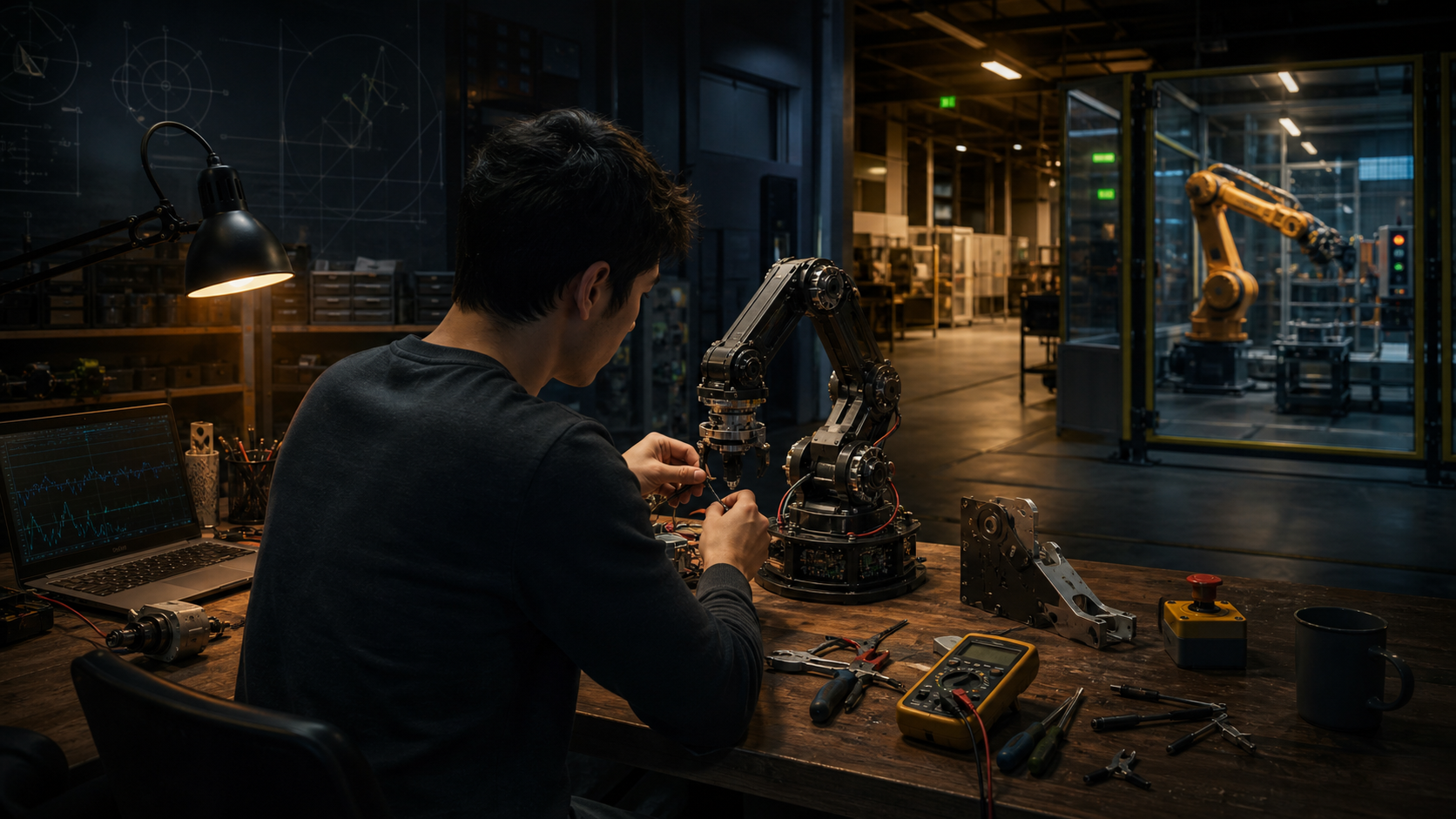
Robotics is not one career. It is a stack of disciplines that meet inside a physical machine, where code encounters friction, tolerances, power limits, timing, uncertainty, and consequences.
That changes the career question. Do not begin by asking, “Which robotics degree is best?” Begin by asking:
Which class of failure do I want to become unusually good at understanding and fixing?
The person who can answer that question has a direction. The person who can prove the answer on a real system has the beginning of a career.
This guide is the education and career companion to the As Above six-month hardware roadmap. The roadmap is the build path. This is the decision path: what to study, how to choose a school, which projects matter, how to pursue internships, and what evidence should exist before you ask someone to hire you.
The shortest honest answer
- Learn enough mathematics and physics to reason about motion, sensing, uncertainty, and control.
- Become useful in one technical specialty.
- Build enough real systems to understand how the specialties collide.
- Preserve evidence of what failed, what you measured, what you changed, and whether the fix held.
The fourth item is the one most applicants miss. A polished robot video demonstrates a moment. An engineering record demonstrates judgment.
01 / Orient
Robotics is a federation of careers
Employers rarely hire someone merely because that person “likes robots.” They hire people to remove a specific bottleneck.
| Track | Failure you learn to own | First technical spine | Portfolio proof | Search terms |
|---|---|---|---|---|
| Embedded and firmware | Sensors drop data, motors miss timing, boards reset | C/C++, microcontrollers, electronics, RTOS, buses | Closed-loop motor controller with logs and fault handling | Embedded, firmware, robotics software |
| Controls and estimation | The robot oscillates, drifts, falls, or cannot locate itself | Linear algebra, dynamics, control, probability, filtering | Balancer, estimator, or trajectory tracker with measured error | Controls, autonomy, state estimation |
| Perception | The machine misreads the world | Python, C++, calibration, computer vision, PyTorch | Calibrated vision or sensor-fusion pipeline under changed conditions | Perception, computer vision, sensor fusion |
| Planning and manipulation | The robot cannot reach, grasp, or avoid collision | Kinematics, optimization, ROS 2, MoveIt | Arm task that plans, executes, recovers, and reports failure | Motion planning, manipulation, autonomy |
| Robot learning | A learned skill fails outside its training distribution | Statistics, ML, imitation learning, reinforcement learning, simulation | Policy evaluated across repeated held-out trials | Robot learning, research, ML robotics |
| Mechanical and actuation | Parts flex, bind, overheat, wear, or cannot be manufactured | CAD, mechanics, materials, GD&T, motors, transmissions | Mechanism with drawings, tolerances, load test, and redesign history | Mechanical, actuation, mechatronics |
| Systems and integration | Every subsystem works alone and the robot still fails | Interfaces, logging, test design, safety, breadth across the stack | End-to-end robot with bring-up procedure, fault tree, and test record | Systems, integration, field robotics |
These tracks overlap. They should. Robotics is an integration discipline. But early in a career, “I can solve this kind of problem” is more credible than “I do everything.”
Current postings offer a useful snapshot, not an eternal law. Sample 2026 roles at Tesla, Field AI, Amazon Robotics, and NVIDIA repeatedly ask for combinations of Python, modern C++, Linux, simulation, real hardware, debugging, and cross-functional work. Research internships can require graduate study, while applied software, firmware, and integration roles use broader filters. Read postings as specifications for evidence, not as promises that a title or credential will be enough.
Choose the failure you want to own
What frustration keeps you curious?
If a circuit resets and you want the multimeter, consider embedded systems. If a robot overshoots and you want to model the motion, consider controls. If a bracket cracks and you want the load path, consider mechanical design.
Where should truth come from?
Firmware is judged by timing and fault behavior. Perception is judged outside the easy examples. Mechanical work is judged by fit, heat, wear, and manufacturability. Choose the evidence you enjoy producing.
Which constraints fit your life?
Some paths need expensive laboratories. Others can begin with a laptop, simulator, microcontroller, or low-cost arm. Your strongest path is the one you can sustain.
Can you name the work?
Try: “I want to make sensor-driven motion reliable under timing constraints.” If you can name the work without saying “AI” or “robotics,” you can search for the right courses, projects, mentors, and jobs.
02 / Educate
School is infrastructure, not identity
A degree can be extremely valuable. It is not magic. Think of school as access to mathematical depth, laboratories, teammates, mentors, research, internships, a recognized credential, and time for difficult work.
The school scorecard
- Hardware access: When can an undergraduate first use a real robot, machine shop, electronics bench, and test equipment?
- Course spine: Does the program require programming, linear algebra, dynamics, controls, circuits, sensors, actuators, embedded systems, and integrated design?
- Build density: How many substantial systems will you design, fabricate, test, and document?
- Undergraduate research: Can first- and second-year students contribute?
- Team structure: Are there serious competition teams, field projects, and capstones with real integration risk?
- Work pipeline: Which employers, laboratories, and co-op partners repeatedly take students?
- Cost: What debt will remain, and what lower-cost route offers similar access?
ABET's current criteria for mechatronics and robotics programs include calculus, differential equations, linear algebra, calculus-based physics, mechanical systems, circuits, controls, computer science, sensors, actuators, embedded controllers, and integrated hardware-software design. Accreditation establishes a quality process and minimum criteria. It is not a ranking. Verify the specific program rather than relying on a university's general reputation.
Programs at WPI, the University of Michigan, and Carnegie Mellon illustrate different ways to build undergraduate robotics education around hands-on systems, depth, and research access. They are examples, not a universal ranking.
Robotics or mechatronics
A clean integrated route when the program has serious controls, embedded work, laboratories, and a hardware capstone.
Electrical or computer engineering
Strong for firmware, electronics, sensing, power, communications, and controls.
Mechanical engineering
Strong for mechanisms, actuation, thermal limits, structures, manufacturing, and test. Add substantial programming and controls.
Computer science
Strong for perception, planning, simulation, and robot learning. Add dynamics, controls, and physical projects.
Technical college or apprenticeship
A strong route into industrial controls, mechatronics, maintenance, and field integration when equipment and employer ties are current.
Graduate study
Often useful for research-heavy roles. Verify funding, adviser fit, hardware access, and placement. Do not use it to postpone building or choosing a specialty.
Three starting points
If you are still in high school
Do not wait for college to grant permission. High school is enough time to learn how finishing feels.
First quarter
Finish one small physical system. Learn safe bench practice, Python, Git, and microcontroller programming.
Second quarter
Add a sensor, log data, tune one behavior, compare before and after, and write down the longest failure.
Third quarter
Join a team. FIRST Tech Challenge, VEX, a makerspace, or a small independent group can impose the deadlines and shared responsibility that solo tutorials cannot.
Fourth quarter
Integrate sensing, decisions, motion, and a safe stop in ROS 2 simulation or on affordable hardware. Keep advancing through algebra, calculus, mechanics, and electricity when available.
If you are in college
- First year: join a team or lab, volunteer for bring-up and test, take linear algebra early, and finish one personal system.
- Second year: read 20 current job descriptions, choose a lane, and begin a specialty project that is harder than a tutorial.
- Third year: connect your specialty to two other layers, seek work that reaches hardware, and measure reliability rather than peak performance.
- Final year: make the capstone a tested system with operating instructions, interfaces, constraints, a failure record, and a clear statement of your contribution.
If you do not have a degree, or you are switching
The route is real, but it is not frictionless. Some research, regulated, defense, and large-company roles impose degree, citizenship, clearance, or advanced-study requirements. Route around those filters deliberately.
Keep your income while building unless you have a sound runway. Use your current domain as a wedge. Manufacturing, automotive repair, industrial maintenance, electronics, software, computer vision, game physics, machining, agriculture, logistics, and healthcare equipment can all become useful context.
A complete novice may need 12 to 18 months of sustained work before junior applied interviews become plausible. That is a planning range, not a promise. Start near deployed work: automation technician, robotics field technician, test technician, manufacturing engineering technician, applications or integration engineer, or junior embedded and robotics software roles.
03 / Build
The dependency graph
Tutorials feel cursed when they assume five invisible layers. Build the layers in the order reality demands.
Electricity and bench safety
Read a schematic. Measure voltage and continuity. Understand current, grounds, regulators, batteries, motor stall, and when not to energize a system.
Python, Linux, and Git
Write small programs, parse logs, automate tests, use the command line, review diffs, and recover from mistakes.
Microcontrollers, motors, and sensors
Learn PWM, encoders, sampling, buses, interrupts, and closed loops. Fail safely when a sensor disappears.
Production-minded C++
Learn memory, ownership, interfaces, concurrency, build tools, testing, and debugging under timing and hardware constraints.
CAD and fabrication
Design one bracket that must fit. Learn tolerances, fasteners, load paths, cable routing, serviceability, and how parts are made.
Classical control and estimation
Measure overshoot, settling time, error, noise, and delay. Learn a complementary filter before treating a Kalman filter as magic.
ROS 2 and robot description
Learn nodes, topics, actions, tf2, URDF, launch, ros2_control, logging, and bag replay. As of September 2026, Jazzy Jalisco is the recommended ROS 2 LTS. MoveIt also recommends Jazzy on Ubuntu 24.04 for beginners.
Simulation, with suspicion
Use Gazebo, MuJoCo, Isaac, or another appropriate simulator. Then list what it hides: friction, compliance, backlash, sensor noise, cables, latency, lighting, wear, and people.
One specialty
Go deep enough to read technical work, implement a baseline, define a meaningful test, and explain where the method stops working.
System integration
Bring up a machine you did not design. Add logging. Reproduce an intermittent problem. Design a safe stop. Hand the system to another person.
The adult skill: making the interfaces tell the truth.
The five-project evidence ladder
A controlled motion
Build a line follower, speed-controlled motor, or balancer.
Exit: show untuned and tuned behavior, plot the response, state conditions, and explain a failure.
A mechanical redesign
Design a bracket, linkage, gripper finger, mount, or enclosure.
Exit: publish the drawing, original mismatch, revision, and fit or load result.
A mobile robot with a map
Use ROS 2 and Nav2 to localize and navigate, first in simulation and then on hardware if practical.
Exit: repeat a route under three changed conditions and separate simulation from hardware results.
An arm that gathers evidence
Use MoveIt, LeRobot, an SO-101-class arm, or similar hardware for teleoperation or a learned task.
Exit: report trials, criteria, successes, interventions, and failure categories. One successful clip does not pass.
A system for a real user
Solve a bounded task for a laboratory, manufacturer, farm, warehouse, accessibility group, or community organization.
Exit: the user defines acceptance, another person can operate it, and the record includes assistance, maintenance, and limits.
Your portfolio is an engineering record
A portfolio should survive three follow-up questions. Each major project needs a short result video, bill of materials or dependencies, block diagram, build instructions, acceptance criteria, expected versus observed behavior, the longest failure, the measurement that changed the diagnosis, before-and-after results, stop behavior, known limits, and the next test.
| Claim | Test | Result | Limitation |
|---|---|---|---|
| The controller reduces overshoot | Ten repeated step responses before and after tuning | Insert your measured median | State load and battery range |
| The arm completes the task | Fifty trials across named object positions | Report successes, recoveries, and failures | State lighting and object constraints |
| Another person can reproduce it | Fresh setup using written instructions | Record time to first successful run | List required tools and versions |
The values must come from your measurements. Never fill a blank with an invented number.
04 / Enter
Internships: make the application easy to believe
Choose 20 current openings that resemble your target. Extract repeated skills, degree expectations, hardware and simulation platforms, research versus deployment emphasis, location and work-authorization constraints, and the problems the team is solving.
Current career pages at Tesla, Field AI, Amazon Robotics, Figure, and Agility Robotics illustrate how widely the work divides across embedded systems, controls, perception, learning, integration, manufacturing, testing, and field operations.
The six-sentence outreach note
- Who you are.
- Why this exact team or laboratory is relevant.
- What you built.
- The hardest measured failure you solved.
- A direct link to a short video and repository.
- One specific question or request.
Do not send a life story. Do not ask someone to invent a role for you. Apply to laboratories and small integrators as seriously as famous companies. A local deployment with a real user can teach more about reliability than an internship spent far from hardware.
The interview packet
- The 60-second proof: the system, task, result, and one metric.
- The failure story: situation, hypothesis, measurement, change, retest, remaining uncertainty.
- The system diagram: power, compute, sensors, actuators, software nodes, communications, and stop path.
- The code sample: readable C++ and Python with tests and a clear build.
- The backup: a recorded demo and logs for the day live hardware refuses to cooperate.
Be ready to explain a feedback loop, coordinate transform, timing failure, noisy sensor, mechanical mismatch, and the difference between a demo and a repeatable result. Say “I do not know” when you do not know, then explain how you would find out.
Use AI without outsourcing understanding
AI can accelerate robotics education as a tutor, reviewer, and test partner. It becomes dangerous when it hides whether you understand the machine.
Use it to expand inquiry
- Request multiple explanations of a difficult concept.
- Generate test cases that you inspect.
- Review code for edge cases.
- Compare hypotheses for a logged failure.
- Draft documentation that you verify against the build.
Do not use it as camouflage
- Do not run actuator code you cannot explain.
- Do not trust invented pinouts, units, limits, or APIs.
- Do not submit generated contributions you cannot defend.
- Do not use fluent prose to hide missing measurements.
- Do not bypass safety review because a model sounds confident.
The instrument, datasheet, source code, and physical result outrank the chatbot. When AI helps create the work, remain the person who can defend every decision.
05 / Compound
A 24-month operating plan
Time alone is not progress. Use gates.
Months 0 to 3: foundations
Bench safety, electricity, Python, Linux, Git, microcontrollers, motors, and sensing.
Gate: one closed-loop motion with a plot and documented failure.
Months 4 to 6: first integrated robot
Mechanical design, C++, control, robot description, and ROS 2 fundamentals.
Gate: another person can build or operate it from your instructions.
Months 7 to 12: specialty and evidence
Choose a lane, test it under changed conditions, and reproduce a baseline.
Gate: repeated trials, clear limits, and readable code.
Months 13 to 18: contact with other people
Join a laboratory, internship, open project, team, integrator, or real-user deployment.
Gate: the work survives collaboration, review, or user acceptance.
Months 19 to 24: convert capability
Build a role map, rehearse the packet, apply in batches, review results, and close the largest evidence gap.
Gate: interviews, a return path, expanded responsibility, or an honest diagnosis of what is still missing.
Two to three focused hours per day can create substantial progress, but there is no universal clock. Every month should end with stronger evidence than it began with.
Money without fantasy
There is no honest single “robotics salary.” The occupation spans technicians, engineers, researchers, managers, regions, degree requirements, equity packages, and industries. Even O*NET's wage page for Robotics Engineers uses the broader Bureau of Labor Statistics category “Engineers, All Other.” It is context, not a clean robotics-only salary series.
Compare roles by location, responsibility, degree and experience requirements, base pay, bonus, equity, benefits, vesting, travel, shift and on-site expectations, company financing, and the evidence you can build there. The durable proposition is not that humanoids make every builder rich. It is that people who can connect models to motors, and make the full system reliable, remain difficult to replace.
Seven traps that waste years
- Identity before evidence: calling yourself a roboticist while finishing nothing.
- Simulation without transfer: polishing an environment while avoiding the machine.
- Machine learning without closed loops: training models without understanding timing, sensing, and actuation.
- Certificates without artifacts: completing lessons that leave no independent capability.
- Five half-built kits: mistaking starting for shipping.
- Prestige as strategy: choosing a school, employer, or trend without examining access and fit.
- AI as camouflage: presenting code or explanations you cannot defend.
The one-week decision protocol
The decision is reversible. The week is not. Change direction because the work taught you something, not because another field became fashionable.
The standard
A robot is an argument made physical. It claims that software, electronics, mechanics, sensing, and judgment can cooperate in the world.
Your portfolio makes the same claim about you.
Can you make a physical system do what you intended, repeatedly; stop it responsibly; measure the miss; explain the failure; and improve the result without pretending uncertainty disappeared?
If you can do that, you are no longer waiting to begin a robotics career. You have begun.
Source register
Evidence checked September 3, 2026. Current job pages are time-stamped examples, not an exhaustive labor-market study.
- O*NET: Robotics Engineers, occupation definition, tasks, and sample titles.
- ABET 2026–2027 engineering criteria, including mechatronics and robotics criteria.
- ROS 2 documentation and distribution status.
- MoveIt getting started and Nav2 Jazzy quickstart.
- LeRobot documentation and real-world workflow.
- FIRST Tech Challenge and VEX competitions.
- Undergraduate examples: WPI, Michigan, and Carnegie Mellon.
- Current hiring examples: Tesla students, Field AI embedded systems, Field AI integration, Amazon Robotics, Figure, and Agility Robotics.
Educational guidance only. Hardware projects involve electrical, battery, mechanical, thermal, tooling, and motion hazards. Use age-appropriate supervision, follow equipment instructions, guard moving systems, and never rely on a general article as a safety procedure. AI tools assisted research and editorial production.
Follow the machines that have to survive reality.
Source-linked research on robotics, AI, capital, and the systems connecting them.